




Seychelles, a Vital Node in India’s Indian Ocean Arc
- In Foreign Policy
- 08:23 PM, Jul 02, 2026
- Ramaharitha Pusarla
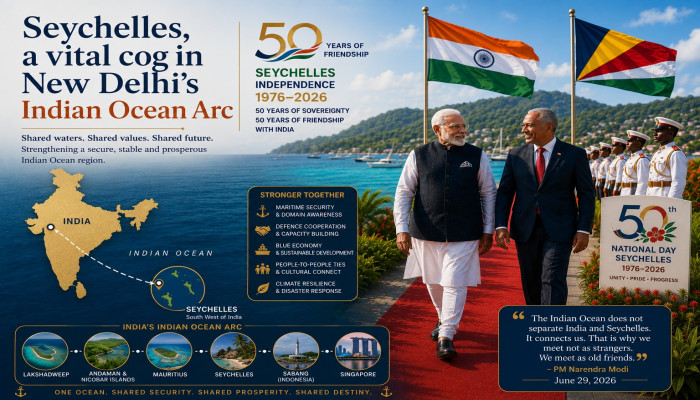
PM Modi was on a three-day visit to Seychelles (June 27-29), his second since 2015, to attend the 50th anniversary of their independence. Invited to grace the National Day Celebrations as the guest of honour, the visit also coincides with 50 years of the establishment of diplomatic ties between India and Seychelles. Received ceremoniously by Seychellois President Patrick Herimine and Vice President Sebastian Pillar, the diplomatic warmth resonates with the growing trust in the strategic partnership.
Disparate in sizes and separated by the Indian Ocean, which is also the binding anchor in the relationships, both nations exuded a new enthusiasm, an ocean of opportunities to build an enduring partnership. Though small in land area, just 460 square kilometres, Seychelles commands an Exclusive Economic Zone of 1.3 million square kilometres and sits adjacent to the Sea Lines of Communication (SLOCs). Notwithstanding the size, India has always treated nations with respect and as equal partners. Reiterating the significance of maritime neighbours in the Indian Ocean Region (IOR), PM Modi announced that Seychelles is an important partner of India’s SAGAR vision in 2015.
India’s historic ties with the Indian Ocean Islands stretch back several centuries, and the Indian Diaspora played a pivotal role in nurturing the connections. The first recorded arrival of five Indians on board the Thelemaque ship at Saint Anne Island of Seychelles dates to 1770. Since then, successive waves of migrations from Tamil Nadu and Gujarat have created enduring bonds of cultural and economic linkages between the two nations. The bilateral ties are underpinned by close people-to-people connections, with the Indian community accounting for 10 per cent of the Seychelles population serving as a living bridge.
During his visit, PM Modi underlined that Seychelles lies at the convergence of India’s advocacy for the Global South policy and the Mutual and Holistic Advancement for Security and Growth for All in the Region (MAHASAGAR) Vision, a holistic approach to Ocean governance. It attempts to integrate maritime safety challenges- maritime terrorism, piracy, drug trafficking, Illegal, Unreported and Unregulated (IUU) fishing with climate action, blue economy, sustainability, resilience and connectivity, which are vital aspects for maritime nations.
After Iran’s weaponisation of geography during the recent conflict, the strategic importance of maritime routes has become more pronounced. Comprising 115 islands, Seychelles, an archipelago spanning 4° to 10° South of the equator, is close to choke points - Mozambique Channel, Bab-el-Mandeb and Cape of Good Hope and major energy trade routes. Aligning with the security requirements of the archipelago, India has gifted two Dornier aircraft in the past and during the current visit, PM Modi announced the upgradation of an aircraft with a glass cockpit and the completion of the refit of PS Zoroaster. Additionally, India has gifted a fast patrol vessel, L’Espoir (meaning Hope in Creole), 10 utility vehicles and five laser-assisted radial boats for maritime surveillance.
Developmental Partnership was at the core of India’s partnership with Seychelles and perfectly blends with the Joint Vision for Sustainability, Economic Growth and Security through Enhanced Linkages (SESEL) adopted by both countries in February 2026. This vision is mirrored in India’s assistance to the nation in development projects, capacity building and training as per its requirements and priorities.
Notably, one in every 50 Seychellois has been a part of India’s training programmes. These formed the bulk of the MoUs signed between countries, and other outcomes included agreements on UPI digital payment infrastructure, export of generic medicines, agriculture, extradition, recognition of seafarers’ training, line of credit, space cooperation and development of a new Seychelles National Hospital. Leaders have laid the ground for the construction of the Seychelles Professional and Technical Education Centre under the special economic package of $175 million announced during President Herminie’s visit to India in February 2026.
For the first time, India extended credit in rupees amounting to Rs 1250 crores. India also provided the archipelago with 500 metric tons of rice and 8500 tons of cement to stabilise food security and infrastructure challenges which were faced due to the Middle East crisis.
Simultaneously, countries are also advancing cooperation in energy, especially green energy and climate action. Seychelles is a Small Island Developing State (SIDS), highly vulnerable to climate change. In his address to the National Assembly, the first ever by an Indian Prime Minister, PM Modi, who calls SIDS, Large Ocean Countries, expressed his steadfast commitment to advance their aspirations at the global level. Positioning the Blue Economy as a strategic pillar of the bilateral relationship, keen on championing climate change, India pledged to share expertise in ocean observation, marine science, and coastal management. Seychelles joined India’s Coalition for Disaster Resilient Infrastructure (CDRI), affirming its trust in India’s climate leadership. In recognition of the pioneering efforts of PM Modi in combatting climate change, Seychelles aptly honoured him with the “Guardian of Blue Horizon” honour.
The conferment of the highest distinction by Seychelles is a new milestone in the India-Seychelles relationship that witnessed cyclical fluctuations in diplomatic ties. In 2015, PM Modi, during his Indian Ocean outreach, signed foundation agreements with Mauritius and Seychelles to build strategic installations at Agalega and Assumption Islands, respectively. In 2024, India and Mauritius jointly inaugurated an air and naval staging facility at Agalega Island. However, eleven years later, the Assumption Island agreement, hijacked by narrative, hit a roadblock.
India’s maritime plans in the Indian Ocean suffered a setback after usual suspects began to peddle Agalega and Assumption Island agreements as military bases. In 2021, strongly denying reports of surrendering sovereignty, Mauritius disclosed the dual-use capabilities of the project. Both India and Mauritius even reworked the blueprint of the project to allay local concerns over environmental fears. Agalega now serves the twin purposes of catering to the patrolling needs of the 2.3 million Sq.km of Mauritian EEZ and offering critical logistical and surveillance support to the Indian Navy.
In 2018, India and Seychelles revised the text of the Assumption Island agreement, which President David Faure approved. The revised text wasn’t made public, fanning dangerous speculation and suspicion about a 20-year lease for the construction of an airstrip and jetty. Indian-origin leader of the opposition in the parliament, Wavel John Charles Ramkalawan, stalled its ratification even after India clarified that the operational control would be with Seychelles. After Ramkalawan became President in 2020, India reiterated its commitment to strengthening maritime security and sent 50,000 doses of COVID vaccine. After COVID, the Assumption Island project lost momentum. Though Ramkalawan didn’t cancel the Assumption Island agreement, he didn’t even ratify it. President Herimine won the October 2025 Presidential elections and visited India in February 2026.
Located southwest of Seychelles, Assumption Island lies along the Mozambique Channel through which global trade transits. Recognising the strategic importance of Seychelles, China has forged close ties with the archipelago through infrastructure contracts since 2000. It has built the Supreme Court, the National Assembly, law institutes, academic institutes, roads, buildings and signed a defence pact in 2004. By 2011, Beijing commenced negotiations for a naval base at Assumption Island and faced domestic opposition over environmental concerns. The Island is close to Aldabra Atoll, a UNESCO World Heritage Site and home to the World’s largest population of tortoises. After China established its first overseas military base at Djibouti, it dropped the Assumption Island plan. This injected a sense of urgency into India’s strategic calculus, prompting New Delhi to secure a foothold in the region.
The strategic geographic location of Seychelles and the India-China rivalry have lent the archipelago strong leverage. Successive leaders of Seychelles secured maximum gratification from India and China by indulging in double talks. Factoring in Seychelles’ colonial legacy as a former French-British colony, India has even explored a trilateral cooperation arrangement for Assumption Island with France. Seychelles’ current dispensation has adopted a new vision which heavily leans on defence capacity-building, joint patrolling, and hydrography. A special invitation to PM Modi as Guest of Honour for the 50th National Day Celebrations underscores a growing trust in India’s friendship.
Along with a change in leadership, India’s remarkable role in the UK-Mauritius treaty and the transfer of sovereignty of the Chagos Archipelago to Mauritius are no mean feat. This diplomatic success, along with India’s strategic patience towards the Maldives in turning an anti-India regime into a friendly one, is definitely not lost on these Indian Ocean Nations. It may not be a coincidence that PM Modi has also been the Guest of Honour for the 50th anniversary of Mauritius Independence Day Celebrations. On that eve, India signed a landmark agreement to establish a satellite telemetry, tracking and communication (TTC) station in the Chagos Archipelago, in a huge boost to India’s space research and maritime surveillance capabilities.
Upholding the mantra of win-win partnership, India has been forging close ties with the extended neighbourhood in the Indian Ocean. Traditionally, India has been the security provider to the entire region and has played a crucial role in averting coups in the Maldives and Seychelles. In the 1980’s several coup attempts were made against President René of the Seychelles. Indian Navy launched “Operation Flowers Are Blooming” in 1986 and dispatched INS Vindhyagiri to Victoria after receiving a firsthand intelligence report of a coup by the Defence Minister. Indian Vessel remained at the port on the pretext of repair for two months and averted the coup. In another instance, President Rene was away from Seychelles for the Non-Aligned Conference in Harare. PM Rajiv Gandhi, who was at the conference having learnt about a coup attempt, lent his Air Force One to reach Port Victoria.
Seychelles’ status as a high-income country has led many Western countries to scale back financial and military aid, creating a critical gap in the archipelago’s maritime security capabilities. India has stepped up to fill this critical role. To strengthen its engagement, India has constituted the Indian Ocean Rim Association (IORA), which includes Mauritius and Seychelles. Seychelles has now become a full member of the Colombo Security Conclave (CSC), which primarily focuses on maritime safety and security.
India now has a permanent eye in the Western Indian Ocean through which Chinese naval vessels must pass when transiting between the Pacific and Indian Ocean theatres. As Beijing continues to expand its commercial and military infrastructure with ‘Pearl of Strings’ encircling India, New Delhi is also broadening its arc of influence.
Mauritius and Seychelles are emerging as key nodes in India’s evolving Indian Ocean Arc, complementing Lakshadweep, Nicobar Islands, Indonesia’s Sabang and Singapore. Through sustained, patient and consequential diplomacy, India is transforming engagement with littoral states into mutually beneficial strategic infrastructure.
Laying out India’s vision, PM Modi succinctly stated, “The Indian Ocean does not separate India and Seychelles. It connects us. That is why we meet not as strangers. We meet as old friends”. The statement encapsulates India’s vision for the region- one rooted in shared history, mutual respect and a common commitment to ensuring that the Indian Ocean remains safe, secure, open and inclusive.
References
- https://www.mea.gov.in/speeches-statements?dtl/41366/English_Translation_of_Prime_Ministers_Press_Statement_during_the_Joint_Press_Statement_with_the_President_of_Seychelles_June_28_2026
- https://www.mea.gov.in/speeches-statements?dtl/41369/PMs_Address_to_the_National_Assembly_of_Seychelles_June_28_2026
- https://www.mea.gov.in/bilateral-documents?dtl/41370/List_of_Outcomes_State_Visit_of_Prime_Minister_to_Seychelles_June_27__29_2026
- https://www.mea.gov.in/media-briefings?dtl/41374/Transcript_of_Special_Briefing_by_MEA_on_the_State_Visit_of_Prime_Minister_to_Seychelles_June_28_2026
Disclaimer: The opinions expressed within this article are the personal opinions of the author. MyIndMakers is not responsible for the accuracy, completeness, suitability, or validity of any information on this article. All information is provided on an as-is basis. The information, facts or opinions appearing in the article do not reflect the views of MyindMakers and it does not assume any responsibility or liability for the same.


 Loading...please wait
Comments