




Senior Russian general killed in car bombing rising speculation of Ukrainian Special Forces involvement
- In Reports
- 07:18 PM, Dec 22, 2025
- Myind Staff
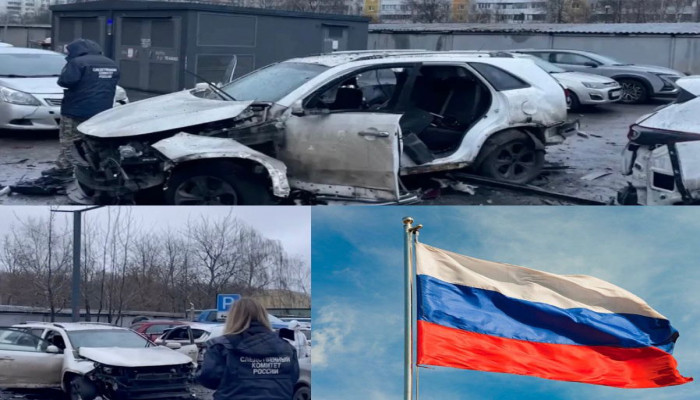
A senior Russian military officer has been killed in a car bombing in Moscow, marking the latest deadly attack on Russian military officials since the Kremlin launched its full-scale invasion of Ukraine nearly four years ago.
Russia’s Investigative Committee confirmed the incident in a statement issued on the morning of December 22. According to the statement, an explosive device planted under a car detonated on a street located on the outskirts of Moscow. The blast caused severe damage and resulted in the death of Lieutenant General Fanil Sarvarov.
Sarvarov served as the head of the Russian General Staff’s army operational training directorate. The Investigative Committee stated that he died from injuries sustained in the explosion. Officials said that the device had been placed underneath the vehicle, indicating a targeted and planned attack.
The explosion occurred shortly after the car began moving. The Russian-language Telegram channel Baza reported that the vehicle carrying Sarvarov had travelled only a short distance before the blast took place. This detail suggests that the bomb may have been remotely detonated or triggered once the car started moving.
A video released by the Investigative Committee from the scene showed a heavily damaged white car surrounded by other vehicles in what appeared to be a parking area. The blast left the car destroyed, with debris scattered around the site. Emergency and investigative teams were seen examining the area following the explosion.
Russian investigators said they are examining several possible scenarios behind the attack. One of the main possibilities being considered is the involvement of Ukrainian special services. The committee stated that this theory is among the key lines of investigation, but did not provide further details.
Ukrainian military intelligence has previously claimed responsibility for several similar attacks that have targeted high-profile Russian figures. However, following this incident, Ukrainian military intelligence did not immediately respond to questions from Radio Free Europe/Radio Liberty (RFE/RL) regarding the bombing or any possible involvement.
Lieutenant General Sarvarov was 56 years old at the time of his death. His military career included participation in several major Russian military campaigns. He had fought against insurgents during the conflict in Chechnya and later took part in Russian military operations in Syria during 2015 and 2016.
According to the investigative group Proyekt, also known as The Project, Sarvarov had also been involved in Russia’s war against Ukraine. His role in operational training placed him among senior military figures responsible for preparing Russian forces.
Sarvarov’s killing adds to a growing list of assassinations of high-ranking Russian military officers in recent months. These attacks have raised concerns within Russia’s security establishment and highlighted the increasing risks faced by senior officials.
Earlier this year, in April, another senior officer, Lieutenant General Yaroslav Moskalik, was killed in a similar incident. Moskalik died when a car exploded on a street in a Moscow suburb while he was walking nearby. The blast killed him instantly and prompted a criminal investigation.
Russian prosecutors later charged a man in connection with Moskalik’s death. Authorities alleged that the suspect had been paid by Ukrainian intelligence services to carry out the attack. The case was presented as evidence of what Russia describes as Ukraine’s involvement in targeted assassinations on Russian territory.
Another deadly incident took place in December 2024, when Lieutenant General Igor Kirillov was killed in Moscow. Kirillov died after a bomb hidden in an electric scooter exploded on a sidewalk as he exited his apartment building. At the time of his death, Kirillov was the head of Russia’s military unit responsible for overseeing defences against nuclear, chemical, and biological threats.
Following Kirillov’s death, Russian officials also accused Ukraine of being behind the bombing. Ukrainian authorities, however, did not publicly confirm responsibility for that attack.
The killing of Sarvarov follows the same pattern as these earlier incidents, involving explosive devices planted in everyday objects or vehicles and detonated in public or residential areas. These attacks have increasingly targeted senior military figures linked to Russia’s war efforts.
As investigations continue, Russian authorities have not announced any arrests related to Sarvarov’s killing. The Investigative Committee said it would continue to examine all possible leads and determine who was responsible for planting the explosive device.
The incident further highlights the ongoing tensions and violence linked to the war in Ukraine, which has now entered its fourth year. The series of attacks on Russian soil shows how the conflict continues to have serious consequences beyond the battlefield.



 Loading...please wait
Comments