




Scotland, Wales and Northern Ireland sign historic MoU to break away from UK
- In Reports
- 04:56 PM, Sep 15, 2026
- Myind Staff
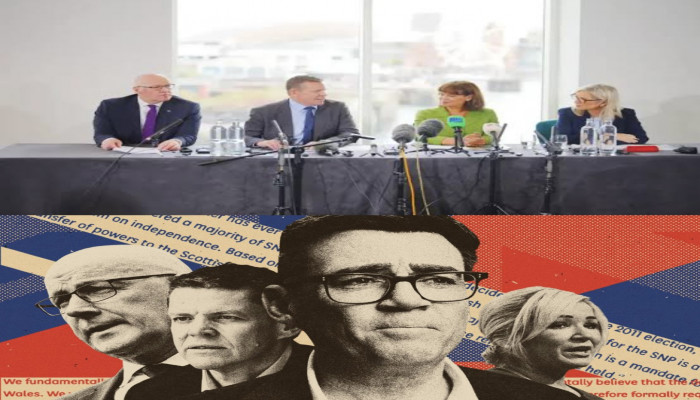
The United Kingdom has taken shape through centuries of unions, laws, conquest and political settlements. The latest challenge to its unity has come from Scotland, Wales and Northern Ireland, whose major nationalist parties have signed a memorandum calling on Westminster to “prepare, plan and facilitate constitutional change”.
The leaders of the Scottish National Party, Plaid Cymru and Sinn Féin signed an agreement in Cardiff. It has no legal force and does not alter the UK's constitutional structure. The leaders signed it as party leaders, not as representatives formally binding their governments.
Wales was incorporated into the English political and legal system first. The Laws in Wales Acts of 1535 and 1542 followed the English conquest of Wales and gave Wales representation in the Parliament of England.
Scotland shared a monarch with England from 1603, when James VI of Scotland became James I of England. The two kingdoms retained separate parliaments and legal systems until the Acts of Union created the Kingdom of Great Britain in 1707. Scotland retained institutions including its separate legal system and church.
Ireland joined the union in 1801 after the 1798 rebellion. The Acts of Union created the United Kingdom of Great Britain and Ireland and abolished the Irish Parliament. Ireland received 100 seats at Westminster.
That arrangement changed after the Irish War of Independence. The Government of Ireland Act 1920 created separate arrangements for Northern and Southern Ireland. The Irish Free State later emerged, while Northern Ireland remained part of the UK. The state became the United Kingdom of Great Britain and Northern Ireland.
Devolution brought another major change in 1998. The Good Friday Agreement restored devolved government in Northern Ireland. Scotland and Wales also gained their own legislatures. The latest pact is significant since pro-independence or pro-unification parties now lead all three devolved administrations.
Their goals, however, differ. The SNP seeks another Scottish independence referendum. Sinn Féin supports a referendum on Irish unity when the required constitutional conditions exist. Plaid Cymru backs Welsh independence but has no similar immediate referendum timetable.
The UK can break up, but the Cardiff pact cannot trigger it. The House of Commons Library describes Britain as a “state of unions”. Scotland faces a major legal hurdle. The UK Supreme Court ruled in 2022 that the Scottish Parliament could not independently hold an independence referendum. Westminster would have to approve one, as it did before the 2014 vote, when Scots rejected independence by 55% to 45%.
Northern Ireland has a separate mechanism under the Good Friday Agreement. The British government must call a border poll if it appears likely that a majority would support leaving the UK for a united Ireland. Wales has no equivalent process.
Scottish independence would also raise major energy and defence issues. Scotland generated 38.5 TWh of renewable electricity in 2025 and had 17.9 GW of operational renewable capacity. Its 20.8 TWh net electricity exports highlight its role in the UK energy system.
The future of Britain's nuclear deterrent would be another major dispute. Trident submarines operate from Faslane, while warheads are stored and handled at Coulport. Moving these facilities would be complex, costly and politically difficult. Scotland's independence would therefore involve negotiations over energy, defence, debt, borders, pensions, citizenship and international treaties.
The next battle will depend on whether nationalist parties can build sustained public support for constitutional change and secure a legal route to referendums.



 Loading...please wait
Comments