



SCO Civilisational Forum adopts Indraprastha Communique, calls for equal respect for all cultures
- In Reports
- 07:22 PM, Nov 23, 2026
- Myind Staff
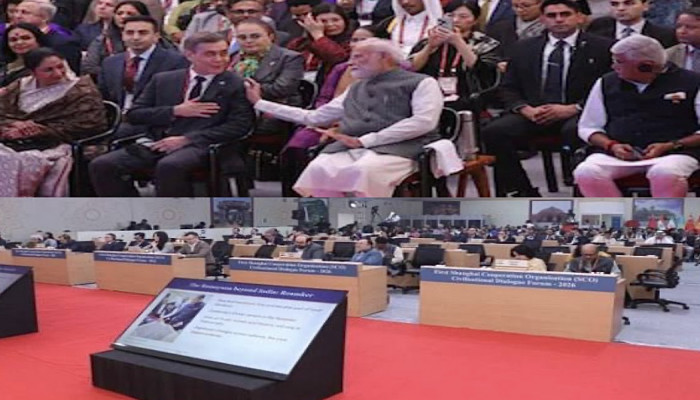
The Shanghai Cooperation Organisation (SCO) Civilisational Dialogue Forum, hosted by India, concluded on Sunday with the adoption of the Indraprastha Communique. The document calls for protecting cultural heritage, preventing illicit trafficking of cultural properties and respecting every civilisation as an equal voice.
The three-day forum was inaugurated by Prime Minister Narendra Modi on November 20 at Purana Qila in New Delhi. It brought together delegates from SCO member countries and dialogue partners, including Pakistan’s federal minister Musadik Malik, to discuss shared cultural heritage and cooperation.
The Communique highlights centuries of interaction, exchange of ideas, movement of people and sharing of knowledge among SCO societies. It also recognises their distinct identities, cultures, traditions and beliefs.
The document reaffirms the SCO's commitment to mutual trust, harmony, equality, consultation, respect for civilisational diversity and sustainable development. It describes culture as a vital bridge of friendship and good-neighbourliness among nations.
It recognises cultural heritage as a broad concept covering monuments, manuscripts, literature, artwork, cuisine, performing arts, living traditions and knowledge systems passed down through generations. It also calls for protecting heritage from natural disasters and illicit trafficking.
Union Culture Secretary Vivek Aggarwal read out the Communique at the closing session. The Ministry of Culture and Ministry of External Affairs organised the forum from November 20 to 22, with the Indira Gandhi National Centre for the Arts (IGNCA) as its knowledge partner.
Explaining the next steps, Aggarwal said the document would be shared with the SCO's permanent Secretariat. Any further action would be taken in coordination with the organisation. He clarified that it was “not exactly a negotiated document; it is an outcome document”, which provides a “roadmap for future course of action”.
The Communique also encourages the “constructive use of artificial intelligence” to improve access to cultural heritage. It calls for recognising every civilisation as an equal voice and acknowledging its identity and contribution to humanity. It further highlights shared traditions in architecture, music, cuisine and textiles.
The document also supports joint nominations by countries for UNESCO heritage recognition. Aggarwal said, “As a principle, it has been discussed, but which countries will join, what nomination will be taken up, that will depend on future discussions that will happen”.
Alok Dimri, Additional Secretary in the Ministry of External Affairs and National Coordinator for the SCO, said the document was not technically a joint statement. He explained, “It’s a matter of technicality, as this is an SCO event, but we have dialogue partners also participating. So, in SCO parlance, typically a joint statement is done by member states. Nonetheless, it encapsulates the proceedings and codifies it in the form of a document.”
Aggarwal said the name Indraprastha reflects the historical identity of the location. He noted, “The name of the place where we are sitting is known as ‘Indraprastha’ in the revenue records also of Delhi. We have shown an artefact here carrying an inscription which mentions ‘Indraprastha’”.
Founded in 2001 by Russia, China, Kyrgyzstan, Kazakhstan, Tajikistan and Uzbekistan, the SCO admitted India and Pakistan as permanent members in 2017. Iran joined in 2023.
The forum builds on PM Modi's proposal at the 2025 SCO Summit in Tianjin, China, to establish a dedicated platform for civilisational dialogue. The proposal received support in the Bishkek Declaration. At the inauguration, Modi said cultural connections were the “strongest guarantee” for world peace amid global war and unrest. He also highlighted the role of cultural cooperation in strengthening ties among SCO members.



 Loading...please wait
Comments