




Scientists unveil world’s first quantum battery with ultra-fast charging potential
- In Reports
- 06:34 PM, Mar 19, 2026
- Myind Staff
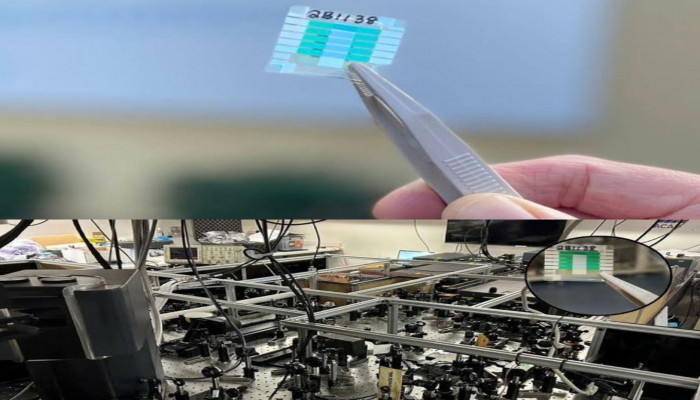
Australian researchers have taken a major step forward in energy technology by successfully developing and testing the world’s first proof-of-concept quantum battery. This innovation marks an important moment in the search for faster and more efficient ways to store and use energy. The study, led by the Commonwealth Scientific and Industrial Research Organisation (CSIRO) in partnership with the University of Melbourne and RMIT University, has been published in Nature Light: Science & Applications.
The new research highlights the potential of quantum batteries to transform everyday energy systems. Unlike traditional batteries that depend on chemical reactions, quantum batteries use the principles of quantum mechanics. This allows them to function in a completely different way. Scientists believe this could eventually lead to devices that charge much faster than what is currently possible.
University of Melbourne researchers Associate Professor James Hutchison and Professor Trevor Smith played key roles in the project. Explaining the concept, Associate Professor Hutchison said, “Similar to conventional batteries, quantum batteries charge, store and discharge energy. But while everyday batteries rely on chemical reactions, quantum batteries leverage properties of quantum mechanics.” His statement underlines how this new technology builds on familiar ideas but introduces a more advanced scientific approach.
One of the most striking features of this innovation is the speed at which it can charge. According to Hutchison, “The advantage of quantum is that the system absorbs light in a single, giant ‘super absorption’ event and this charges the battery faster.” This means that instead of gradually storing energy, the battery can take in energy in one powerful burst. Such a mechanism could dramatically reduce charging times for future electronic devices.
To test this concept, the team used advanced facilities at the University of Melbourne’s Ultrafast Laser Laboratory in the School of Chemistry. The laboratory’s cutting-edge tools allowed researchers to closely observe how the prototype behaved during charging. These tools include highly sophisticated laser systems capable of capturing extremely fast processes. The experiments confirmed that the battery could indeed charge at very high speeds.
Professor Trevor Smith explained the importance of these facilities in the testing process. He said, “The unique capabilities of our Ultrafast Laser Lab, including dual femtosecond laser amplifiers and tuneable optical parametric amplifiers, were critical in enabling us to record ultrafast signals over orders of magnitude in time.” His remarks highlight how advanced technology was essential in validating the performance of the quantum battery.
The project was led by Dr James Quach, who heads quantum science and technologies research at CSIRO. He and his team were responsible for designing and engineering the prototype. Their work demonstrates that quantum batteries can operate effectively even at room temperature, which is a crucial requirement for real-world applications. Without this capability, the technology would remain limited to laboratory conditions.
Speaking about the significance of the findings, Dr Quach said, "The research and proof-of-concept validates the exciting potential of quantum batteries to achieve rapid, scalable charging and energy storage at room temperature, laying the groundwork for next-gen energy solutions.” His statement reflects the optimism surrounding this breakthrough and its future applications.
Dr Quach also pointed out an unusual property of quantum batteries that sets them apart from traditional systems. He said, “Our findings confirm a fundamental quantum effect that's completely counterintuitive: quantum batteries charge faster as they get large.” This goes against the typical expectation that larger systems are slower and less efficient. Instead, quantum mechanics allows the opposite to happen.
Despite the progress, researchers acknowledge that the technology is still in its early stages. Several challenges need to be addressed before quantum batteries can be used in everyday devices. One of the key areas of focus is improving the time these batteries can store energy. Currently, extending their storage time remains a major goal for scientists.
Dr Quach emphasised this next step, stating, "While there's still much work to be done in quantum battery research, we've made an important move towards realising the possibilities. The next step right now for quantum batteries is extending their energy storage time.” His comments make it clear that while the breakthrough is significant, further research is necessary.
Overall, this development offers a glimpse into a future where energy storage is faster, more efficient, and more advanced than ever before. If successfully developed further, quantum batteries could reshape how we power everything from smartphones to large-scale energy systems.



 Loading...please wait
Comments