




Scientists design new virus using AI, marking a new frontier in synthetic biology
- In Reports
- 07:30 PM, Aug 07, 2026
- Myind Staff
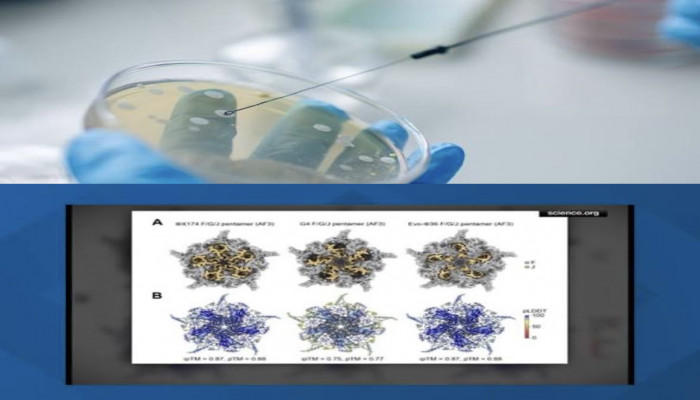
Scientists in the United States have used artificial intelligence to design and create viruses that do not exist in nature. The researchers say the work marks a major step forward in synthetic biology. It shows that AI can now move beyond designing individual genes and proteins to creating complete viral genomes that can function inside living cells.
Researchers from Stanford University and the Arc Institute used a generative AI model called Evo to create new viral genomes. They then synthesised the DNA in a laboratory and tested the designs. The team found that 16 of the AI-designed viruses could replicate and kill E. coli, a type of bacteria. The findings were published on Thursday in the journal Science.
The viruses created in the study were bacteriophages, also known as phages. These viruses infect bacteria but do not infect humans. The researchers selected phages for the experiment as they are well understood and have been studied extensively. “This is a next step in the complexity that's designable by generative AI,” Brian Hie, a computational biologist at Stanford and the study's lead researcher, told the BBC. “This was new territory for us.”
The experiment represents a significant change in how researchers are using AI for biological design. Earlier efforts largely focused on creating individual proteins or genes. This study used AI to design an entire genome that could function inside a living cell.
Evo works in a way similar to a large language model. Instead of learning patterns in language and predicting the next word, it learns patterns in DNA sequences. According to The New York Times, the model was trained using genetic sequences from millions of organisms. It analysed around nine trillion nucleotides.
The researchers then focused the model on Phi X-174, a bacteriophage that infects E. coli. The virus contains 11 genes. The team also used genetic information from around 15,000 of its closest relatives to train the model further.
Evo generated hundreds of thousands of possible viral genomes. Researchers examined the designs and selected the most promising candidates for laboratory testing. After testing the selected genomes, they identified 16 that successfully produced viable viruses. Some of these AI-designed phages also multiplied faster than the natural Phi X-174 virus, according to The New York Times.
“Our study is a proof of concept showing for the first time that generative design can generate entire functional genomes,” Hie told the Financial Times.
The researchers believe the technology could eventually have important medical applications. Scientists have studied phages for years as a possible alternative to antibiotics. Phages can target specific bacteria, making them potentially useful in treating certain bacterial infections. As antibiotic resistance continues to grow, AI could help researchers design phages that target particular harmful bacteria more efficiently.
“With more evidence coming out on the emergence of scary antibiotic-resistant pathogens, we will need innovative alternative solutions — and phage therapy is certainly one,” Samuel King, a Stanford researcher who worked on the study, told the Financial Times.
However, the technology also raises serious concerns. If AI can learn enough about DNA to create a functional virus from scratch, scientists will eventually need to consider what could happen if similar systems are used to design viruses that infect humans.
The Stanford team took several precautions during the experiment. Evo was not trained on viruses that infect humans or other complex organisms. The researchers also worked with bacteriophages and a non-pathogenic strain of E. coli. The experiments took place in a secure laboratory.
Another concern comes from the growing availability of advanced AI models. Unlike some emerging technologies that remain controlled by a small number of companies, Evo 2 is open source and available to download for free, according to the Financial Times. This could make powerful biological design tools accessible to a much wider group of users.
Hie said the researchers currently have no plans to commercialise the work. He argued that its potential benefits for health and humanity outweigh the risks.
The study's wider importance goes beyond the 16 viruses created in the Stanford laboratory. It demonstrates that AI is beginning to move from designing biological structures on computers to creating biological systems that can work in the real world. The development could open new possibilities for medicine and synthetic biology. At the same time, it raises a difficult question for researchers and policymakers: as AI becomes capable of creating increasingly complex biological systems, how should society decide what it should and should not be allowed to create?



 Loading...please wait
Comments