




SC says ‘conscientious objectors’ cannot face punishment for refusing to sing Vande Mataram
- In Reports
- 01:35 PM, Sep 23, 2026
- Myind Staff
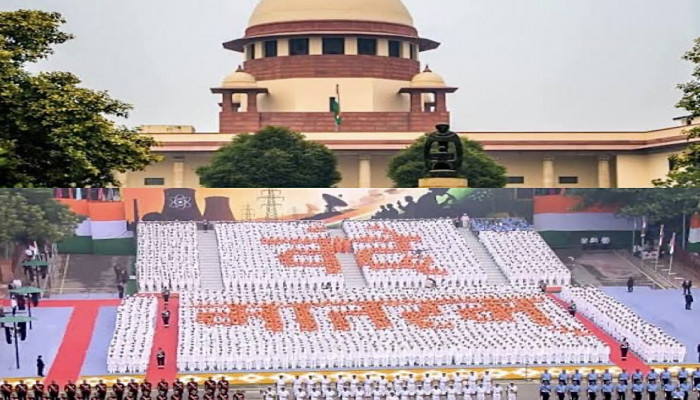
The Supreme Court on Tuesday told the Centre that a “conscientious objector” should not face punishment for refusing to sing Vande Mataram. The court referred to its 1986 judgment in Bijoe Emmanuel vs State of Kerala, which protected schoolchildren who respectfully declined to sing the national anthem on grounds of conscience.
A bench headed by Chief Justice of India Surya Kant was hearing a petition filed by Carnatic vocalist T M Krishna. He has challenged the law requiring the singing of all six stanzas of Vande Mataram. The petition argues that the last four stanzas affect the secular character of the country.
The bench, comprising Justices Joymalya Bagchi and V Mohana, sought the Centre’s response on the plea. It said the principle laid down in the 1986 judgment should apply to the amended law. Justice Bagchi told Solicitor General Tushar Mehta, “... We are not inclined to issue notice. But we would expect that the law of the land, as declared by this court in Bijoe Emmanuel, will govern the (amended) Act.”
Justice Bagchi said the court was not questioning the status of Vande Mataram as the national song. He said the democratic state could decide the form and number of stanzas to be recognised. However, he said people who believe their rights under Articles 25 and 26 have been violated, or those acting as conscientious objectors, should not face penal consequences.
The petition challenges Section 3 of the Prevention of Insults to National Honour Act, 1971, amended in 2026. It also challenges Ministry of Home Affairs orders issued on January 28 and July 9, 2026. The amended provision allows imprisonment of up to three years, a fine, or both for intentionally preventing the singing of the National Anthem or national song, or disturbing an assembly engaged in such singing.
Justice Bagchi said deciding the national sentiments or aspirations linked to Vande Mataram was not the court’s role. He added that the court would instead examine whether the rights of conscientious objectors, especially those refusing to sing on religious grounds, remain protected.
Senior advocate S Muralidhar, appearing for Krishna, argued that the amended law does not define “national song”. He said this could create uncertainty and allow misuse. He also questioned the MHA directions, saying they were issued through an office memorandum and were not gazetted.
Muralidhar said the earlier understanding of Vande Mataram referred to its first two stanzas. He also argued that the amendment was introduced without a wider process of national consensus. The petition further challenges treating all six stanzas as the official version and requiring Vande Mataram to precede the national anthem when both are sung or played.
The hearing also saw a sharp exchange between Muralidhar and Mehta. Mehta said, “Secularism cannot be this narrow”. He later said, “Lawmaking cannot be as per Naxalites idea”. Muralidhar objected and sought withdrawal of the remark. Mehta refused, saying, “I can repeat what I said. One has to go by law. I am not sorry about what I said. I said that is the constitutional way, not what the Naxalite wants. And I am not sorry about it.”
Muralidhar later accused the solicitor general of “playing to the gallery”. The bench did not intervene and said it was not taking note of the comments.



 Loading...please wait
Comments