




SC refuses to restore Friday namaz inside Bhojasala, allows prayers at a nearby site
- In Reports
- 05:34 PM, Jul 14, 2026
- Myind Staff
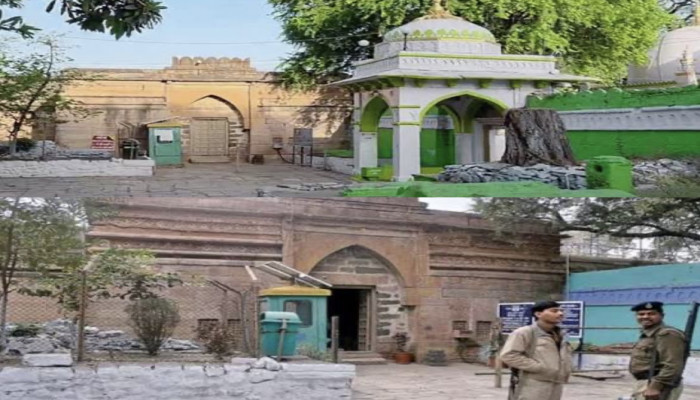
The Supreme Court on Tuesday refused to stay the Madhya Pradesh High Court's judgment that declared the disputed Bhojshala Temple-Kamal Maula Mosque complex in Dhar as a temple of Goddess Saraswati. The court also declined to restore Friday namaz at the disputed site. At the same time, it directed the authorities to provide a nearby space where members of the Muslim community can offer Friday prayers as an interim arrangement.
A bench headed by Chief Justice of India Surya Kant, along with Justices Joymalya Bagchi and V Mohana, directed the Madhya Pradesh administration and the Archaeological Survey of India (ASI) to identify a separate open space "adjacent or near to" the disputed complex. The court said Muslims can offer Friday namaz there between 1 pm and 3 pm until it decides the matter. The bench also restrained the ASI from making any structural changes at the disputed site without prior permission from the Supreme Court.
While hearing the matter, the bench said, “We are inclined to adjudicate the issue of maintainability... let us not pass any order which can lead to issues of law and order or disturb harmony.” The judges said they preferred to hear the main appeals instead of issuing an interim order that restored the previous arrangement for prayers at the site.
The bench noted that the High Court's judgment had already seen partial implementation. It said, “In this situation, we have to protect the rights under the judgment of the high court until it is set aside on appeal. Without prejudice to either side, let the namaz be offered at an adjacent site next to the declared temple.”
The Supreme Court heard appeals filed by petitioner Jebran Ansari, Quazi Moinuddin, who serves as the mutawalli or caretaker of the Kamal Maula Mosque, and the Maulana Kamaluddin Welfare Society. They challenged the Madhya Pradesh High Court's decision that recognised the 11th-century Bhojshala-Kamal Maula complex as a Hindu temple. They also challenged the High Court's order that cancelled the ASI's 2003 arrangement allowing Muslims to offer Friday prayers at the site.
Senior advocate Huzefa Ahmadi, appearing for Ansari, argued that the High Court decided disputed questions of fact during writ proceedings without conducting a trial or allowing cross-examination of ASI experts. He submitted that Muslims had been offering Friday prayers at the site for several decades under the 2003 arrangement. He urged the Supreme Court to restore the earlier practice until it delivers its final judgment in the appeals.
Senior advocate Abhishek Manu Singhvi, representing Quazi Moinuddin, also requested the court to maintain the earlier balance. He warned that reopening historical disputes could affect several other matters. Referring to the Constitution, he said fraternity and secularism should guide judicial decisions in such sensitive cases. He urged the court to preserve communal harmony while considering the legal issues involved.
The Madhya Pradesh government opposed the request for interim relief. Solicitor General Tushar Mehta argued that the petitioners approached the Supreme Court nearly two months after the High Court delivered its judgment. He submitted that restoring the earlier arrangement at this stage would create administrative difficulties since the authorities had already started implementing the new system after the High Court's decision.
Throughout the hearing, the Supreme Court stressed the sensitive nature of the dispute and urged all parties to remain cautious. Chief Justice Surya Kant observed, “What is being said in courtroom number one can have repercussions,” while asking all sides to exercise restraint during the proceedings.
The dispute centres on the Bhojshala-Kamal Maula complex, an 11th-century monument in Madhya Pradesh's Dhar district. The Madhya Pradesh High Court had ruled that the complex is a temple dedicated to Goddess Saraswati. It also held that the Places of Worship (Special Provisions) Act, 1991, does not apply to the site. The High Court said the monument falls under the Ancient Monuments and Archaeological Sites and Remains Act, 1958, as it is a protected monument.
The Supreme Court will now examine several important legal questions while hearing the appeals. It will consider whether the High Court could determine the religious character of the disputed site through writ proceedings. It will also examine whether such a decision is barred under the Places of Worship (Special Provisions) Act, 1991. Until the court delivers its final verdict, Friday namaz will take place at a nearby location identified by the state authorities, while the ASI will maintain the disputed complex without making any structural changes unless it receives permission from the Supreme Court.



 Loading...please wait
Comments