




SC refuses to intervene in Meenakshi Natarajan’s nomination rejection case
- In Reports
- 06:08 PM, Jun 12, 2026
- Myind Staff
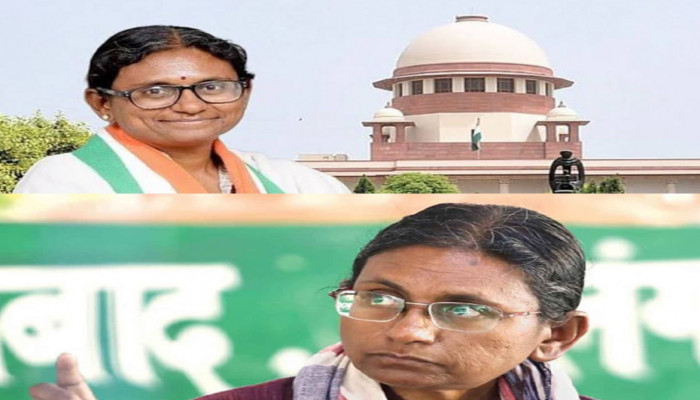
The Supreme Court on Friday refused to intervene in the dispute surrounding the rejection of Congress leader Meenakshi Natarajan’s nomination for the Rajya Sabha elections from Madhya Pradesh. The decision comes as a major setback for the senior Congress leader, whose nomination was rejected by the Returning Officer over the alleged non-disclosure of a criminal case registered in Telangana.
While hearing the matter, the court made it clear that there is a statutory process available under election laws for candidates whose nomination papers are rejected. The bench observed that once a Returning Officer rejects a nomination, the aggrieved candidate must seek relief through the Election Commission. On this basis, the court declined to interfere with the Returning Officer’s decision and left the matter open for further consideration by the poll body.
Senior advocate Abhishek Manu Singhvi appeared on behalf of Natarajan and challenged the rejection of her nomination. He argued that the Returning Officer’s decision was legally unsustainable and contrary to the requirements laid down under election laws. According to Singhvi, the criminal case cited as the reason for rejecting Natarajan’s nomination did not fall within the category of cases that candidates are required to disclose in their election affidavits.
Singhvi submitted before the court that the Representation of the People Act and Form 26 of the nomination affidavit clearly specify the circumstances under which a candidate must disclose criminal cases. He stated that disclosure is mandatory only when charges have been framed by a competent court or when a court has taken cognisance of an offence. He argued that neither of these conditions existed in the Telangana case referred to by the Returning Officer.
Elaborating further, Singhvi told the court that the Telangana matter was only a private complaint and that no court had taken cognisance of it. He maintained that the complaint could not be treated as a criminal case requiring disclosure under the law. Therefore, he argued that rejecting Natarajan’s nomination on that basis was unjustified.
The senior advocate also questioned the relevance of the allegations mentioned in the complaint. Referring to the facts of the case, he informed the court that the incident referred to in the Telangana complaint allegedly occurred nearly three years before Natarajan was appointed as the Congress party’s in-charge for Telangana. He argued that any attempt to connect her with the allegations was legally untenable and lacked a proper basis.
Despite these submissions, the Supreme Court chose not to examine the merits of the Returning Officer’s decision. The court held that the issue essentially concerned the rejection of a nomination paper by the Returning Officer and that election laws provide a specific mechanism to challenge such decisions. The bench indicated that the appropriate remedy lies before the Election Commission rather than through direct intervention by the court at this stage.
While disposing of the petition, the court stated, "The petitioner is free to approach the Election Commission again."
With this observation, the Supreme Court closed the proceedings without granting any relief to Natarajan. However, the order leaves open the possibility of her pursuing the matter before the Election Commission, which can examine the legality of the Returning Officer’s decision.
The controversy has emerged during a politically significant Rajya Sabha contest in Madhya Pradesh. The rejection of Natarajan’s nomination has led to a sharp political confrontation between the Congress and the Bharatiya Janata Party (BJP). The Congress has strongly objected to the decision and has alleged procedural irregularities in the handling of the nomination process.
The opposition party has also accused authorities of misusing electoral procedures to prevent its candidate from contesting the election. The BJP, on the other hand, has maintained its position on the matter, making the nomination dispute a key political issue in the ongoing Rajya Sabha election battle in the state.
The Supreme Court’s refusal to intervene means that the next stage of the dispute is likely to unfold before the Election Commission, which will now be the primary forum for any further challenge by Natarajan regarding the rejection of her nomination.



 Loading...please wait
Comments