



SC orders complete ban on NCERT class 8 textbook over chapter on corruption in judiciary
- In Reports
- 06:28 PM, Feb 26, 2026
- Myind Staff
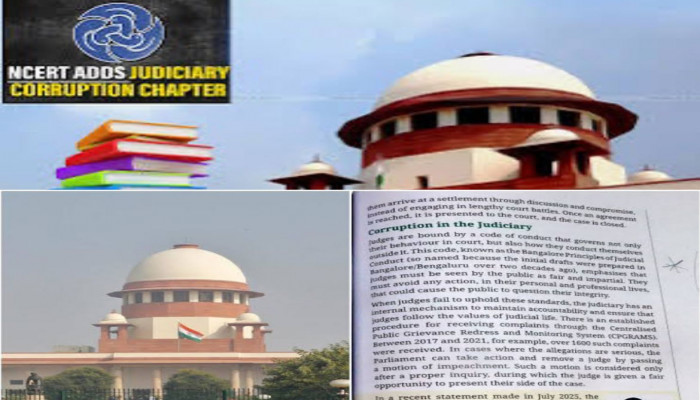
The Supreme Court of India has ordered a total ban on an NCERT Class 8 social science textbook because of a chapter on corruption in the judiciary. The top court described parts of the chapter as offensive and harmful, saying they could weaken people’s trust in the judicial system. The decision came on Thursday, February 26, 2026, after the court took up the matter on its own (suo motu).
The bench of the Supreme Court, led by Chief Justice of India (CJI) Surya Kant, ordered a “complete blanket ban” on any further printing, publication, or sharing of the book titled “Exploring Society: India and Beyond (Vol II)”. The ban applies to both physical and digital versions of the textbook.
The court directed that all existing copies of the book — those already printed and those available online — must be immediately seized and removed from public access. It said this must be done without any delay by both the Central and State governments.
The main reason for the ban was a section in the book titled “Corruption in the Judiciary”. This section discusses issues such as corruption, a long backlog of cases, and not enough judges in the courts. However, the Supreme Court felt these parts were written in a way that could damage the reputations of judges and the judiciary in the eyes of young students.
During the hearing, the CJI expressed his displeasure strongly. In his remarks, he said, “They have fired a gunshot. The judiciary is bleeding.”
This was a symbolic way of saying that the court saw the content as an attack on the institution’s dignity and strength.
The Supreme Court also issued show-cause notices to two key officials — the NCERT Director and the Secretary of the Department of School Education. A show-cause notice is a formal letter asking them to explain why legal action should not be taken against them for being responsible for publishing the controversial material.
The court made it clear it considers the incident serious enough that people involved could be charged under the Contempt of Courts Act, 1971, which deals with actions that disrespect or interfere with the functioning of the judiciary.
The Supreme Court said it was “nearly shocked” to learn from news reports that such a textbook had been released. After seeing reports in a newspaper, the court’s secretary general checked with NCERT to confirm whether the book was genuine and released officially.
When asked about the content, the NCERT Director responded with a written defence, instead of recognising the problem. The court found this defence “reckless, irresponsible, and contemptuous,” and said that, after looking at both the content and the defence, it appeared there may have been a “calculated move to undermine the institutional authority and demean the dignity of the judiciary.”
The court also stressed the importance of the judiciary’s role. It said the content did not talk about positive work done by courts, such as improving access to justice or protecting democratic rights. By only focusing on problems, the book could shape wrong impressions in the minds of young students, which could erode public trust in the judicial system.
Even though the court took strong action, it clarified that it does not want to stop all criticism of public institutions. The bench stated, “We do not propose to initiate the suo motu proceedings to stifle any legitimate critique or with a view to stop any individual or organisation from exercising their right to scrutinise public institutions, including the judiciary.”
However, the court emphasised that because of the possible long-term impact on the judiciary’s independence, autonomy, and public respect, the book’s content falls under the legal definition of criminal contempt if it was deliberate.
During the hearing, Solicitor General Tushar Mehta, representing the government and the education department, offered an unconditional and unqualified apology on their behalf. He said that the two people who wrote the offending chapter would no longer be associated with any work of the ministry.
Mehta also gave details about the distribution of the textbook, “There are 32 books which went in the market and which are being withdrawn. Rest of the books we are not circulating. The entire chapter would be re-visited by a new team,” and added, “We can’t teach our class 8 students that justice is being denied in the country.”
Separately, NCERT itself apologised for the controversial content, calling it “inappropriate” and stating that it would be rewritten in consultation with experts before being published again.
The chapter in question mentioned that corruption, delays caused by a huge backlog of cases, and a shortage of judges are among the challenges facing India’s judicial system. It also noted that judges follow a code of conduct both in court and outside of it.



 Loading...please wait
Comments