




SC directs centre to remove NCERT curriculum chair over class 8 Social Science chapter
- In Reports
- 08:12 PM, Mar 11, 2026
- Myind Staff
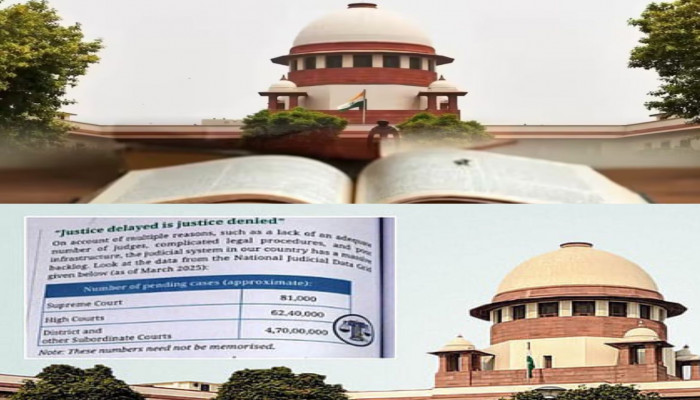
The Supreme Court of India on Wednesday directed the Centre, all state governments, and publicly funded institutions to remove Professor Michel Danino, who headed the social science curriculum at the National Council of Educational Research and Training (NCERT), along with two of his associates, from any role in designing school curricula or finalising textbooks for the next generation.
The order came after a controversy surrounding a sub-chapter titled “Corruption in the Judiciary” included in a Class 8 NCERT Social Science textbook. The court said the individuals responsible should no longer be associated with the preparation of educational material funded by public money.
A bench led by Chief Justice of India Surya Kant also ruled that Danino and his associates must not hold any paid positions in publicly funded institutions. However, the court said they would be allowed to seek a modification of the order by submitting their explanations.
The bench observed that there was no reason for the individuals involved to continue participating in curriculum preparation. The court stated, “At the outset, we have no reason to doubt that Professor Michel Danino, along with Ms Diwakar and Mr Alok Prasanna Kumar, either does not have reasonable knowledge about the Indian judiciary or they deliberately and knowingly misrepresented the facts in order to project a negative image of the Indian judiciary before students of Class 8 who are at an impressionable age.”
It further added, “There is no reason as to why such persons be associated in any manner with the preparation of the curriculum or finalisation of textbooks for the next generation. We direct Union, all States and all institutions receiving State funds to disassociate them from rendering any service which would mean payment to them from public funds.”
During the hearing, the bench also criticised an affidavit submitted by NCERT that claimed Chapter 4 of the textbook had already been rewritten. The court said that even if the chapter is revised, it cannot be included in the curriculum without proper approval from a government-constituted expert committee.
The judges also raised concerns about the composition of the committees that review textbooks. “We find it slightly disappointing that not a single eminent jurist is included in the committee,” the bench remarked.
The court directed that any rewritten version of Chapter 4 must be reviewed and approved by a panel of experts before it is published again. The committee must include one former senior judge, one eminent academician, and one well-known practitioner from the field.
While giving these directions, the court clarified that its interim orders should not be seen as an attempt to block fair criticism of the judiciary. The bench emphasised that constructive criticism is necessary for institutions to improve.
It stated, “We hasten to reiterate paragraph 9 of our order dated February 26 to show that the interim directions issued are not intended to prevent any healthy, objective and legitimate criticism of the functioning of the judiciary. If the judiciary is suffering from any deficiencies like any other institution, it will be a welcome step not only for the future generation of the nation, it will open doors for the present generation to take necessary remedial steps.”
The Supreme Court also directed the central government to form the expert panel within one week.
During the hearing, Solicitor General of India Tushar Mehta informed the court that the NCERT Director had already issued an unconditional apology through an affidavit. Mehta told the bench, “An unconditional apology has been tendered in the affidavit submitted by the Director of NCERT. A one-line unconditional apology has been published. The Central Government has already directed NCERT to review textbooks of all standards in this context.”
While accepting the apology, the court expressed concern over the way NCERT’s curriculum approval process functions. The bench said it was troubling that textbooks could be approved without adequate scrutiny.
The judges observed, “Instead of leaving it to the NCERT, we would have appreciated that the Central government… Not after tendering this apology, this affidavit is eye-opening. That NCERT curriculum is approved without any scrutiny.”
Responding to these concerns, Mehta assured the court that the government would handle the situation appropriately. He said, “We know how to deal with such persons. They must also understand how to respond to the current CJI. They have realised their mistake and issued an unconditional apology.”
Earlier, on February 26, the Supreme Court had issued show-cause notices to the Secretary of the Department of Education and Literacy under the Ministry of Education and the NCERT Director, Dinesh Prasad Saklani. The court asked them to explain how the controversial sub-chapter was included in the Class 8 textbook.
Despite NCERT’s apology, the court refused to stop its proceedings. It had also imposed a ban on the Class 8 textbook and warned that any attempt to bypass the order would be treated as contempt of court.
The court had additionally directed NCERT to provide details about the Teaching-Learning Materials Committee that approved the disputed chapter. This included submitting the names, qualifications, and credentials of all members involved in the decision.
In the latest hearing, the Supreme Court noted that NCERT had complied with its earlier directions and acknowledged the apology submitted by the institution.
The court then ordered the creation of a new expert committee and directed the removal of the panel responsible for including the controversial chapter in the Class 8 textbook, which had triggered the court’s suo motu proceedings.



 Loading...please wait
Comments