




Sarshanghchalak Dr Mohan Bhagwat's Call to Understand Gen Z: A Roadmap for Social Leadership
- In Current Affairs
- 10:56 AM, Aug 13, 2026
- Dr. Siddhartha Dave
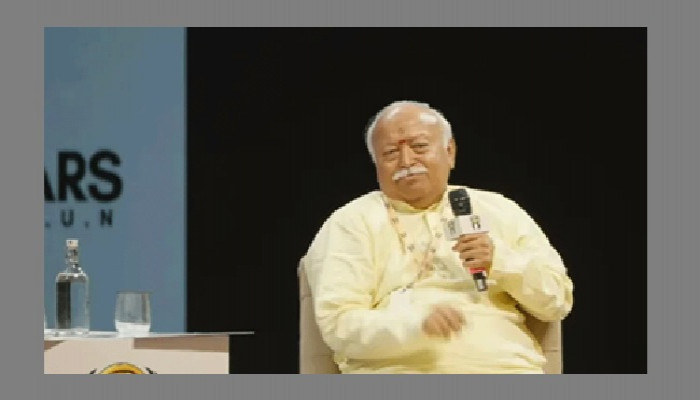
In public discourse yesterday, few subjects generate as much anxiety as India's younger generation. Social media frequently portrays Gen Z as impatient, rebellious, distracted or disconnected from national values. Every protest is quickly branded as anti-national. Every disagreement is interpreted as ideological hostility. Against this backdrop, the address of Rashtriya Swayamsevak Sangh (RSS) Sarshanghchalak Dr Mohan Bhagwat at the India International Movement to Unite Nations (I.I.M.U.N.) on August 6 offered a remarkably balanced and deeply civilisational perspective.
Rather than viewing the younger generation as a problem to be managed, he urged society to see them as its own children who deserve understanding, trust and meaningful dialogue. The message carries important implications not merely for educators or parents, but also for every swayamsevak engaged in social work.
Trust Before Judgement
Perhaps the most striking observation was Dr Bhagwat's assertion that if Gen Z is protesting, it should not automatically be labelled anti-national. Such a statement is significant because it distinguishes dissent from disloyalty. Every generation expresses itself differently, shaped by its own social, technological and economic realities.
His emphasis was not on endorsing every form of protest but on recognising that young people remain integral members of the national family. Dialogue becomes meaningful only when it is rooted in apnatva—a relationship of belonging. Without emotional ownership, communication becomes confrontation.
Even more noteworthy was his confidence that Gen Z and Gen Alpha possess a level of honesty that deserves trust. Such confidence from the head of the RSS shifts the discourse from suspicion to engagement. It places responsibility on elders to understand before they attempt to instruct.
For RSS workers, this is an important organisational lesson. The future expansion of social influence cannot depend merely upon transmitting ideas. It requires building relationships based on empathy, respect and patient dialogue.
Education Beyond Commerce
Dr Bhagwat also presented education as a social responsibility rather than a commercial enterprise. Education, in his formulation, is not simply about producing employable individuals or generating revenue through institutions. It is the process through which future generations are shaped.
His support for increased national investment in education reflects recognition that nation-building requires long-term investment in human capital. Equally significant was his observation that social organisations—including those inspired by the Sangh—already manage thousands of educational institutions. This carries a corresponding obligation to continuously improve quality, teacher training and accessibility.
The larger message is that education reform cannot remain confined to government policy alone. Society itself must participate actively in nurturing the next generation.
Social Media and Moral Responsibility
Unlike simplistic calls to abandon social media, Dr Bhagwat acknowledged its immense influence while emphasising responsibility. His observation that if millions take a wrong decision because of his own communication, he too shares responsibility, reflects a rare ethic of accountability in the digital age.
In an era driven by algorithms, misinformation and viral outrage, the responsibility of leadership extends beyond intention to consequences. Authentic sources, responsible sharing and positive communication become national duties rather than merely personal preferences.
For RSS volunteers, who increasingly use digital platforms for outreach, this message assumes particular importance. Organisational credibility depends not merely upon ideological commitment but also upon intellectual discipline and factual integrity.
Nationalism Without Hatred
Dr Bhagwat's remarks on international conflicts reflected the distinctive worldview that has long informed Bharatiya civilisational thought.
Citizens should stand with their own government during times of national conflict. Yet national commitment need not transform into hatred towards entire populations. His observation that not every Pakistani is India's enemy reflects the ancient Bharatiya distinction between opposing hostile policies while recognising the shared humanity of individuals.
This aligns with India's long-standing diplomatic philosophy of seeking harmony through dialogue rather than domination through conquest. The principle that "Humanity is One" complements rather than contradicts national interest.
Such a perspective enables confident nationalism without descending into civilisational hostility.
Social Questions Through Civilisational Values
On questions relating to LGBT issues and marriage, Dr Bhagwat distinguished between respect for individuals and preservation of social institutions.
He affirmed that LGBT individuals are members of society deserving acceptance and dignity. Simultaneously, he argued that within the Bharatiya understanding, marriage is not merely a contractual relationship between two adults but an institution intended for family continuity, social stability and the nurturing of future generations.
This approach illustrates a broader civilisational method of engaging contemporary debates—not through exclusion but through contextual understanding rooted in India's cultural philosophy.
Similarly, on reservation, he reiterated that social discrimination remains the fundamental reason for affirmative action. Until discrimination disappears, reservation retains its relevance. By discouraging political exploitation of the issue while emphasising genuine social reform, he reaffirmed the Sangh's long-standing emphasis on social harmony as the ultimate solution.
Women, Work and Leadership
Dr Bhagwat's observations on women challenged persistent misconceptions regarding the RSS. He reiterated that women and men are equal yet complementary participants in nation-building, while pointing to the longstanding role of the Rashtra Sevika Samiti and women's participation in organisational decision-making.
On employment, he broadened the definition beyond salaried jobs to include entrepreneurship, skills and dignity of labour. Such thinking resonates with India's demographic aspirations, where self-employment and innovation increasingly complement traditional employment models.
His concluding reflections on leadership were perhaps the philosophical core of the address. Leadership begins with self-leadership. True leadership emerges from inner discipline rather than external authority. Most importantly, leadership should create more leaders rather than followers.
This principle has always distinguished the RSS organisational model. The Sangh's strength lies not in charismatic centralisation but in continuously developing thousands of capable karyakartas who assume responsibility across society.
A Blueprint for the Next Generation
Viewed together, Dr Mohan Bhagwat's address was far more than a series of responses to contemporary issues. It offered a coherent framework for navigating the twenty-first century while remaining anchored in Bharatiya civilisational values.
Its central message is both simple and profound: trust the younger generation, educate with purpose, communicate responsibly, remain rooted in national interest without abandoning universal humanity, strengthen social institutions, and build leaders who empower others.
For RSS functionaries and swayamsevaks, these ideas are not merely subjects for discussion. They constitute a practical guide for expanding social engagement in an India where demographic transformation, technological disruption and cultural continuity must advance together.
The future of Bharat will not be secured merely by defending traditions. It will be secured by transmitting those traditions through dialogue, confidence and compassionate leadership to a generation eager to contribute, provided society first chooses to understand it.
Disclaimer: The opinions expressed within this article are the personal opinions of the author. MyIndMakers is not responsible for the accuracy, completeness, suitability, or validity of any information on this article. All information is provided on an as-is basis. The information, facts or opinions appearing in the article do not reflect the views of MyindMakers and it does not assume any responsibility or liability for the same.


 Loading...please wait
Comments