




Russian shadow fleet LNG Tanker sinks after sudden explosions off Libya Coast
- In Reports
- 06:07 PM, Mar 04, 2026
- Myind Staff
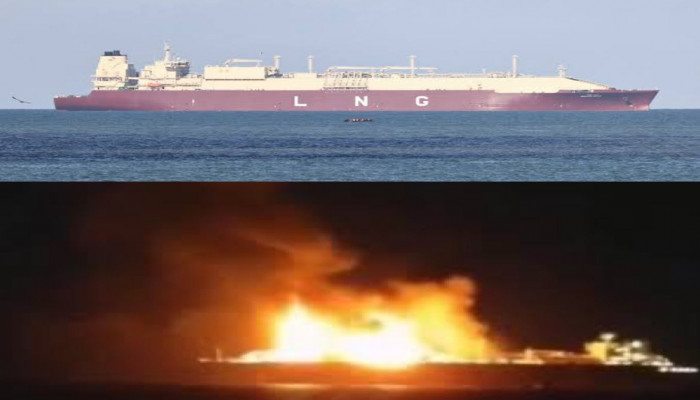
A Russian liquefied natural gas (LNG) tanker named Arctic Metagaz has sunk in the central Mediterranean Sea between Libya and Malta after sudden explosions sparked a massive blaze on board the vessel, according to Libya’s ports and maritime transport authority. The authority said the ship “had experienced sudden explosions followed by a massive fire, which ultimately led to its complete sinking” north of the Libyan coast on Tuesday night.
Libya’s authority also reported that all 30 crew members were rescued in nearby Libyan waters after the explosions. There have been no immediate reports of casualties among the crew, and details on any injuries have not been disclosed by officials so far.
The Arctic Metagaz is believed to have been operating as part of Russia’s so-called “shadow fleet” — a group of vessels used to transport energy resources while avoiding Western sanctions imposed on Moscow after its invasion of Ukraine in 2022. The ship had loaded LNG at a Russian floating storage unit and was sailing through the Mediterranean when its Automatic Identification System signal disappeared roughly 30 nautical miles off Malta’s northeastern coast before the fire.
Officials from Libya’s port authority told reporters that the tanker was engulfed in fire immediately after the explosions. “It ultimately led to the tanker’s complete sinking,” the authority said, underlining that the blasts triggered the blaze, which the crew could not control.
According to local reports, Russia’s transport ministry later accused Ukraine of launching a naval-drone attack against the vessel from the Libyan coast. Moscow claimed that the tanker was struck by uncrewed surface vessels, though Kyiv has not publicly commented on the allegation. The Russian ministry’s statement marked one of the first times Moscow blamed Ukraine for an attack so far from Ukrainian territory.
Officials from the Armed Forces of Malta — whose Rescue Coordination Centre helped coordinate the response — confirmed that survivors from the Arctic Metagaz were found in a lifeboat within Libya’s search-and-rescue area and were all reported safe. Malta’s authorities said they were alerted to a distress situation involving the Arctic Metagaz outside Malta’s own search-and-rescue zone, leading them to initiate verification and coordinate with international partners.
According to their statements, the crew abandoned the ship as the fire spread and were later transferred to another vessel after rescue coordination messages were broadcast to nearby ships in the area. Officials emphasised that the priority was to ensure the crew’s safety amid the emergency.
The Arctic Metagaz had been sailing under the radar of Western tracking systems at times, a tactic often associated with sanction-evading shadow fleet vessels. Tracking data showed the ship sailing from Western Europe into the Mediterranean after loading LNG in northern Russia. Before the incident, it had wrapped around parts of Western Europe and was reportedly heading toward destinations beyond the region.
This incident highlights the growing risks facing ships connected to Russia’s sanctioned energy shipment operations. The shadow fleet has been under increasing scrutiny from maritime authorities and Western governments for its role in transporting energy exports that bypass global sanctions.
So far, environmental impact assessments have not been made public, and no official statement has been released regarding fuel or LNG spillage from the vessel. Local reports have yet to provide information about wider ecological risks following the tanker’s sinking.
Overall, the Arctic Metagaz LNG tanker sank after sudden explosions triggered a fire onboard, resulting in the crew’s rescue but the vessel’s loss. Russian authorities have blamed Ukraine for the incident, though no formal response has been issued by Kyiv. Maltese and Libyan authorities worked together to locate and secure the safety of the crew members before transferring them to another vessel.



 Loading...please wait
Comments