




Russia-North Korea open first road bridge, deepening strategic partnership
- In Reports
- 02:48 PM, Sep 08, 2026
- Myind Staff
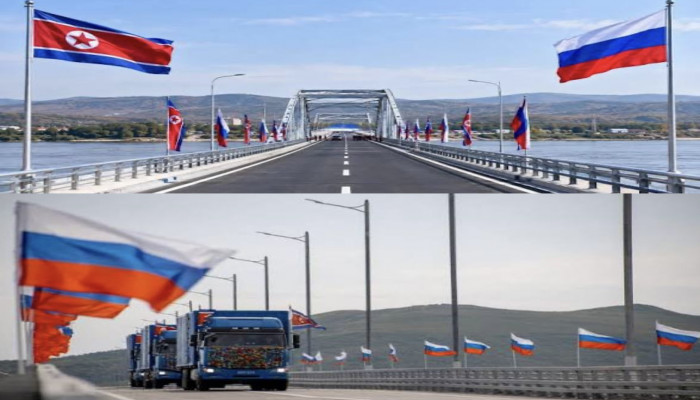
Russia and North Korea opened their first road bridge on Monday, marking a new step in their growing strategic relationship. The two-lane bridge spans the Tumen River and symbolises closer ties. The opening ceremony was carefully organised to highlight the friendship between Moscow and Pyongyang.
The first trucks, decorated with flags of both countries, crossed the 1-km (0.6-mile) bridge during the ceremony. Russian Prime Minister Mikhail Mishustin and North Korean Premier Pak Thae Song joined the event through a video link. They addressed workers and government officials from both sides of the border.
The proposal to build a bridge has been under discussion for several years. Construction began in April last year after Russia and North Korea reached an agreement in 2024 during Russian President Vladimir Putin’s visit to North Korea. The two countries already have direct air and rail connections between Moscow and Pyongyang. However, they did not have a proper road link until the new bridge opened.
For decades, vehicles crossed the border using a special arrangement on the nearby rail bridge. Since 1959, planks had been placed on the railway bridge to allow vehicles to pass. That bridge had remained the only border crossing between the two countries for road traffic.
Mishustin said the new infrastructure would help expand cooperation between Russia and North Korea. "I am convinced that the expansion of cross-border transport infrastructure will provide a powerful impetus for the further development of trade, economic, scientific, technological and cultural cooperation," said Mishustin, who said ties between Moscow and Pyongyang were "at an unprecedented high level" and called the opening of the bridge "a genuinely historic event."
He also described the project as more than an engineering effort. The construction of the bridge was not merely an engineering project, he said, but "a new symbol of friendship".
According to Mishustin, the bridge can handle up to 300 vehicles each day. It will connect with Russia’s federal road network and provide access to a major transport corridor linking Vladivostok in Russia’s Far East with St Petersburg. Trucks will start using the bridge immediately to carry cargo, according to the Russian government.
The bridge is expected to become fully operational by the end of this year. It will then also be available for passenger traffic. The new structure stands near the existing Friendship Bridge, a railway bridge that was commissioned in 1959 after the Korean War. The two bridges now provide important links between the neighbouring countries.
The new bridge, which holds symbolic importance for North Korea, is named after Yakov Novichenko, a Red Army soldier whom Pyongyang credits with saving the life of North Korea’s first leader, Kim Il Sung, in 1946. According to North Korean accounts, Novichenko protected Kim Il Sung and others by intercepting a grenade thrown at them.
North Korean state media KCNA reported on Tuesday that the bridge would support wider economic cooperation between the two countries. It said the infrastructure could help increase people-to-people exchanges, tourism and trade in goods. The opening comes as Russia and North Korea continue to strengthen their relationship.
Relations between Moscow and Pyongyang have expanded sharply since Russia launched its war in Ukraine in 2022. North Korea has supported Russia during the conflict. Pyongyang sent thousands of troops to Russia’s Kursk region to help Russian forces repel a Ukrainian incursion in 2024.
Mishustin referred to that cooperation during Monday’s ceremony. He praised "the Korean heroes who, only recently, fought shoulder to shoulder with our soldiers and defended Russian soil". His comments highlighted the growing military and strategic partnership between the two countries.
The new bridge could also play an important role in supporting that relationship. Lim Eul-chul, a professor at South Korea-based Kyungnam University's Institute for Far Eastern Studies, said the bridge showed that economic sanctions against North Korea were becoming less effective and North Korea seeks to gain maximum benefits from its relationship with Russia.
"While North Korea is trying to maximise its own interests, Russia has secured a direct road route for the transport of military supplies, ammunition and manpower, including troops, for its prolonged war in Ukraine."
The opening of the bridge therefore carries significance beyond trade and transport. While both governments have described it as a symbol of friendship and economic cooperation, the new road connection could also strengthen logistical links between Moscow and Pyongyang. It gives Russia and North Korea another direct route for movement across their border at a time when their strategic partnership is expanding.



 Loading...please wait
Comments