



Rules-based order was a lie: Mark Carney’s stark rebuke of the United States at Davos
- In Reports
- 01:46 PM, Jan 21, 2026
- Myind Staff
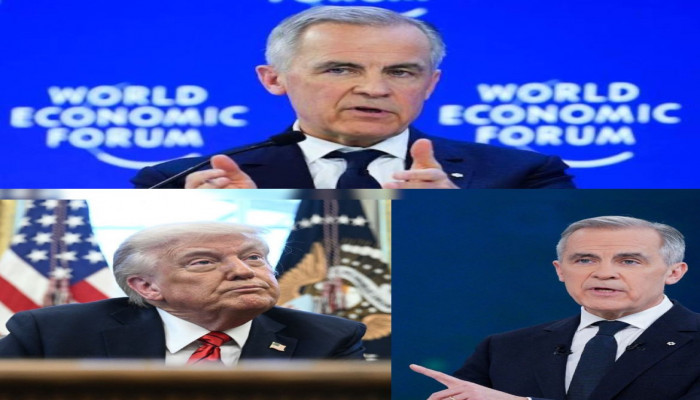
As global leaders gathered in the Swiss Alps for the World Economic Forum in Davos, Canadian Prime Minister Mark Carney delivered a powerful and unsettling assessment of the current international system. In a speech that quickly drew global attention, Carney declared that the era of an American-led global order has effectively ended and warned that the long-promoted rules-based international system was deeply flawed.
Speaking bluntly, Carney said the world is not experiencing a gradual change but a serious break from the past. “Let me be direct. We are in the midst of a rupture, not a transition,” he said. “The old order is not coming back.”
Without directly naming the United States or President Donald Trump, Carney clearly pointed toward American dominance, arguing that the assumptions behind the global rules-based order no longer hold true. According to him, the idea that global integration would always benefit all countries equally was never fully honest.
“We knew the story of the international rules-based order was partially false,” Carney said. “That the strongest would exempt themselves when convenient. That trade rules were enforced asymmetrically. This fiction was useful — and American hegemony in particular helped provide public goods. But this bargain no longer works.”
Carney said that recent crises — including financial instability, global health emergencies, energy disruptions, and geopolitical conflicts — have exposed the risks of deep global interdependence. He warned that powerful countries are now turning economic cooperation into a weapon.
“Great powers have begun using economic integration as weapons,” he said. “Tariffs as leverage. Financial infrastructure as coercion. Supply chains as vulnerabilities to be exploited.”
According to Carney, this shift has serious consequences for countries like Canada. He said that long-standing beliefs that geography, alliances, and integration alone would ensure prosperity and security are no longer reliable.
“You cannot live within the lie of mutual benefit through integration when integration becomes the source of your subordination,” the Canadian Prime Minister warned.
Carney stressed that Canada must now rethink its strategy. He called for a “principled and pragmatic” approach that focuses on strengthening domestic capabilities while also diversifying trade relationships to reduce dependence on any single country. He also acknowledged that global institutions such as the World Trade Organisation and the United Nations have been weakened, forcing nations to act more independently than before.
“A country that cannot feed itself, fuel itself or defend itself has few options,” Carney said. “When the rules no longer protect you, you must protect yourself.”
At the same time, Carney cautioned against turning the world into isolated fortresses. He warned that such a future would make nations poorer and more fragile. Instead, he urged middle powers to work together and form flexible coalitions with like-minded countries.
“If you are not at the table, you are on the menu,” he said.
In his closing remarks, Carney rejected any nostalgia for the past global order. “The old order is not coming back. We should not mourn it,” he said. “From the fracture, we can build something better, stronger and more just. This is the task of the middle powers, the countries that have the most to lose from a world of fortresses and most to gain from genuine cooperation.”
Carney’s remarks were echoed by European leaders, who also used the Davos platform to criticise what they described as President Trump’s “new colonialism.” The comments came amid growing concern in Europe over Trump’s repeated statements about taking control of Greenland, a vast and resource-rich Arctic island that is an autonomous territory within the Kingdom of Denmark.
French President Emmanuel Macron strongly condemned what he described as bullying behaviour and a clear disregard for international norms. Speaking at Davos, Macron said that France and Europe would not accept a world governed by brute force.
France and Europe will not “passively accept the law of the strongest,” Macron said.
He warned that the current moment was “not a time for new imperialism or new colonialism” and criticised what he called the “useless aggressivity” behind Trump’s threats to impose tariffs on countries opposing a US takeover of Greenland.
“We do prefer respect to bullies. And we do prefer rule of law to brutality,” Macron said, hours after Trump threatened to impose a 200% tariff on French wines and publicly shared private messages from the French President.
Macron accused the United States of seeking to “weaken and subordinate Europe” by demanding “maximum concessions” and using trade penalties as pressure tools. He described such actions as “fundamentally unacceptable — even more so when they are used as leverage against territorial sovereignty.”
President Trump has intensified his rhetoric in recent weeks, declaring that the United States would acquire Greenland “one way or the other,” and insisting that there “can be no going back” on this objective. Trump is expected to attend the Davos forum and deliver a speech later today, adding further anticipation to an already tense global gathering.



 Loading...please wait
Comments