




Robert E Hall, Michael Woodford win 2026 Nobel Prize in Economics
- In Reports
- 07:58 PM, Oct 12, 2026
- Myind Staff
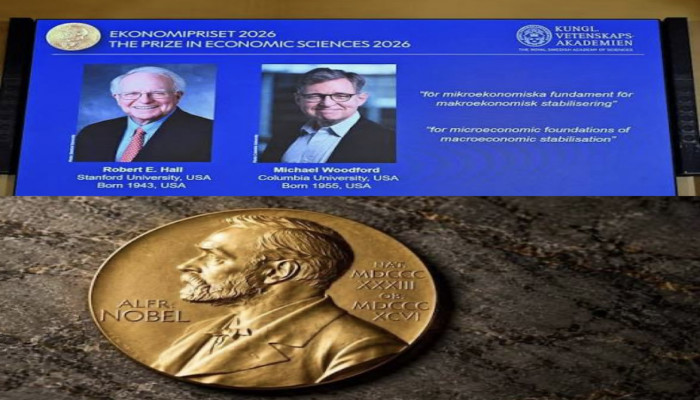
Two US economists, Robert Hall of Stanford University in California and Michael Woodford of Columbia University in New York, have won the 2026 Nobel Prize in Economics for developing models that help governments and central banks stabilise economies, prevent prolonged recessions and control inflation.
The Royal Swedish Academy of Sciences recognised the economists for developing the “microeconomic foundations of macroeconomic stabilisation”. The award carries a combined prize money of $1.2 million (£900,000). The academy said their work marked “a paradigm shift in stabilisation policy”.
Their research led to the development of New Keynesian models, which help policymakers measure how economic policies influence business cycles. Central banks and finance ministries worldwide now use these models to guide their decisions.
The models improved on the stabilisation frameworks developed by economist John Maynard Keynes. His models struggled to explain the oil shock of the 1970s, when countries faced high inflation, weak economic growth and rising unemployment simultaneously.
Hall introduced a framework based on how consumers make decisions by anticipating future economic conditions. This approach moved beyond the traditional rules of thumb linking inflation, unemployment and gross domestic product (GDP). Woodford expanded this research to develop the New Keynesian model, which now serves as a key tool for economic policymakers.
After the 2008 financial crisis, policymakers relied on these models to help steer the global economy away from the threat of a second Great Depression.
“The laureates’ work has provided us with a stable theoretical foundation for the models that are now used by central banks and governments around the world. With them, we are better equipped to deal with shocks in the economy, such as energy crises or sudden changes in how much households consume,” John Hassler, the chair of the committee for the economics prize, said.
Their research also contributed to forward guidance, a policy through which central banks communicate their expectations for future interest rates. The approach gained importance after the 2008 financial crisis and the Covid pandemic, when central banks cut rates to record lows.
However, forward guidance has faced criticism. Current US Federal Reserve chair Kevin Warsh has argued that it should have only a “limited and circumscribed” role during normal times to avoid “creating ambiguity in the name of clarity”. In 2014, then Bank of England governor Mark Carney was dubbed an “unreliable boyfriend” after signalling possible interest rate increases that never materialised.
Woodford expressed his delight after learning about the award. “It’s a tremendous honour. It’s a surprise, but I’m feeling very good about it,” he told reporters in Stockholm by phone.
Hall also coined the distinction between “fresh water” and “salt water” economists in the United States. Fresh water economists, often based at inland universities near the Great Lakes, favour free markets, neoclassical price theory, rational expectations and monetarism. Salt water economists, based at coastal institutions such as Harvard, MIT, UC Berkeley, Yale, Princeton, UCLA and Columbia, generally support Keynesian and New Keynesian approaches, which emphasise the role of governments and central banks in influencing economic demand.



 Loading...please wait
Comments