




Revised NCERT Class IX book to include Ram Rajya, Upanishads, Sengol, Mahabharata
- In Reports
- 06:12 PM, Sep 30, 2026
- Myind Staff
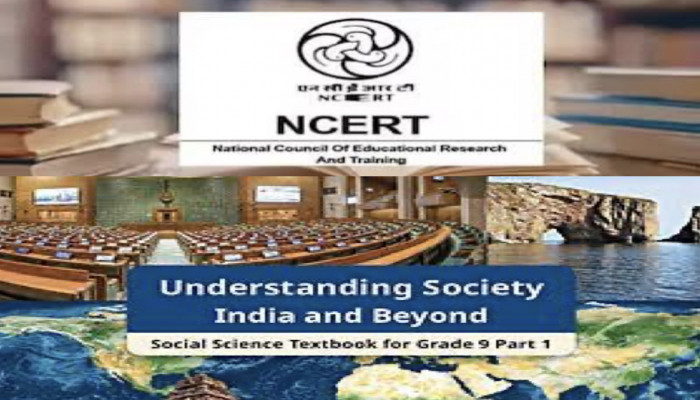
The revised NCERT Class IX Social Science book traces the historical roots of governance in India, linking modern institutions with ideas from the Ramayana, Mahabharata, Upanishads and the Chola tradition. The book, Understanding Society: India and the Beyond, was released on Monday.
Chapter 4, titled “Governance and Public Policy”, examines the evolution of governance in India. It explains how the country’s system has been shaped by its colonial legacy while retaining several traditional Indian ideas and practices.
The chapter notes that India, like other societies that experienced colonial rule, carries the legacy of colonialism. However, it says India has preserved much of its knowledge of pre-colonial institutions and traditions of governance through texts and practices. “The leaders of independent India therefore framed the Constitution in the spirit of India's own values and ideals,” the book says.
The chapter highlights Mahatma Gandhi’s vision of Ram Rajya and describes it as an example of good governance. It says, “Gandhi's views on Ram Rajya reflect the collective imagination of Indians, from their distant past to the present day, that Ram Rajya is one of the best examples of good governance and a good collective life, as enshrined in the Ramayana and the sixteenth-century text of Ramcharitmanas.”
According to the book, Ram Rajya is based on “probity, transparency, compassion, welfare, and people-centric orientation in governance and public policy.” It also examines the influence of the Mahabharata on ideas of governance in modern India.
The chapter states, “From the Vedic period to the Ramayana and the Mahbharata, Indian tradition has consistently viewed governance as a sacred responsibility rather than merely a means of exercising power.” It adds that good governance was judged by peace, prosperity, justice and the well-being of society, rather than only by the authority of the ruler.
The book also highlights how traditional texts have influenced institutional symbols in independent India. India’s national motto, “Satyameva Jayate”, comes from the Mundaka Upanishad. The Supreme Court’s motto, “Yato Dharmas Tato Jayah”, is taken from the Mahabharata.
The chapter contrasts these with colonial-era references. “Since Independence, Indian institutions have continued to draw upon traditional ideas and values of governance and have adapted them to the needs of a modern democracy.” It notes that the British ‘Order of the Star of India’ used the motto, ‘Heaven's Light, Our Guide’, while independent India adopted “Satyameva Jayate” from the Mundaka Upanishad.
The book says the Supreme Court adopted “Yato Dharmastato Jayah”, meaning “Where there is Dharma (righteous duty), there is victory.” It states, “These changes are not just symbolic or superficial. They signify the core values and ideals of our institutions, which have been entrusted with the responsibility of ensuring good governance.”
The chapter also discusses the Sengol, which Prime Minister Narendra Modi placed in the new Parliament building in 2023. The book describes it as “a cultural marker of rulership and good governance” and traces its tradition to the Chola dynasty more than a thousand years ago.
It further states that Jawaharlal Nehru received the Sengol from Adheenam Saints of Tamil Nadu at the time of India’s Independence. “To mark the occasion of India's Independence, at the stroke of midnight on 15 August 1947, the first Prime Minister, Jawaharlal Nehru, received the Sengol from the Adheenam Saints (an old Shaivite tradition) of Tamil Nadu,” the book says.



 Loading...please wait
Comments