




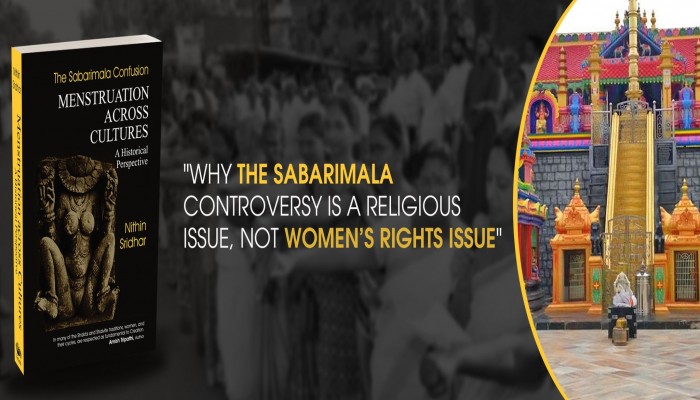
Review of ‘The Sabarimala Confusion: Menstruation Across Cultures: A Historical Perspective’ by Nithin Sridhar
- In Book Reviews
- 12:14 PM, Jan 23, 2020
- Aditi Banerjee
I remember one summer when my grandmother was visiting us in Chicago, we were watching an afternoon soap opera together and a commercial came on for a sanitary napkin. As they always do in these kinds of ads, a pitcher of blue fluid was being poured into the napkin to show off its absorbency. My grandmother wrinkled her nose in disgust. “What’s the need of showing such things publicly?” These things should be addressed in private, was her thinking, and is not meant for general broadcast.
My friends and I felt the same reticence when we could not go to the temple or for some puja suddenly because we were having our periods. We would say it as discreetly as we could without saying it. Those from the old world would understand immediately without explicit discussion. Bodily functions even now are not the subject of polite conversation. However, they have become the subject of strident political activism.
I wonder now what my grandmother would make of all the hullabaloo around things like the free bleeding movement (where one intentionally menstruates in public without a sanitary napkin or other collection device, proudly showing off the resulting bloodstains) or the controversy around temple entry to Sabarimala. I think she would feel an intuitive aversion to airing in public things dealt with at home through tradition, consultations with elders, acharyas and the family gurus, and common sense. One thing is clear, though. Whether or not we wish to partake in this public discourse, it is taking place with or without us. We cannot choose silence.
It is in this context that Nithin Sridhar’s book, The Sabarimala Confusion: Menstruation Across Cultures: A Historical Perspective, is so important and groundbreaking. The first thing that Sridhar has to be commended for is having the courage to write this book about a topic that so many of us still find taboo. The old system of traditional knowledge sharing through family gurus and elders is rapidly dissipating and these practical aspects of everyday life have to be addressed openly and forthrightly, without shame or prudishness. In fact, that prudishness was never there in ancient times. The Mahabharata quite explicitly describes Draupadi’s state in menstruation at the time of her disrobing and how she proudly wore that bloodstained piece of cloth when the Pandavas left for exile after having lost the dice game and the rematch.
While those who protest traditional Hindu restrictions around menstruation are vocal in public, there has been a deafening silence from the traditional Hindu side. There has been little said by acharyas and gurus on this topic and a reluctance to engage. Fortunately, Nithin Sridhar has not hesitated to step into the fray. No one has been more proactive than Sridhar in filling this vacuum, speaking and writing on behalf of traditional Hinduism without compromise, dilution or apology.
There are several remarkable aspects to the Sabarimala book that must be commended. First, it tackles a sensitive issue in a forthright manner, wading into waters that other traditional Hindus have veered away from. The book is exhaustively researched and a comprehensive primer on Hindu views on menstruation – not only providing a plenitude of citations and quotes from the shastras but also delving into local traditions and customs across the breadth of India from a historical and contemporary perspective. Moreover, Sridhar does not gloss over issues that may cause discomfort or unease from a politically correct view or compromise in any way his explanation of orthodox Hindu views on ritual purity and menstruation. This again is refreshing at a time when Hindus generally are willfully ignorant of their own tradition or try to whitewash our ancient rites and customs to pander to SJW visions of the world.
These qualities themselves make is a valuable book for any Hindu library. But what makes this even more relevant of a book is its drawing upon global traditions and views of menstruation to generate further insights on the Hindu approach to menstruation in a global context. This kind of comparative research is something we need to do more of, and this is a good example of how to do it.
Ultimately, Sridhar succeeds in what I believe to be the core mission of this book – he lays out a convincing case for why traditional Hindu norms on menstruation are relevant and worthy of being honored today and effectively rebuts a lot of the sloganeering taking place nowadays about how such customs are patriarchal or disempowering for women. This is a book that every Hindu and every person interested in Hinduism should read to understand in-depth the Hindu treatment of menstruation and to understand a traditional Hindu perspective on why it is important to preserve these traditions.
While Sridhar’s book was written a few years ago, this issue is of growing importance as traditional temple practices are more and more under attach. My hope is that Sridhar will continue his research and writing on this topic. One area of interest that I believe would help strengthen the cause espoused in this book is to collate and share direct personal experiences from women on how Hindu practices around menstruation have actually positively impacted them.
In my own continuing journey of sadhana, I have learned so much about how menstruation affects my psyche and physique and how these traditional practices have given me the rest, healing, detoxification and strengthening I need for my wellbeing and my spiritual practice. While I have sometimes missed out on festivals or temple pilgrimages, I have also experienced for myself how being in the state of menstruation can heighten one’s energies so that manasika japa or meditation without using ritual implements can be orders of magnitude more powerful than at other times. Many women hate their periods and take hormonal birth control to skip them; I have learned to be grateful for the natural monthly cycles that we women go through because, when properly understood, it is not a curse but rather a blessing and even a benefit to sadhana if one understands how to harness and channel these energies and cycles. I have never felt lesser or like a pariah from any of these practices – it has only increased my reverence of our rishis who had such nuanced understanding of the subtle and gross impact of such things and how best to structure around them for optimizing the right balance of vrttis and energies for the individual, for sacred sites and for society in general.
Coming back to my grandmother, I do think she was onto something about the ultimate privacy of menstruation. Ultimately, it is a matter between a woman and her guru, her doctor, her family and her own swadharma on menstruation practices. The shastras were never meant to be absolute on such matters but rather customized and adapted according to time, place and circumstance as well as the individual. That is not the same thing, however, as pandering to social trends of the day for the sake of being feminist or under the guise of equal rights or out of one’s preferences. The starting point always has to be dharma as espoused by our shastras and acharyas, with proper understanding and shraddha, and an understanding that comes not just from the intellect but through sadhana and direct experience under the guidance of a guru. Sridhar’s book is a must for so many Hindus who have become so alienated from their own heritage that they lack the starting point of what our shastras, acharyas and thousands of years of wisdom and experience have taught us. It is my hope that many more will read and become educated by it.
Menustration Across Cultures: A Historical Perspective has been published by Vitasta Publication and is available for purchase from Amazon-https://www.amazon.com/Sabarimala-Confusion-Menstruation-Historical-Perspective/dp/9386473461
Image credits: Vitasta Publishing



 Loading...please wait
Comments