



Reverse Migration Calls for A Labour-Oriented Economic Restructuring
- In Society
- 05:02 PM, Jun 15, 2020
- Niraj Pareek
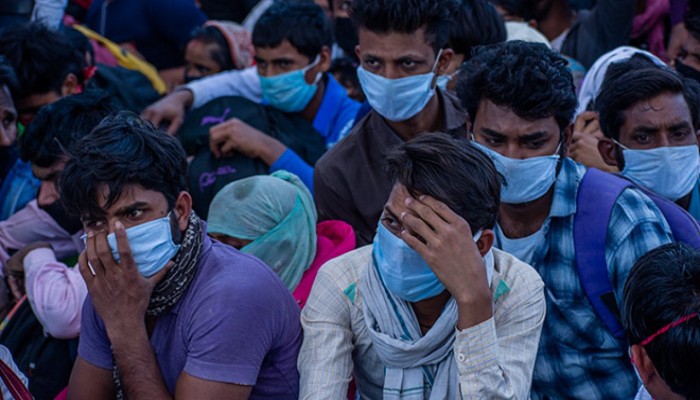
Growing up in the Nineties, there used to be a very popular advertisement of Castrol lubricants, where the then national heartthrob Rahul Dravid tells a Cricket enthusiast mechanic that “Mere Bina Match Shuru Nahin Hoga”. The brand Castrol used Rahul Dravid’s image as an ever-dependable batsman without whom the Indian batting line up was incomplete. Needless to say, the advertisement worked well as the messaging was spot on and it is still etched in the memories of that generation. Similarly, a nation as large as India is incomplete without its working class that is the most important cog in the economy. It is these very people who if properly tallied will make the largest chunk in terms of numbers after the farmers. In fact in a fast urbanized scenario, they just might overtake even the farmers in a few years. The focus of my essay is the large scale migrant labour which has been painfully going back to their natives in these extraordinary circumstances. The saying that India lives in its villages is playing out before our eyes and we as a nation are seeing what has never been witnessed before.
Normally it is the most enterprising people who migrate in search of better opportunities. The people going back to their natives are without doubt hardworking as it takes courage to get out the comfort zones and live in challenging conditions for the sake of a better tomorrow for one’s family. It is expected that they will not like to sit idle for long and will look to either go back to the cities and the ones who decide to stay back will very soon start working on some or the other economic activity.
With the onset on monsoons anytime soon, the duration of stay by our migrant population is set to be prolonged at least beyond the Diwali and Chhath festival season. This will also coincide with the harvest season. Since many of them will look to plough their fields after many years, the total cultivated area should be the highest in a long time. The predictions of a normal monsoon must be all the more motivation for many to leave aside their tools and get hold of their ploughs.
One of the major reasons for the large-scale migration to the cities has been the imbalance in major facilities such as health, education, transportation and job opportunities. Though, there has been a sea change in the rural infrastructure space off late, this sudden rise in the population of village will lead to enhanced economic activities that should lead to an increase in demand and hence further improvements can be expected.
A common grouse in the villages in the last decade was the unavailability of labour force to work in the farms. On the other hand, no one is deprived of opportunities and there has been a steady rise in the wage rates in the last decade. The start of MNREGA changed the contours of labour availability and this has had both positive and negative impacts. Even today, there is enough work available in the villages all year round and this will be helpful now that there will be plenty of economic activity taking place. If the local industry can absorb a chunk of these migrant workers, this can be a win-win scenario for all. Intra-state migration will now take precedence over inter-state migration. With the start of universal health care, energy access to all and other empowerment schemes might just lure many of them to stay back in the villages.
Keeping the large scale reverse migration, the government has almost doubled the MNREGA outlay, which means that there will be a massive infusion of money in the villages. If utilized productively, it could go a long way in achieving the aim of doubling farmers’ incomes as the prime focus should be on creating sustainable assets such as water bodies and tanks for storage and ground water recharging. With so many people going back to their villages, there should be a spike in construction of many new houses or renovations of the old ones in the next few months. The industry is also betting heavily on the demand to pick up during the festival season after an unusually prolonged lull that we are going through.
Once the dust settles down over the issue and the spike in infections is brought under control, which is when the business owners (MSME) and the large scale manufacturers will start feeling the punch. It is these job creators who will stand to lose the most. And if the job creators get destroyed in this tsunami sized downturn, it will take a long while for the economy to get back on its feet. The reason why I feel so is that being a welfare oriented country, there are far more options for the “Shramiks” when compared to the small business owners and even the large corporations. And this is not in any way trying to belittle their struggle, but more of an acknowledgement of their tenacity and resilience to overcome shocks.
Each state will have different problems. The more industrialized will feel the shortage of labour and this means, the labour that remains there will be high demand. There are already few states that are planning a slew of measures to bring back the ones who left recently. States such as UP and Bihar on the other hand will face a problem of plenty. We will have to learn to live with extra working hours as factory owners, especially the MSME’s are already stretched in terms of funds and the backlog of production orders will be difficult in these times when a large chunk of workforce will be absent. How many companies survive this phase will be critical for all stakeholders. Whatever may be the case, one thing for sure is that the issue of migrant workers will remain in the limelight till the next general elections.
There will be mass scale shutdowns and closures in industries which are unlikely to recover in the short and medium term. The start-up bubble is also expected to burst with investors being jittery and paucity of capital will mean that the focus of the investors will be more towards saving their existing investments rather than funding new ones. Frugality will be the new normal. The austerity measures by the government and large industries will also be felt far and wide. Social security measures such as insurance, hygienic working conditions, safety from health hazards and various measures will have to be provided. A proper database (through Aadhar numbers) will have to be maintained to mitigate such mishaps in the future.
One of the greatest thinkers of his time, Dattopant Thengadi had opposed and preferred self-employment against wage employment. However in this phase of rebuilding, we as a nation will require both self-employment and salaried-employment. Another prophetic idea of his which could not have been more relevant in these testing times is that instead of a capital-oriented economic structure, the country needs a labour-oriented economic structure.
Image credits: ORF Online



 Loading...please wait
Comments