




Respected Bhagwatji, Your Definition Is Not Mine: A Bharatiya Hindu response to New York Address
- In Current Affairs
- 11:29 PM, Aug 31, 2026
- YagnaSri
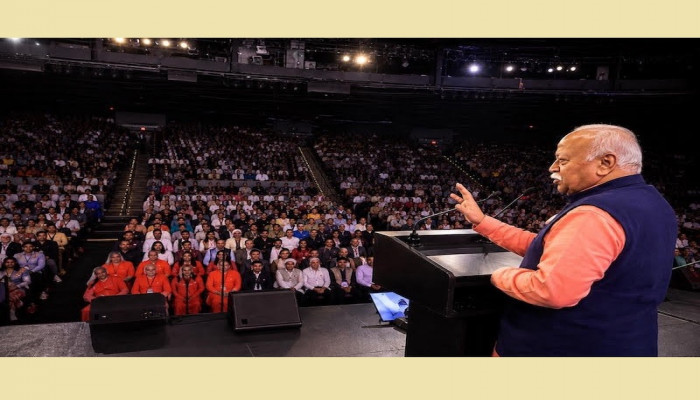
Rashtriya Swayamsevak Sangh Sarsanghchalak Dr Mohan Bhagwat has just concluded a high-profile leg of the Sangh's centenary-year global outreach, addressing the “One World, One Humanity” faith leaders' conference organised by the World Council of Religious Leaders in Manhattan, and separately the Universal Oneness Celebration before several thousand members of the Hindu diaspora from India at Madison Square Garden. The keynote address was delivered at the World Council of Religious Leaders venue on Avenue of the Americas in New York on August 29, 2026, as part of a three-nation outreach tour covering the United States, Canada and the United Kingdom timed to the Sangh's hundredth year.
The speech has been reported, understandably, as a moment of reassurance, a gentle, statesmanlike message to an anxious world. Bhagwat told the gathering that a person who believes Muslims should have no place in the country would cease to be a Hindu, recounting that Muslims had once asked him during a dialogue whether the RSS's vision of a Hindu Rashtra meant they would eventually be driven out. He said all paths lead to the same goal, that every human being possesses equal dignity, and that there is no difference between human beings. He described diversity as a decoration that sits upon an underlying unity, something to be accepted, respected and protected, in the same way one protects one's own particular nature. To the diaspora, he added that Bharatiya-Americans must be loyal first to their karmabhumi, their land of work, and only afterwards, never as an obligation, turn their attention to their janmabhumi, their land of birth.
Read in isolation, on a stage built for interfaith goodwill, none of this is objectionable. It is, in fact, the kind of statement that will earn Dr Bhagwat generous press abroad and a further round of “RSS chief moderates Hindutva” headlines at home. But civilisational and political questions cannot be answered from a podium built for goodwill alone. They have to be tested against history, against the lived experience of the Hindu community over the hundreds of years of history and particularly the last hundred years of so-called leaders like Gandhi and Nehru from their community failing to do their duty, and against the textual tradition that the RSS chief invokes but, by his own admission, does not claim mastery over. Tested that way, this address deserves a considerably more sceptical reading than it has received.
An Authority Problem, Honestly Acknowledged
It is worth starting with something Dr Bhagwat himself said, and that has gone largely unremarked in the coverage: he told his audience plainly that he is not a religious scholar or a religious authority, but someone working in society. This is a rare moment of candour, and it deserves to be taken at face value rather than brushed aside as modesty.
If Hindu Dharma is Sanatana Dharma and the RSS's own literature insists that it is, then pronouncements on what a Hindu must believe to remain a Hindu are, definitionally, pronouncements about doctrine. Doctrine of this kind is properly grounded in the Vedas, the Upanishads, the Dharmashastras, and the accumulated commentarial traditions built on them over unknown numbers of millennia. It is not something that an inspirational address can settle, however elegantly delivered, from the head of what is, by its own constitution and self-description, a cultural and organisational body rather than a religious pontificate. The RSS has done immense service in cultural consolidation, discipline and social work. That is a different function from theological adjudication. Abstract aphorisms borrowed from the Upanishads make for moving oratory; they do not, by themselves, constitute real-world policy, and they certainly do not settle contested questions of doctrine on behalf of a billion Hindus who never delegated that authority to any RSS chief or anyone else.
The Ghost of Gandhi in the Room
The uncomfortable comparison that suggests itself is to Mahatma Gandhi, and it needs to be made explicitly rather than left implicit. Gandhi, too, spoke in the vocabulary of universal brotherhood, unilateral goodwill and the essential unity of all faiths. Gandhi, too, counselled Hindus toward accommodation and restraint at the precise moments- Khilafat, Direct Action Day, Partition, Noakhali when organised violence was being visited upon them. The consequences of that approach are not a matter of dispute among serious historians: the largest forced migration in human history, communal massacres on a scale that still defies an honest official count, and a truncated nation whose eastern and western wings were built on the explicit premise that Hindus and Muslims constituted two separate nations who could not live under one constitution.
Hindus did not invent that premise, the two-nation theory. The Muslim League asserted it as the basis for Partition, and the claim resurfaces, in different registers, whenever separatist movements in the Kashmir Valley or communal mobilisation elsewhere in the subcontinent invoke a distinct national and religious identity incompatible with a shared, syncretic “Bharat.” A speech that speaks movingly of unity in diversity, without reckoning with the fact that one side of that historical bargain has repeatedly walked away from it, is not analysis. It is, respectfully, closer to the same category of well-intentioned abstraction that cost Hindus so dearly in the twentieth century.
What “Unity in Diversity” Has to Explain
The RSS chief's speech asked Hindus to protect, accept and respect diversity as the decoration of an underlying unity. A fair question follows immediately: protect diversity where, and for whom? The forced exodus of nearly the entire Kashmiri Pandit community from the Valley in 1990, at gunpoint and under placards naming individuals for elimination, is not ancient history; it is within living memory of people still alive today, still displaced, still waiting for rehabilitation. The near-total disappearance of Hindu and Sikh minorities from Pakistan since 1947, and the documented, continuing shrinkage of the Hindu population of Bangladesh through forced conversion, abduction, land-grabbing and mob violence against temples, are not contested facts they are the very reasons Parliament enacted the Citizenship (Amendment) Act, explicitly naming Pakistan, Bangladesh and Afghanistan as states where religious minorities, including Hindus, Sikhs, Buddhists, Jains and Christians, face persecution serious enough to warrant an expedited path to Bharat citizenship.
If Dr Bhagwat's logic that a Hindu who wishes to exclude another faith from full belonging ceases to be a Hindu is a universal principle rather than a one-way instruction addressed only to the majority community in Bharat, it ought to travel across the border. Will the RSS chief say, with equal clarity and on an equally prominent stage, that Pakistan's constitutional bar on non-Muslims holding the offices of President or Prime Minister is incompatible with the “unity in diversity” he commends? Will he say that Bangladesh's pattern of temple demolitions and abduction-conversions of Hindu girls is the mirror image of the exclusion he warns Hindus against? If the answer is silence, then what has been articulated is not a universal ethic but a unilateral disarmament: a demand that only the community already on the defensive lower its guard. In contrast, the community carrying out the persecution faces no comparable call to introspection. A peace process conducted from only one side of the table is not peace. It is capitulation dressed in Sanskrit.
The same asymmetry applies to illegal immigration. If diversity is to be protected and every human being accorded equal dignity regardless of the path he follows, does that extend to indefinite, undocumented settlement by illegal migrants from Bangladesh across Bharat's eastern states, an issue that has visibly altered demography in parts of Assam, West Bengal and elsewhere, and that the RSS's own affiliates have, at other times and other platforms, treated as a serious security and cultural concern? A framework of hospitality that cannot distinguish between a persecuted refugee seeking shelter and unchecked illegal settlement altering the demographic character of border states is not hospitality. It is an abdication of the state's basic duty to its citizens.
Love Jihad, Conversion, and the Limits of “All Paths Lead to God”
The proposition that all religious paths lead to the same divine goal is defensible within a certain register of Vedantic philosophy, addressed to a seeker who has already chosen a path and wants reassurance that other seekers, on other paths, are not thereby damned. It was never meant, in the tradition from which it is drawn, as an argument for religious indifferentism in the face of active, organised, and often coercive efforts at conversion.
Here the choice of scriptural anchor matters more than casual citation allows. The famous line “Ekam Sat Vipra Bahudha Vadanti,” “Truth is one, the wise call it by many names,” is routinely quoted, including in Dr Bhagwat's own tradition of address, as a universal warrant for treating all religions as interchangeable. The word Sat mentioned in this sentence is not even remotely applicable to any Abrahamic God or any religious ideas of Abrahamic religions. It is Pure Being; absolute, unchangeable reality. For example, the Nasadeya Suktam says Rigveda 10.129) contemplates the primal state before creation: “Nāsadāsīn no sadāsīt tadānīm... meaning “Neither non-existence [Asat] nor existence [Sat] was there at that time...” and the The Chandogya Upanishad features the discourse between Sage Uddalaka Aruni and his son Svetaketu: “Sadeva somyedam agra āsīd ekam evādvitīyam” meaning “In the beginning, my dear, there was only Sat [Pure Being], One without a second”. Further more the word actually used in the verse is not “the wise” in some generic sense; it is “Vipra” a term with a specific and narrow referent in the Vedic corpus, denoting one who is learned in the Vedas, who has undergone the discipline of Vedic study. The famous sloka “Janmanā jāyate śūdraḥ saṃskārād dvija ucyate Vedapāṭhād bhaved vipraḥ brahma jānāti brāhmaṇaḥ” is well known. It cannot honestly be stretched to cover every claimant to religious truth regardless of tradition, method or textual basis. To universalise a verse addressed to Vedic knowers into a blanket endorsement of theological equivalence across all faiths, including faiths whose own doctrine explicitly denies the validity of every other path, is a mistranslation dressed up as tolerance.
This asymmetry is precisely the problem. Bharat today faces organised, funded and, in numerous documented cases, coercive conversion activity through inducement, through what has come to be called “Love Jihad” and other kinds of Jihads in public discourse, and through foreign-funded missionary networks operating in tribal and economically vulnerable areas. These are not phantom concerns; they are the subject of state legislation in multiple Bharatiya states and of repeated observations by Bharat's own courts. A civilisational message that all paths lead equally to God, delivered without qualification to a global audience, offers no resources with which a Hindu community under active demographic and doctrinal pressure can resist that pressure. It counsels equanimity to the side being converted and says nothing at all to the side doing the converting.
As for the sloka “Ayaṁ nijaḥ paro veti gaṇanā laghucetasām Udāracaritānāṁ tu vasudhaiva kuṭumbakam” from the Maha Upanishad, it means “This person is mine, and that person is a stranger is the calculation of the narrow-minded. For those of noble character/magnanimous hearts, the entire world is but one family”. These are noble words of the Upanishads, not for formulating policy in the real world. In fact, the same words are used in the Hitopadesha and Panchatantra once by the Jackal, who wants to cheat the deer and eat it. He succeeds by using these words.
In Panchatantra, the stupid brahmins use these words to ridicule a person advising them not to make a lion alive, as it will eat them if it becomes alive. They went ahead and made the lion alive, and it ate them. In both cases, it shows how noble ideas, taken too literally and out of context, can destroy people and fail in the real world. Therefore, Vasudhaiva Kutumbakam, “the world is one family,” is a beautiful aspiration. It becomes a strategic liability the moment it is invoked as a reason for the party under attack to stand down, while the party doing the attacking faces no such expectation.
The world is not, in fact, one family in practice, however true it may be in metaphysics; treating a metaphysical truth as an operating instruction for a community whose temples are being demolished and whose demographic share has been in continuous decline for over a century is not wisdom. It is naivety with civilisational consequences.
What the Diaspora Message Got Right and Its Limits
It would be less than fair not to note that one part of the New York address deserves genuine credit rather than criticism. Telling Bharatiya-Americans that their first duty is to the country where they live and earn, and that assistance to Bharat is permissible but never obligatory, is an unusually mature and un-self-serving message for a Bharatiya public figure to deliver to an overseas audience; it rebuts, correctly, any suggestion that the diaspora functions as an instrument of Bharatiya state or Sangh interest abroad. It is a standard the RSS chief could usefully hold his own domestic affiliates to as well, on questions of loyalty, dissent and belonging within Bharat itself.
That said, statesmanship on a foreign stage and clarity on the harder questions closer to home are not substitutes for one another. An address that is generous and philosophically elevated in New York, but silent on Kashmir, silent on the asymmetric burden CAA was designed to address, silent on illegal migration, and silent on the organised conversion activity that Hindu society is contending with in real time, has not resolved these questions. It has postponed them, and dressed the postponement in language too elegant to be immediately challenged.
One more thing that is not even merited a passing reference is the question of increasing attacks on Hindus by extreme left-wing, mainstreamed Jihadis, and Evangelical Christian white nationalists. The fact that the Hindu wife of the US Vice President is also not immune to these attacks shows how deep and wide this Hinduphobia is in the US and how it is now a mainstream feature that even the Cabinet Ministers of the US government openly display without any pushback.
What Should Follow
None of this is an argument for hostility toward Muslims or Christians in Bharat, or for the exclusionary vision Dr Bhagwat rightly disavowed. It is an argument for honesty about where the actual pressure lies. Hindu civilisation does not need to be lectured, yet again, on tolerance; it has practised more of it, for longer, under harder conditions, than almost any other civilisation on earth, and has paid a horrendous demographic and territorial price, like countless genocides, for that tolerance that is rarely acknowledged in the very conferences where it is praised for possessing it. What Hindu society needs from its most visible cultural leadership is not another affirmation of universal oneness aimed inward at Hindus alone, but a clear-eyed, reciprocal demand: that the same standard of restraint, of respect for the other's path, and of acceptance of a shared national community be asked, publicly and unambiguously, of those quarters within Bharat and across its borders where it has been most conspicuously absent.
Until that reciprocity is demanded with the same eloquence that graced Madison Square Garden, addresses of this kind, however well received on the international interfaith circuit, will remain at best a partial account of the civilisational challenge Hindus actually face, one that asks the lion to lie down first, and trusts, on faith alone, that the rest of the jungle will follow.
Disclaimer: The opinions expressed within this article are the personal opinions of the author. MyIndMakers is not responsible for the accuracy, completeness, suitability, or validity of any information on this article. All information is provided on an as-is basis. The information, facts or opinions appearing in the article do not reflect the views of MyindMakers and it does not assume any responsibility or liability for the same.



 Loading...please wait
Comments