




Renaissance Moment for Sonar Bangla — Arise, Awake, and Stop Not Till the Goal is Reached
- In Politics
- 10:54 AM, May 05, 2026
- Rudra Dubey
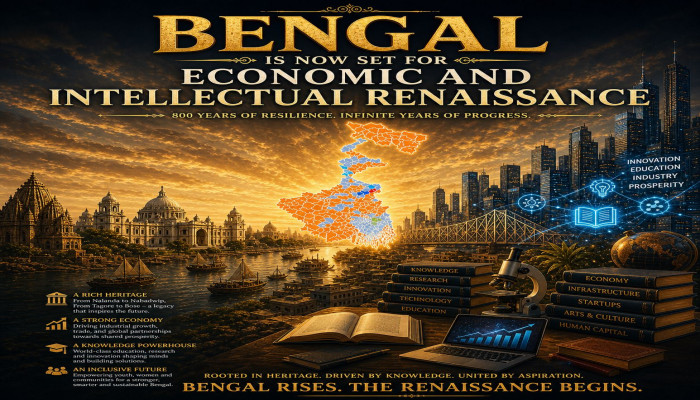
The phrase Sonar Bangla, or Golden Bengal, is neither a sentimental slogan nor a poetic abstraction. It is a historically earned description rooted in Bengal’s civilisational memory. Long before the phrase was immortalised in Rabindranath Tagore’s Amar Sonar Bangla, the region had already emerged as one of South Asia’s most advanced centres of intellect, commerce, and culture. Sonar Bangla signified prosperity, fertility, intellectual breadth, and aesthetic refinement, an integrated social order in which economic vitality, philosophical inquiry, and artistic creativity reinforced one another. Any serious attempt to understand Bengal’s present political and social moment, particularly the transitional phase evident in 2026, must therefore begin with an honest reckoning of why Bengal came to be called golden in the first place.
Historically, Bengal ranked among the wealthiest and most productive regions of the world. During the Mughal period, the Bengal Subah was consistently recorded as one of the empire’s richest provinces, contributing disproportionately to imperial revenues and to India’s substantial share of global GDP, estimated at approximately 24 to 25 per cent in the early modern period (The World Economy: A Millennial Perspective). Bengal’s economy rested not on extractive privilege but on extraordinary levels of commercialisation. Its muslin, silk, indigo, rice, and shipbuilding industries were globally competitive, supplying markets across Europe, Southeast Asia, the Middle East, and East Africa. European travellers of the seventeenth and eighteenth centuries repeatedly described Bengal as both extraordinarily fertile and densely productive, combining agricultural abundance with advanced artisanal specialisation.
Economic historians such as Angus Maddison have shown that India’s global economic prominence during this period was anchored in regions like Bengal, whose per capita output and urban real wages compared favourably with large parts of Southern Europe. François Bernier referred to Bengal as one of the richest regions of the East, while later scholarship confirms that Bengal alone may have generated between one tenth and one sixth of India’s total economic output. Historian Irfan Habib estimates that Bengal produced close to 40 per cent of Mughal imperial revenue despite comprising a smaller share of the empire’s population, clear evidence of its exceptional productivity and market integration (The Agrarian System of Mughal India).
This prosperity was inseparable from geography. The river systems of the Ganges delta created one of the most fertile agricultural landscapes in the world, sustaining intensive rice cultivation, jute production, and a thriving network of inland ports and riverine trade routes. These waterways connected rural production directly to international commerce, lowering transport costs and enabling a scale of trade unmatched in much of the early modern world. It was this structural advantage, not colonial accident, that later made Calcutta the administrative and commercial centre of British India, serving as imperial capital from 1772 to 1911 as a continuation of Bengal’s long-standing centrality.
Living standards in Bengal during the late Mughal period further challenge outdated narratives of pre-colonial stagnation. Research by Paul Bairoch and by Broadberry and his collaborators suggests that real wages in Bengal’s urban centres during the early eighteenth century were comparable to, and in some cases exceeded, those of parts of Southern Europe (The Economic Development of the Third World since 1900; British Economic Growth, 1270–1870). Bengal’s economy was thus neither backward nor isolated, but dynamic, outward-looking, and deeply embedded in global circuits of exchange.
This position unravelled rapidly after the mid-eighteenth century. The Battle of Plassey in 1757 and the subsequent transfer of revenue authority to the British East India Company initiated a dramatic reversal. Colonial governance prioritised fiscal extraction and monopoly control over productive reinvestment. Manufacturing declined as textile producers were displaced by British industrial imports, while land revenue assessments rose to historically unprecedented levels. Dharma Kumar documents instances in which land revenue demands exceeded 50 per cent of agricultural output, pushing rural producers into chronic vulnerability (The Cambridge Economic History of India).
By the late colonial period, Bengal’s relative prosperity had collapsed. Historical income reconstructions by Maddison and others show that by the early to mid-twentieth century, Bengal’s per capita income ranked roughly twenty-fourth among major world regions, a stunning fall from its earlier global standing. The previously integrated manufacturing and trade equilibrium gave way to stagnant agriculture, declining real wages, and systematic underinvestment, while Western Europe and North America surged ahead during the Industrial Revolution.
Yet Bengal’s identity was never defined by material wealth alone. Its most enduring legacy emerged through the Bengal Renaissance, an unparalleled intellectual and cultural awakening spanning the late eighteenth to early twentieth centuries. Often regarded as Asia’s earliest modern renaissance, it transformed social thought, science, literature, and political consciousness far beyond Bengal itself. Luminaries such as Raja Ram Mohan Roy, Ishwar Chandra Vidyasagar, Bankim Chandra Chattopadhyay (Vande Mataram), Swami Vivekananda (address at the Parliament of the World’s Religions), Rabindranath Tagore (Amar Sonar Bangla), Jagadish Chandra Bose, Satyendra Nath Bose (Bose–Einstein statistics), and Meghnad Saha (ionization equation) illustrate a sustained tradition of universal intellectual contribution. Bengal was golden because it cultivated excellence across material, intellectual, and spiritual domains.
This continuity fractured with Partition in 1947. The division of Bengal into East Pakistan and West Bengal was not merely territorial; it severed deeply interdependent economic and cultural systems. Trade routes, labour markets, and industrial supply chains developed over centuries were abruptly dismantled. The influx of millions of refugees imposed immense social and fiscal pressure on West Bengal, while Calcutta, once the capital of an integrated civilisational region, was transformed overnight into a border city.
Post-independence governance struggled under this weight. Congress administrations remained absorbed by refugee rehabilitation and labour unrest. The Left Front’s ascent in 1977 ushered in redistribution and land reforms but coincided with long-term industrial stagnation, capital flight, and the institutionalisation of cadre-driven politics. Over time, Bengal became associated nationally with labour militancy and regulatory unpredictability, eroding its industrial credibility.
The rise of the All India Trinamool Congress in 2011 ended Left dominance but did not reverse structural decline. While welfare programs expanded and selective infrastructure improved, political centralisation intensified. Recruitment controversies, corruption cases, and recurrent political violence entrenched a patronage-driven political economy, further weakening institutional trust.
What Bengal lost during these decades was not only wealth but confidence. Universities and civic institutions grew increasingly politicised. Generations of high-achieving students migrated permanently to Bengaluru, Hyderabad, Pune, and Delhi, normalising the export of human capital rather than its retention. Cultural self-assurance gave way to defensive anxiety, and public life became marked by recurring unrest.
Against this historical backdrop, the ongoing political transition of 2026 carries exceptional weight. As of May 4, 2026, election counting trends indicate a potential regime change unprecedented in recent decades. A Bharatiya Janata Party victory, if confirmed, would represent a democratic rejection of political patterns formed through Congress decline, Left exhaustion, and Trinamool consolidation. It would create a rare opportunity for institutional reset.
Yet no renaissance can be produced by electoral arithmetic alone. Renewal must be built. Bengal’s geography, its ports, rivers, and role as India’s eastern gateway still offer substantial potential if governance, infrastructure, and policy stability align. Kolkata can once again function as a modern maritime and commercial hub rather than a memorial of imperial history.
Education must remain central to this revival. Institutions such as Presidency University, the University of Calcutta, and Jadavpur University require depoliticisation and renewal grounded in merit, research excellence, and global engagement. Bengal’s future lies in advanced manufacturing, biotechnology, artificial intelligence, and digital infrastructure, not nostalgia. Rebuilding institutional trust through transparent recruitment, professional administration, and the rule of law is indispensable.
Culturally, Bengal must reclaim confidence through excellence rather than exclusion. Demographic and border management challenges demand constitutional seriousness, balancing national security with legality and human dignity.
History rarely grants repeated opportunities for renewal. Bengal may now possess one such moment. Sonar Bangla was never created by politics alone. It emerged because society demanded discipline, creativity, knowledge, and courage from itself. The original Bengal Renaissance was not decreed; it was earned.
That remains the challenge today. If Bengal can restore merit over patronage, law over violence, and production over dependency, it can once again claim its place as India’s intellectual and economic crown jewel, not by returning to the past, but by rediscovering what made it golden in the first place.
Not by returning to the past, but by rediscovering what made it golden in the first place.
References
1. Sarkar, Sumit. Calcutta: The Living City, Volume I: The Past. Oxford University Press.
2. Dasgupta, Subrata. The Bengal Renaissance: Identity and Creativity from Rammohun Roy to Rabindranath Tagore. Orient BlackSwan.
3. Kopf, David. The Brahmo Samaj and the Shaping of the Modern Indian Mind. Princeton University Press.
4. Raja Ram Mohan Roy historical record and reform legacy 
5. Rabindranath Tagore and the Bengal Renaissance 
6. Jagadish Chandra Bose scientific contributions 
7. Bengal Renaissance historical overview 
8. Choudhuri, Arnab Rai. “The Golden Age of Calcutta Physics”
Disclaimer: The opinions expressed within this article are the personal opinions of the author. MyIndMakers is not responsible for the accuracy, completeness, suitability, or validity of any information on this article. All information is provided on an as-is basis. The information, facts or opinions appearing in the article do not reflect the views of MyindMakers and it does not assume any responsibility or liability for the same.



 Loading...please wait
Comments