




Reimagining Israeli Relations Through a Civilisational Lens
- In Foreign Policy
- 12:12 PM, Feb 28, 2026
- Ramaharitha Pusarla
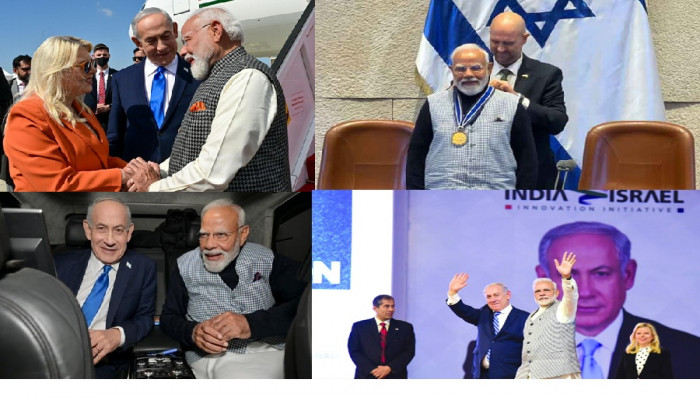
PM Modi embarked on a two-day state visit to Israel on February 25th at the invitation of Israeli counterpart Benjamin Netanyahu, amid the US’s massive deployment of forces in the region. The visit comes nine years after PM Modi set a precedent of becoming the first Indian Prime Minister to visit Israel in 2017. This was followed by a four-day visit of PM Netanyahu to India in February 2018. The High-level back-to-back visits and sustained engagement have energised the relationships and fostered genuine respect between Indians and Israelis to a new high.
The marked upswing in ties was accompanied by an upbeat economic engagement, with bilateral trade reaching a new high of $10.77 billion (excluding defence) in 2022-23, fell to $3.62 billion in 2024-25 due to regional security issues and trade route disruptions. The dastardly October 7 Hamas attacks have fundamentally altered the strategic landscape of the Middle East, ending the illusion of stability. Countries which stood with Israel immediately after the attack started recalibrating their position. As the conflict in Gaza continued, Israel faced partial economic sanctions, an arms embargo and even diplomatic isolation. But Indian engagement with Israel hardly changed. On the contrary, it has intensified and stabilised. India’s long-term defence cooperation remained stable as it continued to import defence supplies from Israel.
As per Stockholm International Peace Research Institute (SIPRI), India is the largest defence importer of Israeli defence equipment, accounting for 34% of sales from 2000-2024, worth $20.5 billion. By 2024, the tactical defence purchases transitioned into a partnership with Israeli companies setting up subsidiaries and joint ventures in India, in tune with the ‘Make in India’. By opening production units in India, Israel seeks to anchor New Delhi as its gateway to Asia and penetrate newer markets. Promoting this mutually beneficial cooperation, countries shifted toward co-production, co-development, and transfer of technology, which is the core of the long-term MoU defence cooperation signed in November 2025. It provided a policy framework for defence industrial cooperation, Science & Technology, AI and cybersecurity.
As India seeks to create an ‘impregnable’ multilayered air defence to thwart Pakistani attacks, India’s appetite for Israeli systems and weapons has increased significantly. Israeli weapons- Harop loitering munitions, SkyStriker drones, Rampage air-to-surface missiles with their precision strikes- gave India an upper hand during Operation Sindoor. As per reports, India is seeking to make $8.6 billion in defence purchases from Israel in 2026. While defence has been the central pillar of the India-Israeli partnership, the strategic convergences are further bringing the nations closer. Both countries have been the worst victims of ideologically motivated terrorism.
Invited to address the special plenary of the Knesset, PM Modi, in a rare honour and a first ever for an Indian Prime Minister, opened his speech by offering deepest condolences of 1.4 billion Indians to the families shattered by the Oct 7 terror attack. Extending solidarity to Israel in the fight against terror, he said, “We feel your pain. We share your grief. India stands with Israel-firmly, with full conviction-in the moment and beyond”. Even as the opposition back in India continued to egg on PM Modi about the Israeli genocide, he reiterated, “No cause can justify the murder of civilians. Nothing can justify terrorism”, underscoring, “terror anywhere threatens peace everywhere”.
India adopts a zero-tolerance policy towards terrorism and has been at the forefront in global fight against terrorism. India and Israel have a longstanding cooperation on terrorism. With reports of Hamas joining hands with Inter-Services Intelligence (ISI) and sharing the stage with Jaish-e- Mohammad (JeM) and Lashkar-e—Toiba (LeT) at a public conference in PoJK, both countries might intensify intelligence sharing and counter terrorism cooperation. Indeed, the 10th meeting of the India-Israel Joint Working Group on Counterterrorism concluded on Feb 24th, ahead of PM Modi’s visit.
Endorsing India’s commitment to fight terror and its support to Israel, PM Netanyahu, in his welcome remarks, stated, “Immediately after the terrible massacre of October 7- you stood clearly, morally firm with Israel.. You did not flinch. You did not waver. You did not give excuses. You stood next to Israel. You stood by Israel. You stood for Israel”. India recognised Israel in 1950 but established diplomatic relations only in 1992. During this period, India actively championed the Palestinian cause but continued to receive Israeli weapons and intelligence support during wars. For the past seven decades, India has been reluctant to come out in the open assertively. It changed with 2017 PM Modi’s visit.
PM Modi’s present visit, coming in the wake of the US-Iran nuclear negotiations of February 6, has turned the region into a powder keg. Unwavered by the regional tensions and the looming threats of military strikes, as a testimony of steady friendship, PM Modi travelled to Israel. Amid geopolitical turbulence, uncertainty and conflict, displaying a rare strategic confidence, PM Modi preferred to ground the partnership in the age-old traditional links. Echoing this in the Knesset speech, redefining his outreach, PM Modi presented himself as a “representative of an ancient civilisation”. Invoking the ancient ties between the Indus Valley and Jordan Valley, insulating the strategic ties from the underlying complex geopolitical tensions, he fostered civilisational alignment.
By reimaging the ties through a civilisational lens, PM Modi completely de-hypenated Indian ties with Israel and Palestine. Political compulsions and shackles of minority appeasement severely constrained India-Israeli relations. Placing the Israeli ties on a civilisation pedestal, Modi scripted a new chapter. This delineation of India-Israeli ties from New Delhi’s commitment to the Palestinian issue will allow the standalone relations to flourish to their full potential. Shattering decades-long ambiguity and reticence through civilisational decoupling, Modi infused a new momentum into the bilateral partnership to thrive on the strength of shared interests and values.
At a time when the West is doubling down on Israel over the humanitarian crisis in Gaza, PM Modi redefined and consolidated ties with Israel on the grounds of civilisational linkages. To this end, PM Modi deliberately avoided any reference to brewing tensions in the region but extended full support to “durable peace and regional stability”. Supportive of the Gaza Peace Initiative, India, which is yet to take a call on joining the Gaza Peace Board, attended the inaugural meeting as an “Observer” ahead of PM Modi’s visit to Israel.
The delineation of India-Israeli relations from the Palestinian cause was in vogue since the Modi government’s first term. With separate and standalone visits, the Prime Minister reoriented India’s policy back in 2017. Firming up this policy, PM Modi is propping up the partnership on the strength of the centuries-old civilisational connection and realism. Afflicted by grandstanding and moral posturing, India faltered for decades. Shunning ambiguity and hesitation, India is now openly courting Israel, whose timely help in crucial times remained underappreciated and unacknowledged.
Exuding clarity and pragmatic dynamism, countries elevated the ties to “A Strategic and Special Partnership for Peace, Innovation and Prosperity through technology and innovation”, setting the stage for a multi-dimensional partnership. With ‘Hugplomacy’ in full display, abounding with friendly gestures and symbolisms, the leaders have restructured the partnership that long deserved a high place.
Symbolism is perceived as tokenism. However, protocol-defying gestures like a warm welcome by the host Prime Minister at the tarmac and send off fortify ties and buffer them from domestic push and pull factors. In recognition of the exceptional contribution and leadership of PM Modi to strengthen bilateral ties, he was conferred the Medal of the Knesset, making him the first ever recipient.
Among the listed 17 outcomes of the visit are MoUs on Cooperation in AI, education, agricultural research, geophysical exploration, development of National Maritime Heritage Complex (NMHC) at Lothal, fisheries and aquaculture, commercial arbitration, financial cooperation and implementation of UPI. Countries signed a Letter of Intent on the establishment of the Indo-Israel Cyber Centre of Excellence in India and exchanged declaration of Intent in the field of Horizon scanning.
India and Israel have been knowledge-driven economies with complementary strengths. Israel is a global powerhouse of technology and innovation. India serves is hub of talent, manufacturing excellence and entrepreneurial energy. Through a synergistic integration, both nations can prosper and succeed. For a futuristic partnership defined by creativity, technology and talent, countries have affirmed collaboration in AI, cybersecurity, semiconductors, quantum computing, biotechnology, agriculture and water management, defence platforms, and space exploration.
Elevating the Joint Commission on Science and Technology to the Ministerial level, countries welcomed India–Israel Financial Dialogue and an initiative on Critical and Emerging Technologies led by the NSAs (National Security Advisors). Having signed the Bilateral Investment Treaty in September 2025, countries signed Terms of Reference (ToR) to commence negotiations on the Free Trade Agreement (FTA) on February 24th. Deepening the people-to-people connection, an additional 50,000 Indian workers would join Israeli sectors within the next five years.
Notorious as a conflict-ridden region, the Middle East is pivotal for global trade, energy security, maritime security and connectivity. Indian interests are closely intertwined with the region in terms of remittances and secured energy flows. Navigating the layered strategic alignments of the region is absolutely essential for India’s economic growth.
The Middle East, which is the centrepiece of the India-Middle East-Europe Economic Corridor (IMEC), now lies at the intersection of India, Israel, the UAE, the US (I2U2) and Mediterranean outreach. In his Knesset address, PM Netanyahu outlined a geopolitical vision to involve India in the “Iron Alliance” of like-minded countries. The envisioned broader “Hexagon Alliance”, a potential axis against extremism, will emerge as an interconnected corridor of trade, technology and maritime security. Putatively comprising India, Israel, Cyprus, Greece, the UAE and Morocco, this informal security network can be a potential alternative to China’s Belt and Road Initiative (BRI).
Tipped to become the third-largest economy by 2030, India is ramping up engagement with diverse partners and exploring a multi-layered engagement with Middle East nations and beyond. Reimaging the ties through the civilisational lens and anchoring in shared historical and ideological affinities, PM Modi adeptly preserved Israeli ties from being consumed by geopolitical and domestic pressures. India has emerged as a new anchor for Israel in this geopolitical landscape. PM Modi’s visit has laid a framework for a forward-looking partnership between two ancient civilisations and modern nations- one that advances “national interests while contributing to global stability and prosperity”.
References
- India - Israel Joint Statement (February 26, 2026)
- As Narendra Modi visits, Israel-India defense cooperation deepens | The Jerusalem Post
- What is ‘Iron Alliance’ & How Does India Fit Into Benjamin Netanyahu’s ‘Hexagon of Alliances’ Plan?
- Press Release_ Press Information Bureau.pdf
- https://www.mea.gov.in/bilateral-documents.htm?dtl/40818/Joint_Statement_of_the_10th_Meeting_of_the_IndiaIsrael_Joint_Working_Group_JWG_on_Counter_Terrorism_CT
- https://www.mea.gov.in/bilateral-documents.htm?dtl/40827/List_of_Outcomes_Visit_of_Prime_Minister_to_Israel_February_25__26_2026



 Loading...please wait
Comments