




Reform After Rupture: The Legislative, Institutional and Technological Response of 2026 — and the Road Ahead Part 6
- In Current Affairs
- 01:13 PM, Aug 03, 2026
- YagnaSri
Immediate Operational Reforms for the Re-conducted Examination
Between the cancellation of the 3 May examination and the re-conducted test on 21 June 2026, the NTA and the Centre implemented a set of intensified, largely Phase-I-style security measures for the re-examination cycle. Question papers were transported under Indian Air Force and state police escort from secure printing facilities directly to district treasuries, with GPS-tracked transit boxes fitted with digital smart-locks openable only through geo-fenced, time-limited one-time passwords generated shortly before distribution at each venue. Venue migration to government infrastructure was pushed further, with over 99.5 of centres hosted in Kendriya Vidyalayas, Navodaya Vidyalayas and government engineering institutions.
Candidates underwent multi-stage Aadhaar-linked facial-recognition and biometric checks at both venue entry and again inside the examination hall; reporting at the time indicated a very large deployment of CCTV cameras feeding a central AI-assisted surveillance unit, alongside an expanded network of 5G signal jammers across examination centres. The total examination duration was extended by fifteen minutes, to 3 hours 15 minutes, to absorb the additional time required for stricter biometric checks and frisking without reducing candidates’ effective writing time. District Collectors and Superintendents of Police were designated personal custodians of examination material within their jurisdictions, and the NTA separately reported the removal or reassignment of several contractual and unvetted officials following internal vigilance review.
These measures address the same category of vulnerability physical custody and candidate-side security at the venue that Phase-I reforms had already targeted since late 2024. They do not, on their own, resolve the Phase-II structural gaps (a permanent workforce, digital paper transmission, and a multi-session examination architecture) identified as the deeper cause of the May 2026 breach, a distinction the government’s own subsequent legislative and institutional responses appear to acknowledge.
The Public Examinations (Prevention of Unfair Means) Amendment Bill, 2026
On 27 July 2026, the Ministry of Personnel, Public Grievances and Pensions introduced the Public Examinations (Prevention of Unfair Means) Amendment Bill, 2026 in the Lok Sabha, amending the Public Examinations (Prevention of Unfair Means) Act, 2024 — the principal central legislation criminalising organised examination malpractice, in force since 21 June 2024, and applicable to examinations conducted by UPSC, the Staff Selection Commission, Railway Recruitment Boards, the Institute of Banking Personnel Selection, the NTA, and other notified central authorities.
The Bill’s principal substantive changes are:
- Enhanced imprisonment for individuals resorting to unfair means: the minimum term rises from not less than three years to not less than five years, with the maximum remaining extendable up to ten years.
- Enhanced fines for individuals: the maximum fine rises from ₹10 lakh to ₹50 lakh.
- Enhanced liability for service providers (private logistics, printing, biometric and IT vendors) found complicit in offences: the maximum fine rises from ₹1 crore to ₹5 crore. The period of debarment from conducting or assisting in any public examination is extended from four years to eight years, with enhanced imprisonment also proposed for the managerial personnel of such service providers.
- Institutional and procedural reforms: provision for Special Task Forces to investigate examination offences, mandatory Special Fast-Track Courts (in consultation with High Courts) to complete trials within three months of chargesheet filing, appointment of Special Public Prosecutors, time-bound disposal of appeals, and a requirement that investigations themselves be completed within two months.
The Bill’s introduction was preceded, on the same day, by a separate and significant development before the Supreme Court: in a hearing on a petition seeking a shift of NEET-UG to computer-based format, the Solicitor General informed the Court that the Centre had constituted a fresh high-powered task force a development with a direct bearing on the future direction of examination reform, addressed below.
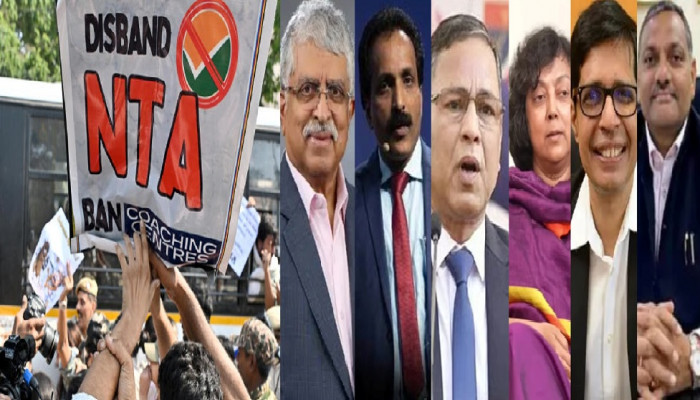
The Nilekani Task Force: The "Next Phase" of Reform
On 26 July 2026, the day after Minister Pradhan’s resignation, the Prime Minister announced a six-member high-powered task force chaired by Nandan Nilekani, co-founder of Infosys and the architect of India’s Aadhaar biometric identity programme, to recommend the next phase of examination reform and, in the government’s own framing before the Supreme Court, to help “future-proof” the NTA. The task force’s other members are former ISRO Chairman S. Somanath, former Intelligence Bureau Director Tapan Deka, IIT Madras Director V. Kamakoti, former Union Education Secretary Anita Karwal, and logistics expert Amrit Lal Meena.
The composition signals a deliberate emphasis on secure digital-infrastructure design (Nilekani’s Aadhaar experience), complex national-security-grade operations management (Somanath’s ISRO background and Deka’s intelligence background), and logistics, precisely the domains implicated in the 2026 supply-chain breach. Hearing a separate petition seeking a shift to computer-based NEET testing, a Supreme Court bench of Justices P.S. Narasimha and Alok Aradhe indicated on 27 July 2026 that it would await the Nilekani task force’s recommendations before ruling on whether NEET-UG should move to an online format, observing that any such transition would require more than a technological upgrade and would need to be backed by demonstrated cybersecurity and database-protection safeguards, and inviting “out-of-the-box” solutions rather than incremental fixes. The matter was posted for further hearing on 3 August 2026.
Separately, in an affidavit filed before the Supreme Court on 29 May 2026 in his capacity as both the original Radhakrishnan committee’s chairman and chairman of the subsequent High-Powered Steering Committee monitoring implementation Dr Radhakrishnan informed the Court that a majority of the 101 original recommendations had by then either been implemented or were under active execution, citing in particular the functioning State- and District-Level Coordination Committees and expanded biometric authentication as evidence of progress, while implicitly leaving open the question of how much of the unfinished Phase-II agenda CPPT, DIGI-EXAM at national scale, the 1,000 permanent testing centres, and the permanent-cadre buildout remained to be completed.
The Announced Transition to Computer-based Testing
Independently of the Nilekani task force’s pending recommendations, the Ministry had already indicated an intention to transition NEET-UG fully to a multi-session Computer-Based Test format from 2027, aligning its administration with the model long used for JEE (Main). Whether, and in what form, that transition proceeds now, per the Supreme Court’s own stated approach, is contingent on the task force’s findings regarding cybersecurity and database protection adequacy. Till then, it is a live and unresolved question rather than a settled administrative decision. It is also worth noting, in fairness to the alternative view, that Parliament’s own 371st Report expressed a preference for strengthening secure pen-and-paper administration, pointing to CBSE’s board examinations and UPSC’s examinations as long-running, largely leak-free paper-based models rather than assuming that digitisation alone resolves examination-integrity risk. The debate over format is therefore best understood not as a simple binary between an insecure paper system and a secure digital one, but as a genuine, still-open policy question about which model, properly resourced and administered, best secures an examination of NEET-UG’s scale.
NEET-UG and JEE (Main): A Comparative Administrative Case Study
Because the same agency conducts both examinations, a comparison of their administration is instructive for understanding what a different institutional design choice can achieve.
|
Feature |
JEE (Main) |
NEET-UG |
|---|---|---|
|
Target courses |
Engineering (B.Tech/B.E./B.Arch) |
Medicine and allied courses (MBBS, BDS, BAMS, BHMS, veterinary) |
|
Exam mode |
Computer-Based Test (CBT), with a pen-and-paper exception for the B. Arch drawing section |
Pen-and-paper (OMR sheet) |
|
Frequency and structure |
Two sessions a year (January and April), each spread across 5–7 days in two daily shifts, with each shift using a distinct question set drawn from an encrypted item bank. |
A single national sitting, once a year |
|
Score comparability |
Raw scores converted to percentile scores per shift and statistically normalised, so a harder or easier shift does not disadvantage candidates; the better of two sessions’ percentiles is used for final ranking. |
A single score from a single sitting; no shift-to-shift normalisation architecture exists because there is only one shift |
|
Resilience to a single-point breach |
Compromise of one shift’s paper affects only that shift’s cohort, which can be locally re-conducted without invalidating the national exercise. |
Compromise of the single master paper places the entire national cohort’s result at risk, as occurred in May 2026 |
The structural lesson is not that computer-based testing is inherently more secure in every respect — a digital examination introduces its own risks around cybersecurity, database integrity and equitable access for candidates in low-connectivity regions, concerns the Supreme Court has itself flagged. It is, rather, a multi-session architecture with statistical normalisation, a design choice independent of whether the underlying mode is paper or digital, that confines the consequences of any single breach to a subset of candidates rather than the entire national cohort. This is precisely the design principle underlying the Radhakrishnan committee’s multi-session/two-stage recommendation for NEET-UG, and it was not implemented by the time of the 2026 breach for reasons of candidate preparedness and short notice, as explained by the Ministry.
The Unresolved Question of Statutory Status
The most far-reaching structural recommendation now on the table repeated with increasing emphasis by Parliament’s Standing Committee across its 371st and 381st Reports, and gaining renewed attention after the 2026 cancellation, is that the NTA be converted from a registered society into a statutory body established by an Act of Parliament, on the model of the UPSC. The case made for this change rests on the institutional analysis set out earlier in this series: a society-form body answering primarily to the executive, staffed almost entirely through deputation and outsourcing, has neither the guaranteed leadership tenure, direct parliamentary accountability, nor the legal standing to build a genuinely permanent, specialised, non-outsourced workforce that its own reviewers have concluded it needs. Converting the NTA into a statutory body would require primary legislation, a materially larger legislative undertaking than the amendment to the 2024 unfair-means Act now before Parliament and, as of the most recent parliamentary and judicial proceedings, remains a recommendation rather than a decision.
Summary: Diagnosis, Delay and a Second Reckoning
Read across this series, the arc of NEET-UG’s administrative history is one in which each successive failure has been followed by a broadly accurate diagnosis from the MCI’s original unification proposal in 2010, through the 2015 AIPMT technology-cheating episode, to the Radhakrishnan committee’s 101 recommendations in 2024 and Parliament’s own independent 371st Report in December 2025 but in which the harder, structural half of each diagnosis (a permanent workforce, digitally secured paper transmission, a multi-session architecture, and durable statutory accountability) has consistently lagged behind the easier, venue-level security half. The events of May 2026 were, on the documentary record examined across this series, an occurrence at precisely the point in the system that had already been identified and prescribed for, eighteen months in advance, and not implemented in time. Whether the Nilekani task force’s forthcoming recommendations, the pending Amendment Bill, and the renewed push for statutory status finally close that gap, or whether, as in 2016 and again in 2024, implementation once more outpaces diagnosis only partially, will be the measure by which the next examination cycle is administratively judged.
The NEET-UG 2026 Paper Leak: Anatomy of a Systemic Administrative Failure Part 5
Disclaimer: The opinions expressed within this article are the personal opinions of the author. MyIndMakers is not responsible for the accuracy, completeness, suitability, or validity of any information on this article. All information is provided on an as-is basis. The information, facts or opinions appearing in the article do not reflect the views of MyindMakers and it does not assume any responsibility or liability for the same.



 Loading...please wait
Comments