




Rare military purge shakes China’s PLA as Xi Jinping tightens control over top command
- In Reports
- 05:24 PM, Jan 30, 2026
- Myind Staff
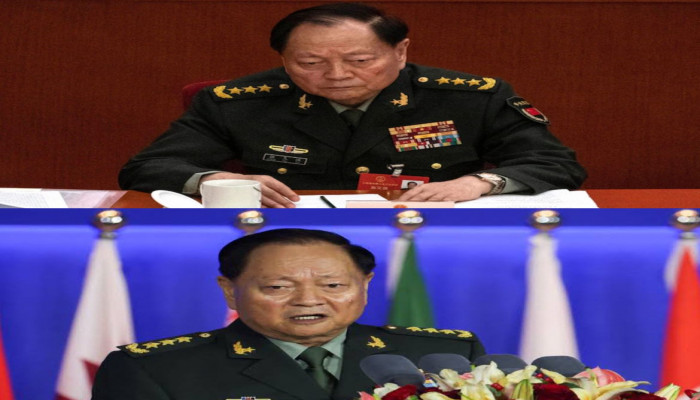
China’s military is facing one of its most serious internal crises in decades as investigations reach the highest levels of the People’s Liberation Army (PLA). The probes against General Zhang Youxia, a trusted ally of President Xi Jinping, and General Liu Zhenli, the PLA’s top operational commander, have exposed deep cracks within the military leadership. Beijing has confirmed that both generals are under investigation for “serious violations of discipline and law,” though no detailed explanations have been provided.
The removal of General Zhang Youxia is especially significant. He was widely seen as Xi Jinping’s closest and most reliable partner within the military. His fall marks a rare break at the very top of the PLA and raises questions about Xi’s grip on the armed forces. Zhang had remained in office beyond the usual retirement age, reportedly because of his strong personal ties with Xi. With his departure, the Central Military Commission (CMC), China’s top military body, has been severely weakened.
In just six months, at least 11 senior commanders have been removed, with nine falling in October alone. Although the government describes the campaign as an anti-corruption drive, many analysts believe it is also aimed at removing potential challengers to Xi’s authority. Over the years, the purge has expanded across the Rocket Force, the defence industry and senior command posts, often linked to corruption in weapons procurement, missile programmes and military readiness.
Experts warn that such large-scale removals could disrupt China’s military modernisation, weaken internal coordination and create short-term vulnerabilities, especially amid rising tensions over Taiwan. The situation has also raised concerns about leadership stability and future succession under Xi.
According to People’s Daily, the official newspaper of the Chinese Communist Party (CCP), the phrase “severely trampled on and undermined the CMC chairman responsibility system” suggests that the purge is not limited to corruption charges. It also points to disobedience and possibly more serious offences than those faced by former senior officer He Weidong.
Dr Geeta Kochhar, assistant professor at the Centre for Chinese and South East Asian Studies at Jawaharlal Nehru University, said that Xi’s decision to act against General Zhang would not have been easy. She described Zhang as a battle-tested officer who fought in the Sino-Vietnamese war of 1979 and played a key role in strengthening Xi’s authority within the military after the 18th and 19th Party Congresses. Removing someone of his stature, she said, signals a deliberate and serious break at the top.
“The PLA now faces a vacuum in senior leadership, with most members of the CMC either removed or under investigation for corruption. This points to a deep rot in China’s military-industrial system and suggests that Xi is attempting a sweeping overhaul,” Dr Kochhar said. She also noted that by purging nine senior generals in October 2025 and implicating both Zhang Youxia and Liu Zhenli, Xi has demonstrated strong control over the PLA. At the same time, she argued that such internal disruption makes any near-term military action over Taiwan less likely.
Chinese state media continues to portray the campaign as a strict enforcement of discipline, but online speculation paints a different picture, suggesting deeper instability and power consolidation within the system. While there is no credible evidence of violence or coup attempts, the message is clear: no rank or relationship guarantees protection. Xi appears willing to remove even once-untouchable figures to tighten control at a politically sensitive moment.
The current purge follows a long pattern. Since 2012, Xi’s anti-corruption campaign has punished many officials, including at least 17 PLA generals and eight former members of the top military body. Of the six uniformed officers Xi personally appointed to the CMC in 2022, five have already been removed, leaving major gaps in leadership.
Even combat experience has not shielded senior officers. Both General Zhang, aged 75, and General Liu, aged 61, are veterans of the conflict with Vietnam in the 1970s. Rumours have circulated about issues ranging from nuclear security lapses to family corruption, but what stands out is that political loyalty now appears more important than battlefield expertise. The PLA Daily has warned of a “total collapse of beliefs” due to corruption and has repeatedly stressed absolute loyalty to the Communist Party.
The fallout has affected key military commands and intensified talk of internal divisions. Many purged officers are linked to the Western Theatre Command, which oversees the sensitive border with India, including figures associated with former ground forces chief He Weidong. Others come from the eastern theatre’s old 31st Group Army near Fujian, a unit focused on Taiwan, where most of the October dismissals reportedly originated from a close-knit leadership circle.
Senior figures from the Rocket Force and navy have also disappeared amid procurement scandals. Since 2023, more than 20 senior officers have been removed, including former defence ministers Li Shangfu and Wei Fenghe.
Manoj Panigrahi, associate professor at O.P. Jindal Global University, said it was surprising that the purge began just weeks after the PLA completed its “Justice Mission 2025” targeting Taiwan. He described the move as a long-term plan to remove Zhang Youxia and Liu Zhenli. Drawing a historical parallel, he recalled how Mao Zedong had purged Peng Dehuai after criticism of the Great Leap Forward.
Panigrahi suggested that high-level disagreements over PLA operations and personal conflicts may have led to corruption charges. He also cited possible issues related to delays in “joint warfare planning and training,” which went against Xi’s timeline. He warned that as purges continue, remaining generals may adopt more aggressive postures to prove their loyalty, especially toward India, the Philippines and Taiwan.
China watchers believe that Zhang’s removal shows that even established military elites are no longer untouchable. His fall highlights Xi’s determination to keep the military under tight control despite concerns about corruption and factionalism.
Sriparna Pathak, professor of China studies at O.P. Jindal Global University, said the purge reflects Xi’s long-term effort to dismantle old patronage networks that existed before his rule. “By sidelining a figure once seen as indispensable, Xi demonstrated that no senior official is irreplaceable. The purge places renewed emphasis on political reliability over professional expertise in military leadership,” she said. She added that the shake-up raises doubts about the PLA’s confidence and readiness during a time of external tension, while Xi’s consolidation of power reduces space for dissent and internal debate.
Ultimately, General Zhang’s fall could affect the Indo-Pacific balance. A weaker China at home may seek to display strength abroad to reassure its domestic audience. In the short term, Xi’s actions strengthen his personal control. In the long term, they reveal deep structural weaknesses. With the top command understaffed until the 2027 Party Congress and tensions rising around Taiwan and the United States, the PLA risks becoming more fragile and unpredictable at a time when stability is crucial.



 Loading...please wait
Comments