




Rajnath Singh unveils Land Warfare Doctrine 2026, puts focus on AI and drone warfare
- In Reports
- 06:33 PM, Oct 24, 2026
- Myind Staff
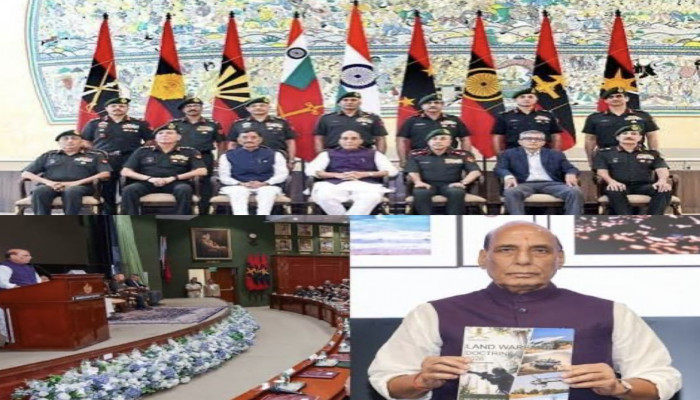
Defence Minister Rajnath Singh on Friday released the Indian Army’s Land Warfare Doctrine 2026, outlining plans to prepare the force for future conflicts driven by advanced technology, drones, artificial intelligence (AI), precision strikes and multi-domain operations.
The revised doctrine reflects lessons from recent conflicts, where unmanned systems, continuous surveillance, disrupted communications and information warfare have become key battlefield factors.
Aligned with Defence Forces Vision 2047, the doctrine stresses coordination among the Armed Forces, integration of capabilities across multiple domains and the importance of land power in achieving decisive military and political outcomes.
A major focus is on Atmanirbharta and a Whole-of-Nation Approach. It highlights the need for indigenous defence capabilities, national infrastructure and coordination between the military and other institutions. The doctrine also stresses empowering soldiers, combining human capabilities with unmanned systems, strengthening logistics and maintaining effective operations in technology-driven battlefields.
The doctrine gives commanders the flexibility to adapt their operational strategies according to threats, terrain and mission requirements. The Army is also advancing several training initiatives, including a five-year roadmap for multi-domain operations training, a three-level AI skill development programme for officers and a new approach to make drone operations a secondary skill across the force.
The updated framework reflects the Army’s efforts to become a technology-enabled and adaptable force capable of handling conflicts across different levels and domains.
The Indian Army last released its Land Warfare Doctrine in December 2018, following the Armed Forces’ joint doctrine in April 2017. The earlier document covered the geostrategic environment, different levels of conflict, hybrid warfare, multi-front operations, surveillance, precision strikes, information warfare, space warfare and special forces.
The 2018 doctrine also laid the foundation for strategies concerning India’s Northern and Western Fronts. Since then, changes in the security environment have influenced military planning.
The Army has faced a prolonged stand-off with China along the Line of Actual Control in Ladakh. Conflicts elsewhere have also highlighted the growing role of drones, missiles and electronic warfare in modern combat.



 Loading...please wait
Comments