




Rajnath Singh says India will respond strongly to Pakistan, rules out dialogue other than on POK
- In Reports
- 02:37 PM, Jul 27, 2026
- Myind Staff
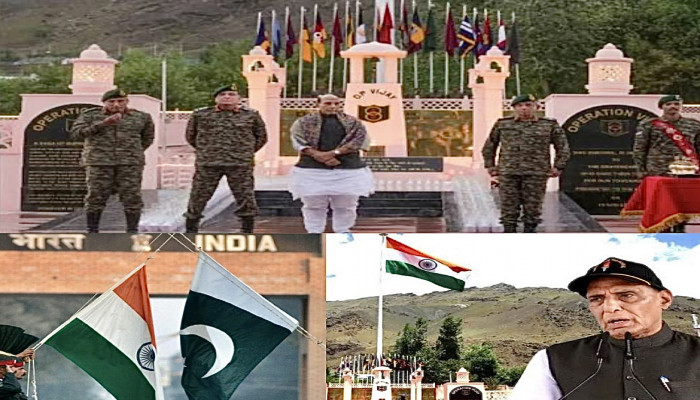
Defence Minister Rajnath Singh on Sunday said Operation Sindoor proved India's capability to give a powerful response to any hostile action by Pakistan. He said India has shown that it can retaliate with force beyond Pakistan's imagination. He also ruled out any dialogue with the neighbouring country on issues other than Pakistan-occupied Kashmir (PoK). Singh made these remarks while addressing the 27th Kargil Vijay Diwas celebrations in Dras, Ladakh.
During his speech, Singh strongly criticised Pakistan's approach towards terrorism. He said there is no difference between Pakistan's military and terrorist groups, claiming that terrorism has become a part of the country's state policy. According to him, Pakistan's armed forces actively support terrorist organisations instead of acting against them.
“Pakistan’s military not only shelters terrorist organisations but also works with them. That is why, during Operation Sindoor, we made it clear that India no longer views terrorists and the governments that nurture them as separate entities,” he said.
The Defence Minister said every attempt by Pakistan to challenge India's sovereignty would receive a firm response from the Indian armed forces. Referring to Operation Sindoor, he said the operation reflected India's determination to act strongly against terrorists and those who support them. He added that India would continue to protect its national interests with the same resolve.
The Kargil Vijay Diwas celebrations commemorate the bravery of Indian soldiers who fought during the 1999 Kargil War. Indian troops successfully pushed back Pakistani intruders from the strategic mountain peaks they had occupied in the Kargil sector. Army Chief General Dhiraj Seth also attended the event in Dras to honour the soldiers who secured victory in the limited war. The conflict was fought along a 170-km mountainous stretch from Mashkoh Valley to Turtuk in the Kargil sector and remains India's fifth war.
Singh said the two neighbouring countries have followed completely different paths over the past 27 years. He said India has focused on development, innovation and technological progress, while Pakistan has continued to encourage terrorism and infiltration.
“While India is exploring new avenues of innovation, Pakistan is seeking new routes for infiltration. India is engaged in chip design, whereas Pakistan is busy designing terror. India is building a start-up ecosystem, while Pakistan is constructing a terror ecosystem. India is manufacturing semiconductors; Pakistan is preparing suicide bombers. India is recognised for space missions, while Pakistan is running proxy missions,” Singh said.
Continuing his comparison, the Defence Minister highlighted India's technological achievements and contrasted them with Pakistan's alleged support for terrorism.
India, he added, is sending satellites into space, whereas Pakistan focuses on sending terrorists across the border. “India is providing software to the world, while Pakistan is exporting sleeper cells. India is establishing data centres; Pakistan is setting up radicalisation centres. India is connecting the world through UPI, while Pakistan is linking terrorism with hawala networks.”
The Kargil War remains one of the most significant military victories in India's history. A total of 527 Indian soldiers lost their lives during the conflict. There is no confirmed figure for Pakistani casualties, though different estimates place the number between a few hundred and a few thousand. The conflict began only months after the Lahore Peace Declaration, when thousands of Pakistani intruders crossed the Line of Control (LoC), exploited gaps in Indian defences and occupied several strategic mountain heights.
Recalling the lessons of the war, Singh stressed the need for constant vigilance along India's borders. He said the experience of Kargil continues to guide the country's security strategy.
“Kargil War has taught us that we must remain ever-vigilant at our borders in every season and under all circumstances,” Singh said.
He noted that the lessons from the Kargil conflict led to major reforms in India's defence and security systems. These changes included improvements in intelligence gathering, military modernisation, border management and structural reforms within the armed forces. According to Singh, these steps have significantly strengthened India's defence preparedness.
The Defence Minister also spoke about India's progress in indigenous defence manufacturing. Referring to Kargil war hero Captain Vikram Batra's famous slogan, "Yeh Dil Maange More," he said the country has achieved significant milestones in producing modern defence equipment but will continue working towards greater self-reliance.
“We have developed the next-generation Akash missile. India’s first indigenous aircraft carrier ‘INS Vikrant’, Light Combat Aircraft ‘Tejas’, Light Combat Helicopter ‘Prachand’, Advanced Light Helicopter ‘Dhruv’, Main Battle Tank ‘Arjun’, ‘Pinaka’ multi-barrel rocket launcher, ‘Astra’ air-to-air missile, and modern drones and counter-drone systems are also strengthening the combat readiness of the defence forces. But, ‘Yeh Dil Maange More.’ We will continue working to manufacture even more modern weapons, next-generation fighter aircraft, submarines, and missiles right in India,” Singh added.
Singh's address focused on India's military strength, national security and growing defence capabilities. He reaffirmed the government's commitment to strengthening the armed forces and promoting indigenous defence production. He also reiterated that India would continue to respond firmly to any threat against its sovereignty while remaining focused on modernisation and self-reliance in the defence sector.



 Loading...please wait
Comments