




QUAD expands Indo-Pacific cooperation with new maritime, energy, critical minerals initiatives
- In Reports
- 01:36 PM, May 26, 2026
- Myind Staff
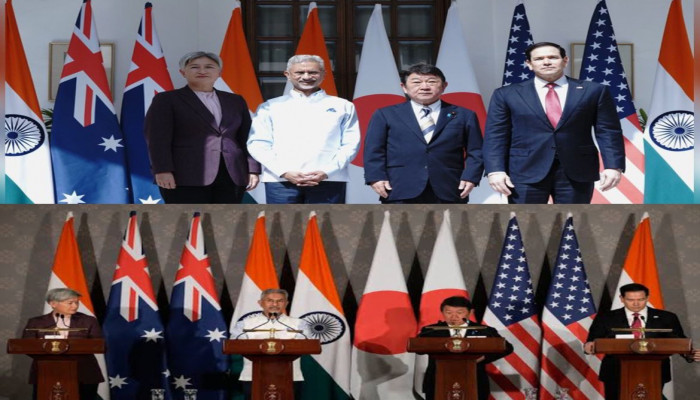
The QUAD grouping of India, the United States, Australia and Japan expanded cooperation in critical minerals, maritime surveillance and energy security during the foreign ministers’ meeting held in New Delhi on Tuesday. External Affairs Minister S Jaishankar chaired the meeting, which was attended by US Secretary of State Marco Rubio, Australian Foreign Minister Penny Wong and Japanese Foreign Minister Toshimitsu Motegi.
The meeting focused on strengthening coordination in the Indo-Pacific region. The four countries announced several new initiatives linked to maritime security, port infrastructure and energy cooperation. Jaishankar later described the discussions as “productive” and shared the key outcomes of the meeting on social media.
One of the major announcements was related to the Indo-Pacific Maritime Surveillance Initiative. Sharing details, Jaishankar said, “Agreed on Indo-Pacific Maritime Surveillance Initiative and on a Common Operating Picture in the maritime domain. Will consider an expert panel on Port Infrastructure, collaborate on a pilot port project in Fiji, and on undersea cables.”
The initiative aims to improve coordination among the four countries in monitoring activities across the Indo-Pacific waters. It will also help in building stronger maritime awareness and security cooperation in the region. The proposal for a common operating picture is expected to improve information sharing between the QUAD nations.
The grouping also discussed plans to improve port infrastructure in the Pacific Islands. Fiji was identified as the location for the first joint port infrastructure project under the QUAD framework. Along with ports, the countries will also cooperate on undersea cable projects, which are considered important for communication and digital connectivity in the Indo-Pacific region.
Another major outcome of the meeting was the finalisation of the QUAD Critical Minerals Framework. Critical minerals are important for sectors such as technology, clean energy and manufacturing. Jaishankar said, “Finalised the QUAD Critical Minerals Framework. Also signed the India-US Critical Minerals Framework. QUAD is working with other like-minded countries in this sector.”
The framework is expected to help the four countries strengthen supply chains and reduce dependence on limited sources for important minerals. Quad countries will mobilise $20 billion to bolster critical minerals supply chains. This initiative will aim to reduce import reliance and boost local industries by supporting mining, processing, and recycling. The Quad partners will identify and back projects crucial for advanced technologies and regional economic security, fostering diversified and fair mineral markets.
India and the US also signed a separate agreement on critical minerals cooperation during the meeting.
The QUAD nations further announced a new initiative focused on Indo-Pacific energy security. According to Jaishankar, “Announced the QUAD initiative on Indo-Pacific Energy Security in technology, management, policy, international market analysis, and emergency response exercises.”
The initiative aims to improve cooperation in energy-related sectors and help countries prepare for emergencies that may affect energy supplies and markets. The focus will include technology sharing, policy coordination and market analysis.
US Secretary of State Marco Rubio also addressed the media after the meeting and highlighted the importance of maritime security in the Indo-Pacific region. He said the QUAD had decided to launch an Indo-Pacific Maritime Surveillance Cooperation Initiative.
“It will leverage each of our country's maritime surveillance capabilities in the Indo-Pacific,” Rubio said.
Rubio also announced the expansion of the Indo-Pacific Maritime Domain Awareness Initiative among the QUAD nations. He stressed that maritime security remains important because a large portion of global trade passes through the Indo-Pacific region.
“The reason why maritime security is so important, beyond the fact that current events remind us of what can happen when maritime security is impeded, is the fact that 60 per cent of global maritime trade passes through the Indo-Pacific,” Rubio said.
He further said that maintaining safe maritime routes is important not only for the QUAD nations but also for many countries across the world that depend on trade through the region.
Speaking on port infrastructure cooperation, Rubio said, “The second initiative: we're going to be partnering on issues of port infrastructure, in response to insufficient port capacities in the Pacific Islands.”
“We're announcing plans to work with Fiji to advance that country's port infrastructure. It'll be the first time that the QUAD partners work together on a port infrastructure project,” he added.
Australian Foreign Minister Penny Wong also spoke about regional maritime issues and said the QUAD recognised efforts aimed at ensuring freedom of navigation in the Strait of Hormuz.
“We recognised the importance of maintaining the principle of freedom of navigation and our opposition to any tolling proposition,” she said, referring to Iran's plan to demand fees for transiting the Strait.
Wong also said the four countries are working together to strengthen cooperation against scam centres operating in parts of Southeast Asia. She added that the QUAD will initially coordinate maritime surveillance efforts in the Indian Ocean.
The meeting in New Delhi reflected the QUAD’s growing focus on strategic and economic cooperation in the Indo-Pacific. Maritime security, energy cooperation, critical minerals and infrastructure development remained at the centre of discussions as the four countries looked to deepen coordination in the region.



 Loading...please wait
Comments