




Putin renews Su-57 fighter joint production with India, backs Modi’s independent foreign policy
- In Reports
- 02:57 PM, Jun 05, 2026
- Myind Staff
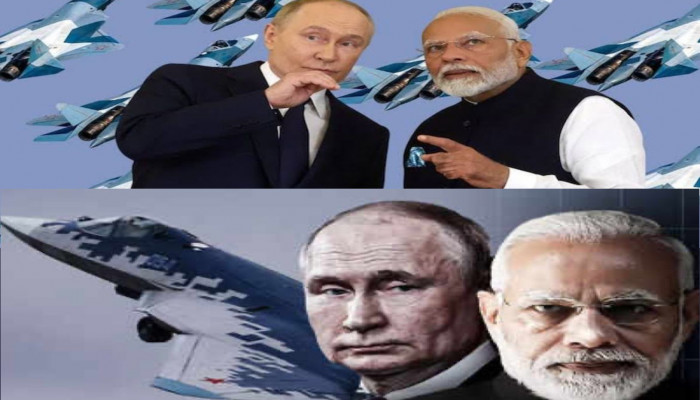
Russia has renewed its offer to jointly develop and manufacture the Sukhoi Su-57 stealth fighter jet with India, a move that comes at a crucial time as the Indian Air Force (IAF) continues its search for a fifth-generation fighter aircraft.
Speaking to global news agencies on Thursday, Russian President Vladimir Putin said Moscow is ready to deepen defence cooperation with New Delhi by supplying the advanced fighter jet and sharing critical technologies. The proposal comes as India seeks to strengthen its air power capabilities while its indigenous Advanced Medium Combat Aircraft (AMCA) project remains years away from operational deployment.
At present, the IAF does not operate any fifth-generation fighter aircraft. Concerns have also grown over reports that Pakistan may soon acquire China's Shenyang J-35AE stealth fighters. With the AMCA expected to enter service only in the mid-2030s, India has been exploring options to bridge the capability gap.
Addressing the issue, Putin said, "We are ready to supply India with this aircraft, to keep developing it. We don't have any issues or limitations. The same goes for air defence systems."
His remarks signalled Russia's willingness to expand defence collaboration with India without imposing restrictions on technology transfer. The statement was also seen by many observers as an indirect reference to limitations and conditions often associated with Western defence partnerships.
Putin recalled that Russia had earlier proposed a joint fifth-generation fighter project with India. The initiative, known as the Fifth Generation Fighter Aircraft (FGFA) programme, was discussed around 2018 but did not move forward after India decided to withdraw.
"At one point, we proposed to our Indian friends to work together on this technology. But back then, our Indian friends said, 'Go ahead on your own, and then we will see — maybe we'll join'," Putin said.
"The aircraft could have been our joint project. We built it independently, but we are ready to work with India in this field," the Russian President further said.
The Su-57 is Russia's most advanced fighter aircraft and is designed for a wide range of combat missions against air, land and maritime targets. It combines stealth features, high manoeuvrability and advanced avionics. The aircraft is often grouped with other fifth-generation fighters currently in service, including the American F-35 and China's J-35.
India's decision to exit the FGFA programme in 2018 was largely linked to concerns raised by the IAF. Reports at the time suggested that the Air Force was not fully satisfied with the aircraft's stealth capabilities. There were also differences regarding technology transfer and development responsibilities.
Putin's latest proposal appears aimed at addressing those concerns and reopening discussions on future cooperation. The offer has generated fresh speculation about India's fighter aircraft plans.
The development comes amid growing debate over whether India could choose the Russian Su-57 over the American F-35. During Prime Minister Narendra Modi's visit to the White House last year, US President Donald Trump had offered the F-35 fighter jet to India.
Recent conflicts have highlighted the increasing importance of stealth technology and detection capabilities in modern aerial warfare. Defence analysts believe these factors are likely to play a major role in India's future fighter aircraft decisions.
A report by NDTV in February claimed that India could consider acquiring around 40 Su-57 jets as an interim solution following hostilities with Pakistan last year. However, no official decision has been announced so far.
Putin's offer has once again brought the Su-57 into the centre of India's defence discussions. Whether New Delhi chooses to move ahead with the proposal remains to be seen.
Apart from defence cooperation, the Russian President also strongly backed India's independent foreign policy and praised the country's economic growth. During the same interaction with international media organisations, including PTI, Putin described India as one of the world's leading economies and expressed confidence about the future of bilateral ties.
He said trade between the two countries is expected to continue growing and could reach the USD 100 billion mark in the coming years.
"India is among the world's major economies and is currently demonstrating an impressive rate of economic growth," Putin said.
Responding to a question from PTI CEO and Editor-in-Chief Vijay Joshi, Putin added, "India is one of the leading economies of the world that has shown the highest rate of economic growth. This is not something that comes out of the blue. This is result of the hard work that the government of India has been doing under the leadership of Prime Minister Narendra Modi."
Putin also made it clear that Russia does not view India's growing engagement with the United States as a threat to its relationship with New Delhi. He stressed that India has the right to pursue partnerships that serve its national interests.
"We are glad that India is developing its relations with all countries it thinks important for its national interests," Putin said when asked whether India's deepening ties with Washington could create friction with Moscow.
At the same time, he criticised efforts by some Western countries to pressure India over its relationship with Russia. According to Putin, such attempts have not produced the desired results.
"Everyone has understood that pressure on Prime Minister Narendra Modi and India is detrimental for international relations," he said.
The Russian President described India as a dependable partner and emphasised that Moscow sees no negative consequences arising from New Delhi's relations with other nations.
"India is a great nation and democracy and Russia will continue to expand its relations with it," he said.
Putin's remarks underline Russia's intention to strengthen both strategic and economic ties with India. His offer on the Su-57 fighter programme and his praise for India's independent foreign policy reflect Moscow's continued efforts to maintain a strong and long-term partnership with New Delhi amid shifting global geopolitical dynamics.



 Loading...please wait
Comments