




Putin hails test launch of nuclear-capable ICBM ‘Sarmat’
- In Reports
- 07:31 PM, May 13, 2026
- Myind Staff
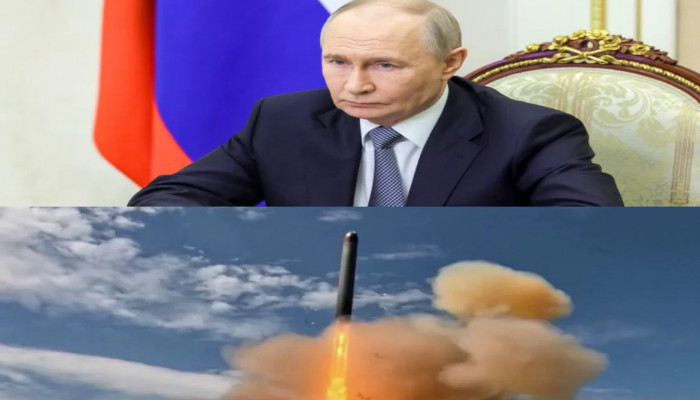
Russia has carried out a test launch of its new intercontinental ballistic missile, the Sarmat, with President Vladimir Putin calling it the world’s “most powerful” missile. The nuclear-capable weapon was launched successfully on Tuesday, according to Russian authorities. State television showed footage of Sergei Karakayev, the commander of Russia’s strategic missile forces, reporting the successful launch directly to Putin. The Russian President later confirmed that the missile would officially enter combat service by the end of the year.
Speaking in televised remarks, Putin described the Sarmat as a major addition to Russia’s military strength. “This is the most powerful missile in the world,” he said. He also claimed that the missile’s warhead yield is more than four times greater than Western equivalents. According to Putin, the Sarmat can travel through suborbital flight paths, giving it a range of more than 35,000 kilometres. He further stated that the missile can “penetrate all existing and future anti-missile defence systems”.
The missile has been under development for more than a decade. Russia first began work on the Sarmat in 2011. Before this week’s launch, the missile had only one publicly known successful test. Reports also suggested that one of its earlier tests in 2024 ended in a massive explosion after the launch was aborted. Despite those setbacks, Russia has continued developing the system as part of its effort to modernise its nuclear forces.
Known in the West as “Satan II”, the Sarmat missile is designed to replace nearly 40 Soviet-era Voyevoda missiles currently used by Russia. Putin stated that while the Sarmat matches the Voyevoda in destructive power, it offers greater precision and improved capabilities. The missile is seen as a key part of Moscow’s long-term military strategy.
The launch also took place at a time of growing concern over the weakening global arms control system. The New START treaty, which had limited the number of strategic nuclear warheads and delivery systems held by both Russia and the United States, expired in February. Its expiry means the world’s two biggest nuclear powers are now operating without formal restrictions for the first time in more than 50 years.
Although Moscow and Washington have agreed to restart high-level military discussions after the treaty ended, there has been no visible progress towards a replacement agreement. Both countries have repeatedly accused each other of failing to follow the treaty’s terms during its final years.
US President Donald Trump has argued that any future nuclear arms agreement should also include China. Washington has expressed concern over the rapid expansion of China’s nuclear arsenal, even though it remains smaller than those of Russia and the United States. However, Beijing has rejected pressure to join such negotiations. Trump had largely avoided discussing the extension of New START before it expired earlier this year.
Since coming to power in 2000, Putin has focused heavily on modernising Russia’s nuclear triad. This includes upgrading land-based intercontinental ballistic missiles, introducing new nuclear submarines, and improving nuclear-capable bombers. Russia has spent years replacing ageing Soviet-era systems with more advanced weapons.
Putin first introduced the Sarmat missile publicly in 2018 during a presentation of several new Russian weapons systems. Among them was the Avangard hypersonic glide vehicle, which Russia says can travel at 27 times the speed of sound. Putin stated that the first Avangard systems have already entered service.
Russia has also introduced the Oreshnik intermediate-range ballistic missile, which is capable of carrying nuclear weapons. Moscow has already used conventionally armed versions of the missile twice during strikes in Ukraine after launching its invasion in 2022. The Oreshnik missile has a reported range of up to 5,000 kilometres, making targets across Europe reachable from Russian territory.
During his latest remarks, Putin also announced that Russia was in the “final stages” of developing two more advanced weapons systems. One is the Poseidon underwater drone, which is nuclear-armed, and the other is the Burevestnik cruise missile, powered by miniature atomic reactors. Russia claims these weapons are designed to strengthen its strategic deterrence capabilities.
Putin has repeatedly linked the development of these new weapons to the United States missile defence system. Washington expanded its missile shield programme after withdrawing in 2001 from a Cold War-era treaty with the Soviet Union that limited missile defence systems. Russia has long argued that the US shield threatens the balance between the two nuclear powers.
Russian military officials have expressed fears that the American missile defence system could eventually allow Washington to launch a first strike against Russia’s nuclear arsenal. Moscow believes the shield could then intercept the small number of Russian missiles that survive and are launched in retaliation.
Explaining Russia’s military strategy, Putin said, “We were forced to consider ensuring our strategic security in the face of the new reality and the need to maintain a strategic balance of power and parity.”



 Loading...please wait
Comments