




Provocative slogans by IUML against Hindus after Satheesan named CM spark massive row in Kerala
- In Reports
- 07:00 PM, May 15, 2026
- Myind Staff
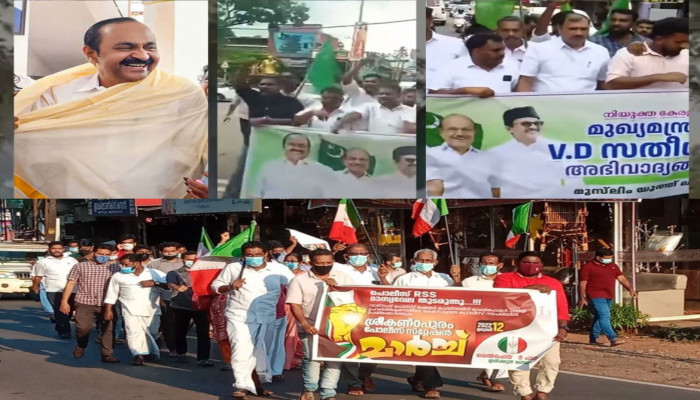
The political atmosphere in Kerala turned tense on May 14, 2026, soon after Congress leader V. D. Satheesan was announced as the Chief Minister-designate. Celebrations by workers of the Indian Union Muslim League (IUML) across several districts quickly became controversial after videos surfaced showing cadres raising abusive slogans, alleged death threats, and provocative statements against Hindu community leaders and activists.
Reports from Thodupuzha, Thrissur, Kasaragod, Idukki and other areas showed Muslim League supporters carrying green crescent-moon flags and shouting aggressive slogans. The anger was reportedly directed at Sree Narayana Dharma Pariapala (SNDP) Yogam general secretary Vellappally Natesan and Nair Service Society (NSS) general secretary Sukumaran Nair after they publicly opposed giving the Education portfolio to the Muslim League in the new government.
During the rallies, slogans were raised directly targeting the two leaders. Protesters shouted, “Aaraada ee Vellappally... Ethavanada Sukumaran” — roughly translated as “Who the hell is this Vellappally….. who the hell is this Sukumaran.” The slogans did not stop there. Videos also captured League supporters declaring, “League will rule Kerala's soil. The laws of this land will be decided by the League.”
The controversy deepened because the rallies were not isolated incidents. Similar scenes were reported from multiple districts, creating a wider political debate in the state. Critics alleged that the celebrations reflected an aggressive assertion of power by the Muslim League rather than a normal political victory celebration by the United Democratic Front (UDF).
The issue became more serious after videos surfaced from Idukki and other districts showing alleged threats against Hindu activists. One of the most discussed clips reportedly featured League supporters issuing violent threats against Hindu activist Jithin Lal. Chants in the rally allegedly threatened physical violence and death, drawing strong criticism on social media and among political observers.
Following the backlash, the Idukki district Youth League committee was suspended after its members were accused of raising provocative slogans against Vellappally Natesan and Sukumaran Nair. The Muslim League acknowledged that the slogans were unacceptable. However, the action came only after the videos had already circulated widely online and triggered outrage across the state.
The incident also revived memories of earlier controversies involving the Muslim League in Kerala. In Kanhangad in Kasaragod district, a previous rally organised by League workers had drawn criticism after anti-Hindu slogans and alleged death threats were raised publicly. Videos from that event had shown threats to hang and burn Hindu believers in front of temples. The controversy had forced Kerala Police to register cases against more than 300 people, most of them members of the IUML youth wing. Cases were filed under Section 153A of the IPC, which deals with promoting enmity between groups on religious grounds.
What made the latest controversy politically significant was the messaging used during the celebrations. In several rallies, the victory was projected not as a Congress-led UDF win, but as a victory of the Muslim League itself. Protesters repeatedly claimed that “the League had come to power.” This narrative became a major talking point for critics who argued that the League’s street-level messaging appeared more dominant than that of the Congress party.
Even before the formal announcement of Satheesan as Chief Minister-designate, tension within alliance circles had started becoming visible. When Satheesan arrived in Delhi for discussions, activists of the Muslim Students Federation, the student wing of the Muslim League, reportedly raised slogans against Kerala Pradesh Congress Committee president Sunny Joseph. In Wayanad, provocative posters allegedly targeting Congress leadership and Priyanka Gandhi also surfaced, adding to the controversy.
The debate surrounding the issue expanded further because of Satheesan’s earlier remarks regarding Jamaat-e-Islami (JeI). Not long ago, Satheesan had publicly stated that Jamaat-e-Islami was secular and had abandoned the idea of a “theocratic state.” His statement had already attracted criticism from political opponents and ideological groups in Kerala.
However, Kerala Ameer of Jamaat-e-Islami, P. Mujeebur Rahman, later made remarks that appeared to contradict Satheesan’s position. Rahman stated that the organisation had not abandoned any of its core principles. He reiterated the group’s belief in “Hukumath-e-Illahi,” a concept referring to divine governance under Islamic law.
“Hukumath-e-Illahi” literally translates to “Divine Governance” or “Rule of God.” The doctrine holds that sovereignty belongs to Allah alone and governance should follow Sharia instead of laws created by human legislatures. Critics pointed out that Rahman’s remarks directly contradicted Satheesan’s earlier claim that Jamaat-e-Islami had moved away from the idea of a theocratic state.
The controversy has now become more than just a debate over political slogans. Opposition voices argue that the issue raises larger concerns about communal messaging, political influence, and ideological assertions in Kerala’s coalition politics. The fight over the Education portfolio has also gained symbolic importance because it involves control over policies that shape future generations.
Despite the growing outrage and circulation of videos online, the Congress leadership has largely remained silent on the issue. Critics have questioned why stronger public condemnation has not come from the party even after multiple controversial videos surfaced from the celebrations.
The developments of May 14 have therefore triggered a major political and social debate in Kerala. What began as victory celebrations after the announcement of a new Chief Minister quickly turned into a controversy involving communal slogans, alleged threats, ideological debates, and questions over the balance of power within the ruling alliance.



 Loading...please wait
Comments