




Protests erupt in Pakistan as Islamists demand resignation of Chief Justice over controversial blasphemy ruling
- In Reports
- 10:18 PM, Aug 20, 2024
- Myind Staff
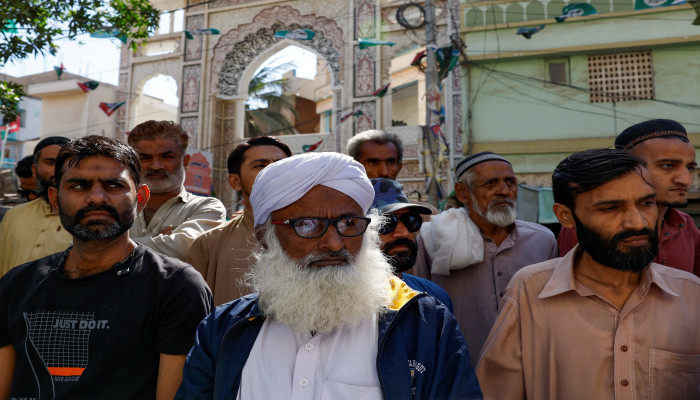
Thousands of protesters in Pakistan, chanting the incendiary slogan “Sar tan se juda,” are rallying against Supreme Court Chief Justice Qazi Faez Isa. Appointed as Chief Justice in November last year, Isa has been the target of death threats and widespread protests since February, following his decision to order the release of Mubarak Sani, an Ahmadiyya man. On May 29th, a three-judge bench, including Chief Justice Isa, Justice Irfan Saadat Khan, and Justice Naeem Akhtar Afghan, reserved its decision on the case.
The latest wave of protests erupted after the court, on July 24th, accepted the Punjab government’s plea, along with those of several Islamist organisations, seeking a review of its February ruling. The court emphasised that the constitutional right to profess religion and religious freedom is subject to law, morality, and public order. A hearing on these pleas is scheduled for August 22nd.
The protesting Islamists are calling for Chief Justice Faez Isa’s resignation. On August 19th, a large number of demonstrators from various Islamist groups breached Islamabad’s highly secured Red Zone, storming the entrance gates of the Supreme Court to protest the Pakistan apex court’s verdict in the Mubarak Sani case.
In its February ruling, Justice Faez Isa granted bail to Mubarak Ahmad Sani, an Ahmadiyya man accused of blasphemy in 2019 for distributing pamphlets promoting his religious beliefs. Although Sani was convicted under the Punjab Holy Quran (Printing and Recording) (Amendment) Act, 2021, the three-judge bench led by Justice Isa noted that the offence for which he was charged had not been criminalised until 2021. As a result, the Supreme Court granted bail to Sani and ordered his immediate release. This decision sparked a backlash from the Tehreek-e-Labbaik Pakistan (TLP) and other Islamist groups, who launched a hate campaign against Justice Isa.
In February, around 3,000 people in Peshawar blocked roads and raised slogans like “Death to Qadianis.” The mounting pressure from these Islamist groups eventually led the Supreme Court to issue a statement defending its decision in the Mubarak Sani case.
Notably, the Islamist group Tehreek-e-Labbaik Pakistan (TLP) has escalated its campaign against Justice Faez Isa by placing a bounty of 1 crore Pakistani rupees on his head. Pir Zaheerul Hasan Shah, the second-highest leader of TLP, publicly announced this bounty.
“TLP aside, as a momin [faithful Muslim] and a slave of Prophet Muhammad, I announce in my capacity to give one crore [ten million] rupees to any person who beheads Faiz Isa who desecrated the law of the country, kicked the blood of 10,000 martyrs and permitted Marzai [Ahmadis] and hurt the feelings of Muslims,” Shah said in a rally.
On the other hand, Information Minister Attaullah Tarar shared a video of Shah’s inflammatory remarks and said, “There is no room for such statements in the state of Pakistan and it will not be tolerated. Qazi Sahib did not make any decision in favour of any group or group. On the basis of which this hateful narrative is being propagated, we strongly condemn and strongly deny such statements, such mentality is causing serious damage to Pakistan. There are political motives behind this false narrative.”
Ahmadiyyas in Pakistan face severe persecution, particularly since the state formally designated them as non-Muslims in 1974, with blasphemy laws frequently used against them. Mubarak Sani’s release was viewed by Islamist groups such as Tehreek-e-Labbaik Pakistan (TLP) as a challenge to their religious beliefs, as they consider Ahmadiyyas heretics. The persecution of this group in Pakistan has been documented by various agencies. Ironically, the Ahmadiyya community was instrumental in Pakistan’s creation. Given the intense pressure and backlash against the Pakistani Supreme Court, it is likely that the court may reverse its decision and reincarcerate Sani.
It is important to note that blasphemy allegations are often weaponised by Islamists in Pakistan to target individuals, particularly non-Muslims. Offences can range from Arabic calligraphy and QR codes to non-Muslims practicing their faith. Such accusations frequently provoke violent protests, including calls for “Sar tan se juda,” mob lynchings, and other forms of extreme action.
Image source: Reuters



 Loading...please wait
Comments