



President Al-Sharaa meets Putin as Russia tries to secure military bases in Syria
- In Reports
- 02:09 PM, Jan 29, 2026
- Myind Staff
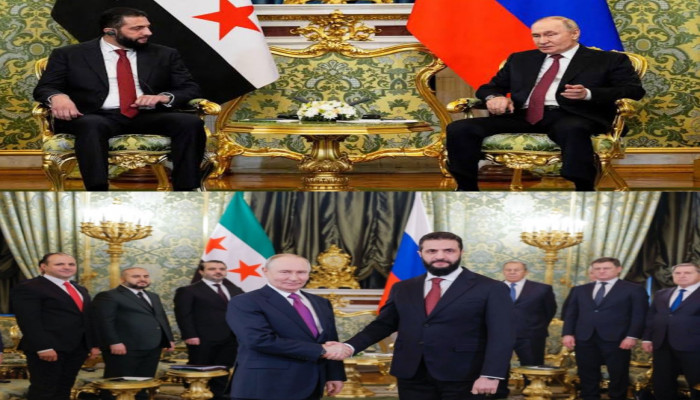
Syrian President Ahmed al-Sharaa met Russian President Vladimir Putin in Moscow as Russia tries to protect its military presence in Syria, more than a year after al-Sharaa removed Bashar al-Assad from power. The Kremlin has not said whether it will accept al-Sharaa’s repeated requests to extradite Assad.
Before their meeting on Wednesday, al-Sharaa spoke at a news conference and thanked Putin for supporting Syria’s unity and for what he called Russia’s “historic” role in the “stability of the region”. Putin, in response, expressed support for al-Sharaa’s efforts to stabilise Syria and congratulated him on progress towards “restoring the territorial integrity of Syria”.
For more than a decade, Putin and al-Sharaa were on opposite sides of Syria’s civil war. This history has raised concerns in Moscow about the future of Russia’s military presence in the country. Ahead of the talks, Kremlin spokesperson Dmitry Peskov said that “the presence of our soldiers in Syria” would be discussed. Russian troops are currently based at the Khmeimim airbase and the Tartous naval base along Syria’s Mediterranean coast.
Earlier this week, Russia reportedly withdrew its forces from the Qamishli airport in northeastern Syria, which Kurdish groups control. This move left Russia with only its two Mediterranean bases, which are its only military outposts outside the former Soviet Union. Journalist Amberin Zaman from the Middle East outlet Al-Monitor shared the footage of the abandoned base in Qamishli on Monday.
Syria has long been one of Russia’s closest allies in the Middle East. Their relationship began during the Cold War, when the Soviet Union provided strong military and political support to the Ba'athist government in Damascus, led first by Hafez al-Assad and later by his son Bashar al-Assad. After Bashar al-Assad was overthrown, Moscow feared that a new government in Syria might become hostile to Russia.
Samuel Ramani, an associate fellow at the London-based RUSI think tank, told Al Jazeera that Russia had been worried about the emergence of a “populist anti-Russia” government in Damascus. “They feared he [al-Sharaa] would squeeze them out, but the Russians have been pleasantly surprised, even if they’ve had to downgrade their ties from before,” he said.
Ramani also explained that al-Sharaa has taken a pragmatic approach in foreign policy. He said al-Sharaa is trying to build relations with powers outside the region as a way to protect Syria from possible political changes in the United States. “The Republicans are lenient towards Syria engaging Russia as long as they keep Iran out,” Ramani said, “whereas the Democrats have been more sceptical overall and have wanted to move more slowly on the removal of sanctions and other issues.” He added, “Al-Sharaa also needs Russia, and that is why he is engaging.”
During his first visit to Moscow in October, al-Sharaa tried to adopt a friendlier tone and played down Russia’s role in Syria’s war despite Russia giving refuge to Bashar al-Assad and his wife. Assad and his wife fled Syria in December 2024, when opposition forces led by al-Sharaa advanced towards Damascus. Al-Sharaa has demanded Assad’s extradition and said last month that there would be justice for Syrians who suffered under the former president’s repression.
Putin is particularly eager to maintain Russia’s presence in Syria, especially after losing another ally recently. This month, the United States sent special forces to abduct Venezuelan President Nicolas Maduro. On Tuesday, Russian Defence Minister Andrey Removich Belousov said after meeting his Chinese counterpart that Moscow was closely watching the situation in Venezuela and Iran, both of which have strong ties with Russia and have faced threats from the United States in recent weeks.
Syria’s new leadership has shifted the country’s foreign policy away from Russia and is seeking a strategic relationship with the United States. The Trump administration has responded positively to this approach. Although the US did not fully act on warnings against Syrian government engagement with the Kurdish-led Syrian Democratic Forces, it later helped broker a truce to stop the fighting. A fragile ceasefire is now in place and has largely been holding.



 Loading...please wait
Comments