




Prahaar – The Ujjwal Nikam Story
- In Movie Reviews
- 10:00 AM, Oct 18, 2026
- Dr. Nidhi Shendurnikar
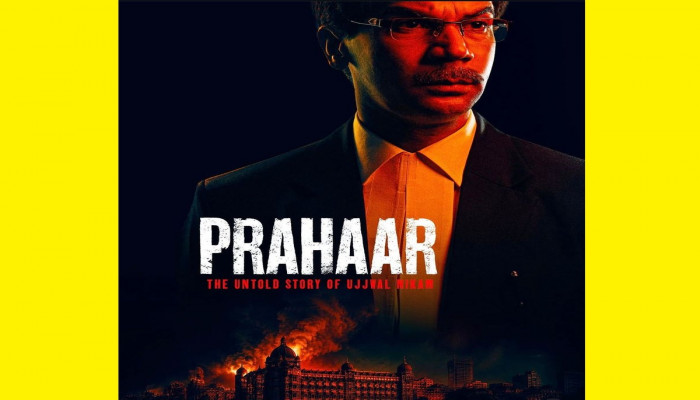
The horrific terror attacks of 26/11/2008 in Mumbai are not a distant memory, but a reminder to the Indian people that Pakistan continues to harbour terrorists to ‘bleed India by a thousand cuts’, groom ‘jihadis’ in the war against infidels, with Indian urban naxals posing as its most visible front. Prahaar, with Rajkumar Rao in the lead and directed by Avinash Arun Dhaware, brings to the screen the 26/11 trial, which convicted Ajmal Amir Kasab for his role in the attacks.
Indians have a habit of collective amnesia. We forget what we went through – persecution, genocide, brutal killings at the hands of invaders, forced conversions, colonisation and most recently state subversion of Hindu civilisation. That is why we probably need movies to keep reminding ourselves of what we have suffered as a community, as people. Unlike the Jews, in whose memory the Holocaust is etched and who have successfully preserved their history through narratives in books, museums and movies.
That is why we need a movie like ‘Prahaar’ which takes the ordinary Indian on a journey beyond the massacre in Mumbai on the fateful night of 26 November. The movie presents the story of the court battle fought by the Indian State against Kasab, the lone terrorist bravely captured by Constable Tukaram Omble, without whom Pakistan’s role in the terrorist attack could never have been proven. Omble’s sacrifice also ensured that the liberal-secular lobby’s (the likes of Digvijay Singh & Mahesh Bhatt) sinister intentions of proving 26/11 to be a Hindu/RSS conspiracy failed miserably (for the Hindu community, this is déjà vu since recently leaked WhatsApp group chats in Cockroach Janta Party (CJP) groups showed a similar intent – “bring Kasab energy”, ‘wear, tilak, tie Kalawa on hand” – so that any riot incited by anarchists looks like one orchestrated by Hindus.
Prahaar doesn’t come across as a biopic even though it traces Nikam’s journey from Jalgaon to the big city of Mumbai, where he makes his mark for the very first time in the field. He was appointed as special public prosecutor in the 1993 Mumbai bomb-blast case in 1994, a trial that lasted for 14 long years. Nikam is seen making a reputation for himself, taking on tough cases, immersing himself in his work, while his wife and children support him through ups and downs. Then comes 26/11 and the challenge to prove Kasab guilty of murdering 166 innocent people – a challenge that Nikam accepts on his own terms, with the underlying principle that “justice hurried is justice buried.”
The film moves at a steady pace with gripping court scenes. In the first half, one almost feels as if everything is going wrong for Nikam as Kasab and his lawyer – Abbas Kazmi play tactics to delay the case. Nikam’s struggle to understand the case and its complexities, his goal of not merely exposing Kasab but the entire terrorist network in Pakistan, is what is at the heart of the film. Nikam is clear from the beginning – this is not just about one terrorist Kasab – but about a country which wants to wage war against India. This is something that we as people of this country, as Hindus need to understand and appreciate. A terrorist act is not an isolated act – especially when emanating from Pakistan – it is part of a broader agenda called ‘Ghazwa-e-Hind’ and annihilating idolators. Pakistan’s entire existence is dependent on anti-India rhetoric – this is the message that the film clearly delivers.
Nikam’s personal struggles with his family, children, his hot-headed nature have been beautifully woven into the narrative. As a lawyer dealing with such important cases where national security is at stake, his struggle on the personal front hits home. But a supportive and understanding family, on the same page as he is as far as service to the nation is concerned – keeps things going for him.
The film’s highpoint is survivor testimonies in the courtroom – those who saw and suffered 26/11, those who saw loved ones being mercilessly slaughtered in front of their eyes – while Kasab smiled with glee. The press photographer who captured the only clear photo of the terrorist, the nurses at Cama Hospital who saved countless lives, the young ten-year old girl who despite suffering fatal injuries came forward to identify Kasab in the court of law – these and other who were the heroes of the day – heart wrenching stories of coping up and living with the scars of loss and painful memories. The film captures this impactfully, shakes us up to feel what victims of 26/11 went through.
Prahaar is gripping, emotional and hard-hitting. Each scene contributes to the build up and tells us something about 26/11 that we don’t know. For most, 26/11 ended when the terrorists were killed and Kasab was captured but for Nikam, it only ended the day when Kasab was hanged to death. Supporting characters like the Pakistani prosecutor Chaudhry Zulfiqar Ali (played by Jaideep Ahlawat), the Mumbai police team, Kasab’s lawyers have an important role in the story. It is quite enlightening for the audience to learn about Nikam’s visit to Pakistan during the time of the investigation, his interaction with Pakistani counter-parts and the farce 26/11 trial going on in our neighbourhood. These significant aspects of history will become very crucial for India in times to come.
Kasab is the most hated character of this film, played convincingly by Lalit Prabhakar. His behaviour – innocent, menacing, manipulative at times, the games he played during the trial, how he misled the court and the nonchalance he exhibited during the trial is blood boiling, until Nikam pins him down psychologically and emotionally. However, if there is the slightest attempt on part of the film-makers to humanise Kasab and convince the audience as to how this young lad was brainwashed into doing what he did – then that is an absolute downer. Kasab and his actions deserve no empathy in public memory – either by means of what took place in court or by what films choose to represent.
Nikam emerges as the film’s hero – a man who has dedicated his life to serving the nation and paid the price for it by missing onto spending precious time with his family, seeing his wife in severe pain and regretting the distance and coldness in his relationship with his son. It reminds us of the fact that serving the nation entails immense sacrifice. Prahaar also demonstrates how our police officials, intelligence agencies, administrative machinery and legal acumen worked together to pin down on the role of Pakistan in the attacks.
The most impactful scenes that stay with you after the film are the horrors inflicted on common people during 26/11, mayhem on the streets of Mumbai, public anger against Kasab by way of demands for his public execution and dilly-dallying of the Pakistani establishment in taking onus of what they did to India. The scene with the little girl standing up firm against Kasab in the court room proves the grit and courage that ordinary Indians possess in the face of the worst – a trait of the Bharatiya civilisation which has endured unending massacres of its indigenous populations since time immemorial.
However, the film also reminds us of Bollywood’s unending obsession with political correctness and forced secularism. The makers maintain pin-drop silence on the government of the day and how it messed up the investigation, how it could not stand up to Pakistani propaganda and international pressure – a weak establishment during which terror attacks were unleashed in different parts of the country. Additionally, Muslim victimhood portrayal through Kasab’s lawyer (even though Kasab was represented by multiple Hindu lawyers), Muslim patriotism depicted through how the Muslim community boycotted the lawyer and the ad nauseam that “true Muslims never engage in terrorism’ is boring, predictable, fake and could have been avoided.
Rajkumar Rao’s portrayal of Ujjawal Nikam is convincing, given the physical transformation he underwent for the role. He plays someone far elder to his age and does that convincingly, bringing out Nikam’s unassuming and understated personality through his acting. Nikam emerges as the hero in the story – a man who stood by the principle of धर्मो रक्षति रक्षितः as a lasting legacy of India’s fight against ‘Adharma’.
26/11 has inspired several films – the most popular one being The Attacks of 26/11 (2013), starring Nana Patekar. Prahaar is a step further. It doesn’t take you to the attacks per se; it relives what happened after the attacks. It is a testimony to India’s Constitutional Democracy, which provided a fair trial even to a monstrous terrorist. It is a part of India’s unending fight against radical ideologies which inspire acts of terrorism, a battle that seems to be unending. The film, though, misses an important point that: democracies can be weak and democratic systems can be weaponised to protect the accused and guilt-trip the victims. In how 201 individuals who cannot be called Indians signed a clemency petition for Ajmal Kasab in 2012. Democracy and its institutions allow for such loopholes, which should be a matter of serious concern. Still, the film is an important modern history lesson – a historical trauma of the present times that should never be forgotten – history that teaches important lessons to India as a nation and civilisation because those who don’t learn from history are condemned to repeat its errors.
Disclaimer: The opinions expressed within this article are the personal opinions of the author. MyIndMakers is not responsible for the accuracy, completeness, suitability, or validity of any information on this article. All information is provided on an as-is basis. The information, facts or opinions appearing in the article do not reflect the views of MyindMakers and it does not assume any responsibility or liability for the same.



 Loading...please wait
Comments