




Powering Energy Resilience, India–UAE Partnership Redefines Strategic Horizons
- In Foreign Policy
- 01:32 AM, May 18, 2026
- Ramaharitha Pusarla
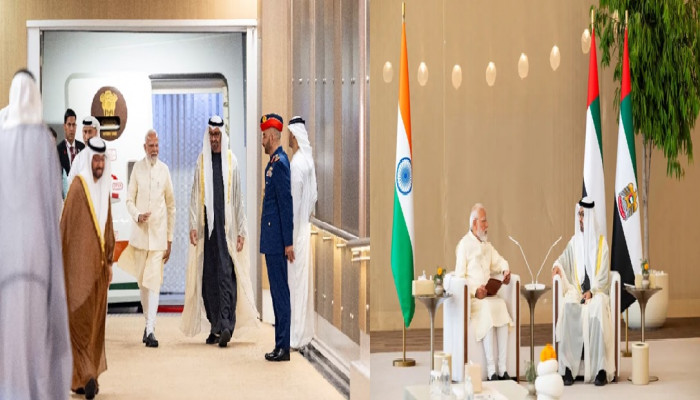
PM Modi made his first stop at Abu Dhabi in his five-nation visit on Friday. Symbolising close ties, F-16 jets escorted Air India One upon entering the UAE’s airspace. PM Modi was warmly received by President Sheikh Mohamed bin Zayed Al Nahyan at the tarmac and extended a ceremonial welcome. PM Modi’s eighth visit to the UAE in twelve years, coming at the thick of the ongoing West Asia conflict, signals solidarity and strong friendship with the UAE.
PM Modi is the first foreign leader to visit the UAE since the conflict began. The UAE faced over 2800 drone and missile attacks, more than any other country. PM Modi strongly condemned the attacks on the UAE and stated, “the manner in which the UAE has been targeted is not acceptable in any form”. The statement, coming at a time when New Delhi is hosting the BRICS Foreign Ministers meeting attended by the Iranian Minister, is doubly significant. He also reiterated the need for unimpeded transit passage through the Strait of Hormuz. Both leaders called for the cessation of attacks on shipping and on mariners.
Prolonged closure of the Strait of Hormuz and aerial attacks on the oil infrastructure have caused trade disruptions. The tremors of the conflict eventually changed the political contours of the region, with the rise of the Saudi Arabia, Egypt, Turkey and Pakistan axis to coordinate diplomatic response.
In a bold move to prioritise national interests, the UAE exited OPEC effective from May 1st. With the restrictive quotas off the table, the post-OPEC scenario has opened new avenues for partnerships. The UAE is set to expand production, infrastructure investment and diversification of energy sources. To bypass the Strait of Hormuz, the UAE is fast-tracking the West-East pipeline to double its export capacity by 2027. The existing Habshan-Fujairah pipeline, built in 2012, currently carries 1.5-1.8 million barrels per day.
Currently, the UAE is India’s fourth-largest supplier of crude oil and largest supplier of LPG. It accounts for 11 per cent of India’s crude and 40 per cent of LPG. India is also the UAE’s largest buyer of LNG, totalling 4.5 metric tonnes per annum. The UAE is the first and only country to participate in India’s Strategic Petroleum Reserve programme. In 2018, Abu Dhabi’s National Oil Company (ADNOC) leased the underground cavern of Mangaluru SPR to store 5 million barrels of crude, which is roughly one day’s worth of consumption.
PM Modi’s short visit of three hours, coming at a time when the world is bracing for shipping disruptions, supply chain vulnerabilities and regional conflicts, has been highly substantial. With the international rule-based order reduced to mere political rhetoric, global conflicts have shifted from being exceptions to becoming the norm. The global commons are becoming increasingly destabilised, disrupting the maritime routes and energy choke points.
The militarisation of the Strait of Hormuz and its subsequent closure have triggered a cascading effect. Forced rerouting has increased transport charges. India imports more than 85% of its energy sources, making it vulnerable to the strategic weaponisation of maritime chokepoints by nations. Energy cooperation has been the primary pillar of the India-UAE partnership.
Moving away from the buyer-seller relationship, in a landmark arrangement, ADNOC has announced to store 30 million barrels of crude in facilities at Visakhapatnam and Odisha’s Chandikol. The UAE will retain the ownership, and India will be allowed to use it during emergencies. Reciprocally, storage facilities at Port Fujairah will now be part of India’s strategic petroleum reserve.
The closure of the Strait of Hormuz has heightened India’s vulnerability, particularly in its LPG and LNG supplies. To minimise risk and mitigate shortages, India is exploring long-term purchase and storage of LPG and LNG.
President MBZ received PM Modi, saying, “welcome to your second home”, reflecting an exceptional trust and confidence. Since PM Modi’s first visit to the UAE in 2015, leaders have personally led the relationship by investing diplomatic capital, time and resources to give the relationship a strategic direction and institutional depth. In 2017, leaders elevated the relationship to a Comprehensive Strategic Partnership, and with the signing of the Comprehensive Economic Partnership Agreement (CEPA) in 2022, bilateral trade reached a new milestone, surpassing $100 billion. The UAE is now India’s seventh-largest investor. What began as reliable economic partnerships is now overshadowed by looming war clouds, pushing nations to prioritise security.
The Iran War has deepened the schisms among the Gulf countries, underscored by the UAE’s withdrawal from OPEC. It has shattered the guarantee of Washington’s security commitment for hosting its military facilities and as a vital deterrent against regional adversaries. Taking a cue from Saudi Arabia’s SMDA, with Pakistan symbolic of the unreliability of the US architectural framework for Gulf countries, President MBZ, on his short visit to New Delhi in January, signed a Letter of Intent (LoI) on a strategic defence partnership. Iran’s full-blown assault on Gulf Countries, especially on the UAE, has been the force behind the conclusion of a framework for a strategic defence partnership with India. This marks the beginning of a new strategic security alignment with India.
Besides defence industrial collaboration, countries will now jointly work on cyber defence, intelligence sharing, interoperability, maritime security and special operations, including training and exercises. Other than security, Abu Dhabi now finds a greater convergence with India on several strategic aspects, including the core objectives of the “We the UAE 2031” vision. The broad pillars of the vision are economic stability, technological modernisation, strategic diversification and maritime security. India’s vibrant markets, opportunities for growth and its role as the regional security provider make it an indispensable partner for the UAE’s economic diversification pursuits.
India’s non-interventionalist approach, expanding economy, technological ecosystem and focus on manufacturing make it a natural partner for the UAE. To shore up marine logistics and ship-repairing infrastructure, countries will now cooperate to set up a ship-repair cluster at Vadinar with an underlying framework to train and employ a skilled maritime workforce.
In a boost to technological modernisation, countries agreed to collaborate to set up an 8 Exaflop Super Computing Cluster as part of the AI Mission India. Additionally, the UAE pledged $5 billion investment in the infrastructure and banking sector.
Steadily exploring newer alignments, the UAE has ratcheted up cooperation with Israel after the 2020 Abraham Accords. Exploring new partnerships, the UAE has become an active part of the I2U2 and aligned its maritime ambitions with the IMEC. Israel is another vital partner of IMEC. Amid the unrelenting Iranian attacks, the UAE has deployed Israeli surveillance and defence systems to protect its strategic assets from Iranian strikes. At a time when a new Middle East Quad is shaping up, PM Modi’s visit to the UAE has shifted attention to the trifecta (India-Israel-UAE) on the horizon.
Prolonged global conflicts have ushered the world into an era of volatility and fragmentation. Seeking stability, nations are recalibrating alliances and strategic partners to bolster economic resilience and energy security. Amid these uncertainties, India’s relationship with the UAE has emerged as a promising anchor. Increasingly, nations are now favouring strategic flexibility over rigid geopolitical blocs. As India and the UAE deepen their alignment, they are restructuring the geopolitical order towards a multipolar world.
Disclaimer: The opinions expressed within this article are the personal opinions of the author. MyIndMakers is not responsible for the accuracy, completeness, suitability, or validity of any information on this article. All information is provided on an as-is basis. The information, facts or opinions appearing in the article do not reflect the views of MyindMakers and it does not assume any responsibility or liability for the same.



 Loading...please wait
Comments