



Power Shift in Vietnam: To Lam Takes Dual Leadership, Signals New Political Era
- In Reports
- 01:27 PM, Apr 07, 2026
- Myind Staff
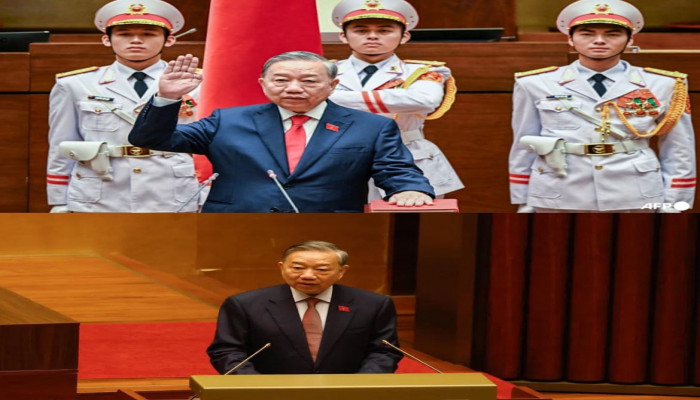
Vietnam has entered a significant political phase as To Lam was unanimously elected as the country’s state president by the National Assembly on Tuesday. Already serving as the General Secretary of the Communist Party, Lam will now hold both positions for the next five years. This development makes him one of the most powerful leaders Vietnam has seen in decades. It also marks a shift away from the country’s long-standing system of collective leadership, where power was traditionally shared among top officials.
The election result was decisive. All 495 lawmakers present at the session supported Lam’s nomination, while five members were absent. The parliament confirmed that the nominations for top leadership roles had already been finalised in a meeting held in late March. With this move, Lam now holds what many are calling a “double mandate,” having already secured a second term as party chief earlier this year. This consolidation of power is being compared to governance styles seen in countries like China, where authority is more centralised.
Later in the day, parliament is expected to appoint a new prime minister, who will succeed outgoing leader Pham Minh Chinh. This leadership reshuffle comes at a time when Vietnam is aiming to strengthen its economic growth and political stability.
Following his election, Lam addressed the National Assembly in a televised speech. He expressed gratitude and described it as an honour to serve in both roles. He outlined his vision for the country’s future, stating his commitment to "a new growth model with science, technology, innovation, and digital transformation as the primary driving forces". He also stressed the importance of strengthening national defence through self-reliance. According to Lam, his main goals include maintaining stability, ensuring rapid yet sustainable development, and improving "all aspects of people's lives".
Experts believe that holding both top positions could help Lam push his agenda more efficiently. However, they also warn about the risks that come with concentrating too much power in one individual. Le Hong Hiep, a senior fellow at the ISEAS Yusof Ishak Institute in Singapore, said, "Concentrating greater power in To Lam's hands could pose risks to Vietnam's political system, such as increased authoritarianism". At the same time, he added that such a structure "could enable Vietnam to formulate and implement policies more quickly and effectively," which may support economic growth.
Alexander Vuving from the Asia-Pacific Centre for Security Studies also highlighted the broader political impact of this change. He said that the combination of roles "will shift Vietnam's domestic politics to a new normal where most of the old assumptions about Vietnam's politics, including those about collective leadership, are no longer valid". These views reflect a growing consensus that Vietnam is entering a new phase in its governance.
This is not the first time Lam has held both positions. After the death of former party chief Nguyen Phu Trong in 2024, Lam temporarily assumed both roles. Even after stepping down as president in favour of army general Luong Cuong, he continued to act as a key representative of the country. He remained active in international engagements and often led meetings with foreign leaders, which indicated his strong influence within the system.
During his earlier tenure as party leader, Lam introduced several economic reforms aimed at improving Vietnam’s global competitiveness. These reforms received mixed reactions. Some praised them for modernising the economy, while others raised concerns about their pace and impact. Lam has consistently supported a shift away from Vietnam’s reliance on low-cost manufacturing, which has long been the backbone of its export economy. Instead, he has promoted a development model focused on innovation and higher-value industries.
At the same time, Lam has shown flexibility in balancing different interests. He has supported the growth of private businesses and large domestic corporations. However, he has also emphasised the importance of state-owned enterprises, especially to reassure more traditional elements within the Communist Party. This dual approach reflects his attempt to maintain political balance while pushing for economic progress.
Foreign investors, who play a crucial role in Vietnam’s economy, have generally viewed Lam as a pro-business leader. They appreciate the country’s political stability and see his leadership as a positive factor for continued growth. However, some concerns remain. His strong backing of national champions and ambitious growth targets has raised questions about potential favouritism, risks of corruption, and the possibility of economic imbalances such as asset bubbles or inefficient investments.
In terms of foreign policy, Lam has maintained a steady and pragmatic approach. He continues to follow Vietnam’s strategy of “Bamboo Diplomacy,” which focuses on balancing relations with major global powers while preserving national independence. He has worked to expand international partnerships without aligning too closely with any one country. Khang Vu, a visiting scholar at Boston College, noted that "Lam's double-hat would not signal any changes in Vietnam's foreign policy, even if there are concerns that Vietnam is concentrating more power in a single individual".
Overall, Lam’s appointment signals a major shift in Vietnam’s political structure. It combines stability with the possibility of faster decision-making. At the same time, it raises important questions about the future direction of governance in the country. As Vietnam moves forward under this new leadership model, the balance between efficiency and accountability will remain a key issue to watch.



 Loading...please wait
Comments