




Political storm kicks in Nepal, protestors demand resignation of Balen Shah over his border remarks
- In Reports
- 01:17 PM, Jun 03, 2026
- Myind Staff
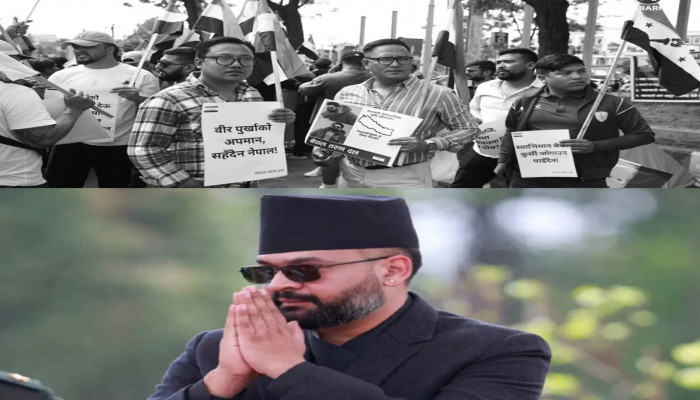
Nepal Prime Minister Balendra "Balen" Shah is facing mounting pressure after his remarks on the India-Nepal border dispute sparked a major political controversy. His statement in Parliament has united opposition parties and student groups, many of whom are now demanding his resignation. The controversy has also reignited debate over the long-standing border dispute between India and Nepal involving Kalapani, Lipulekh and Limpiyadhura.
During a discussion in Nepal's Parliament on Sunday, Shah stated that the border dispute between India and Nepal was not a one-sided issue. He said Nepal had also crossed into Indian territory at several points along the border. His comments immediately triggered criticism across the political spectrum and led to widespread protests.
Shah reportedly called for the dispute to be resolved through the findings of historians, surveyors and experts. He referred to diplomatic notes exchanged between India and Nepal and even suggested the involvement of the United Kingdom because of colonial-era maps linked to the dispute. He argued that the issue should be addressed through mutual understanding rather than accusations from one side.
India responded to the remarks on Tuesday. The Ministry of External Affairs made it clear that there can be no role for any third party in matters related to the India-Nepal border. MEA spokesperson Randhir Jaiswal said boundary-related matters are strictly bilateral and are being addressed through mechanisms already established by both countries.
The controversy comes years after Nepal, under former Prime Minister KP Sharma Oli, took steps to strengthen its territorial claims. Oli's government had approved an updated national map that included the disputed regions within Nepal's borders.
Balen Shah, a former rapper, Bengaluru-trained engineer and former mayor of Kathmandu, rose to power as a political outsider. He gained popularity by challenging Nepal's traditional political establishment and rode a wave of public support and protests to become Prime Minister.
His earlier actions had also generated debate. While serving as Kathmandu's mayor, Shah displayed a "Greater Nepal" map in his office. The move was widely viewed as a response to the "Akhand Bharat" map displayed in the Indian Parliament.
Public anger over Shah's latest remarks was swift. On Monday, student organisations staged a protest at Maitighar Mandala in Kathmandu. According to The Kathmandu Post, demonstrators gathered under the slogan "Let's protect sovereignty" and accused the Prime Minister of making "anti-national" statements.
The Nepali Congress-affiliated Tarun Dal also organised a peaceful protest march at the same location. Protesters criticised what they described as irresponsible comments by the Prime Minister. Opposition parties argued that Shah's statement weakened Nepal's long-standing position on the border issue.
The Kathmandu Post reported that many protesters believed acknowledging Nepali encroachment into Indian territory could weaken Kathmandu's negotiating position in future discussions with India.
The controversy also disrupted proceedings inside Parliament. Lawmakers protested in both the House of Representatives and the National Assembly. Opposition members demanded that Shah apologise and that his remarks be removed from official parliamentary records.
Several opposition parties, led by the Nepali Congress and CPN-UML, staged protests inside Parliament on Monday. According to news agency ANI, lawmakers raised slogans and demanded Prime Minister Balendra Shah's resignation, accusing him of failing to provide satisfactory answers to the House.
As criticism intensified, Nepal's Foreign Ministry stepped in to clarify the Prime Minister's comments. The ministry said Shah was referring to practical and localised border management issues rather than making concessions on major territorial disputes. Officials explained that the remarks related to activities in no-man's-land areas and changes caused by natural features such as rivers.
The ministry said, "The issue mentioned by the prime minister in Parliament is essentially related to encroachment in the Dasgaja area [no-man's land] and cross-border occupation."
The clarification, however, did little to calm the political storm. Critics continued to argue that Shah's remarks undermined Nepal's consistent diplomatic position regarding the disputed territories.
At the centre of the controversy is the long-running territorial dispute involving Kalapani, Lipulekh and Limpiyadhura. The disputed region covers around 370 square kilometres near the India-Nepal-China tri-junction and remains one of the most sensitive issues in bilateral relations.
The roots of the dispute date back to the 1816 Treaty of Sugauli, signed between the Nepalese monarchy and the British East India Company after the Anglo-Nepalese War. The treaty identified the Kali River as Nepal's western boundary. However, India and Nepal disagree over the exact source and course of the river, leading to different interpretations of the border.
Nepal maintains that the Kali River originates at Limpiyadhura. Based on this interpretation, it claims that Kalapani and Lipulekh fall within Nepali territory. India, however, argues that the river's source is located near Kalapani. It cites historical records, surveys and long-standing administrative control as evidence supporting its position.
India currently administers the disputed region as part of Uttarakhand's Pithoragarh district and has maintained a presence there for decades due to its strategic importance near the Chinese border. Nepal has continued to pursue its claims through diplomatic channels and updated official maps. India has consistently rejected those claims and maintains that its position is backed by historical and legal evidence.
Lipulekh Pass remains especially important because it serves as a major trade route and a key pathway for Indian pilgrims travelling to Mount Kailash in Tibet. The issue gained fresh attention in 2020 when India's Border Roads Organisation (BRO) inaugurated a road leading to the pass. Nepal strongly objected to the project.
At the time, then-Army Chief General MM Naravane suggested that Nepal's opposition to the road project may have been influenced by an external actor, an apparent reference to China. Since then, the issue has remained highly sensitive in India-Nepal relations.
The latest controversy highlights the delicate balance Nepal must maintain in its relationship with India. The two countries share deep cultural, economic and people-to-people ties. Their open border allows the free movement of people and trade.
For Balen Shah's government, the immediate focus is now on limiting political damage and reaffirming its commitment to resolving border disputes through dialogue. In a striking twist, a leader who rose to national prominence through public protests is now facing protests of his own only months after taking office.



 Loading...please wait
Comments