




Policing New Battlespace, Case for a 21st-Century Police Force: Cybercrime, Narco-Terror, Jihadi Networks
- In Current Affairs
- 02:23 PM, Jun 22, 2026
- YagnaSri
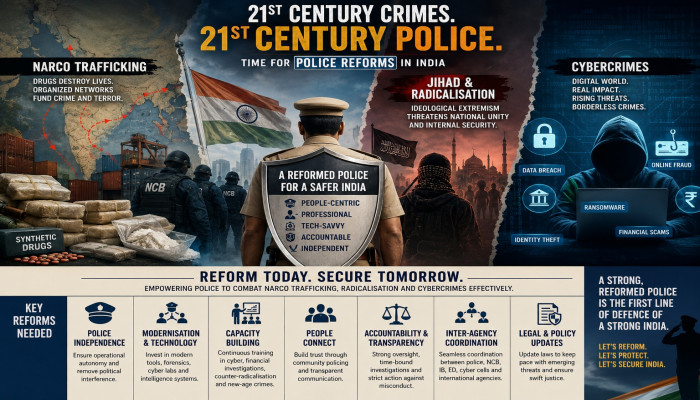
The Enemy Has Changed. The Police Have Not.
When the Police Act of 1861 was drafted, the threats it was designed to address were essentially pre-industrial: seditious gatherings, armed peasant uprisings, banditry, and enforcement of property rights in a rural economy. The police officer of 1861 carried a lathi, operated in a district, and answered to the District Magistrate.
The police officer of 2025 is expected to investigate cryptocurrency heists orchestrated from servers in Southeast Asia, intercept drone-dropped narcotics along the Line of Control, detect dark-web radicalisation networks, counter deepfake-enabled financial fraud targeting millions simultaneously, and dismantle transnational organised crime syndicates whose operations span a dozen jurisdictions. The tools of crime have undergone a revolution of epochal proportions. The institutional architecture of policing has not.
This is not merely a question of training or technology acquisition. It is a question of fundamental structural reform — the design of a policing institution appropriate to the threat environment of the 21st century, in a nation that is simultaneously the world's most populous democracy, a rapidly digitalising economy, and a strategic target of state-sponsored terrorism and narco-trafficking from hostile neighbours.
The New Crime Landscape: Four Converging Threats
Threat One: The Cybercrime Tsunami
The scale of cybercrime in India has reached crisis proportions that demand a generational rethinking of police capabilities. According to the National Cybercrime Reporting Portal (NCRP) managed by the Ministry of Home Affairs, cybercrime complaints surged from 25,049 in 2019 to over 15.56 lakh in 2023 — a sixty-fold increase in four years. Between January and April 2024 alone, approximately 7.41 lakh complaints were registered, with daily complaints reaching 7,000 — a 113.7 per cent increase over the previous year.
The financial dimension is equally alarming. Indians lost Rs 1,750 crore between January and April 2024 alone to cybercriminals. A 2025 analysis by CloudSEK projected that India could face direct financial losses of ₹20,000 crore from cybercrime in 2025, driven primarily by fake digital identities and fraudulent domains. The Data Security Council of India's Cyber Threat Report 2025 warned that AI-driven and deepfake-enabled cyberattacks were anticipated to reach extremely high levels.
The topology of cybercrime has transformed dramatically. The era of phishing emails has given way to:
- Cybercrime-as-a-Service (CaaS): Organised, offshore "scam factories" — largely operating from Myanmar and Cambodia — running call-centre-style financial fraud operations targeting Indian citizens with "digital arrest" scams, investment fraud, and OTP theft
- Deepfake-enabled fraud: AI-generated videos impersonating family members, senior officials, and business leaders to extract money or sensitive information
- Cryptocurrency laundering: The WazirX hack of July 2024, attributed to the North Korea-linked Lazarus Group, resulted in theft of approximately USD 234.9 million in digital assets
- State-sponsored cyber operations: Pakistan-linked groups conduct persistent cyber espionage targeting India's defence, financial, and critical infrastructure sectors
India's institutional response has shown genuine innovation: the Indian Cybercrime Coordination Centre (I4C), CERT-In, and the Defence Cyber Agency represent real progress, and India achieved Tier 1 status in the International Telecommunication Union (ITU's) Global Cybersecurity Index in 2024. Yet state police forces remain almost entirely unprepared for cyber investigation. Intermediaries based abroad frequently refuse to share information — some cases have been pending for over a decade — and the structural mismatch between bureaucratic police organisations and the speed of digital criminality represents a systemic vulnerability of the first order.
Threat Two: Narco-Terror — The Weaponisation of Addiction
India's location between the Golden Crescent (Afghanistan-Pakistan-Iran) to its northwest and the Golden Triangle (Myanmar-Laos-Thailand) to its northeast places it at the geographic epicentre of the global narcotics trade. This geographical reality has been systematically exploited by Pakistan-based terror networks to simultaneously generate terrorist financing and destroy target communities through addiction — a dual strategy that security analysts describe as narco-terrorism.
During 2024, narcotics worth over Rs 25,330 crore were seized by various agencies — a 55 per cent increase over 2023, reflecting both enhanced enforcement and exponential expansion of trafficking operations. The Comprehensive Integrated Border Management System (CIBMS), integrating thermal imaging cameras, ground sensors, radar systems, and drone surveillance across 4,096 kilometres of vulnerable borders, represents a genuine technological upgrade.
The narco-terror threat operates through three convergent mechanisms: financial (drug proceeds funding terrorist infrastructure through the same hawala networks used for terror financing), social destabilisation (deliberate flooding of Punjab, J&K, and border states with cheap high-purity narcotics to degrade military-age population cohesion), and operational concealment (embedding terrorist logistics within drug trafficking to maintain ISI deniability). Kerala's June 2026 launch of Operation Toofan: The Narco Hunt and the NCB's seizure of "Jihadi drugs" in Delhi in May 2026 underscore the urgency of this convergent threat.
State police forces are structurally ill-equipped to address narco-terror as an integrated threat. Their jurisdictional limits — state boundaries — create seams that transnational trafficking networks exploit with precision. The absence of Joint Operational Centres meaningfully integrating state police intelligence with NCB, IB, BSF, Coast Guard, and financial intelligence data represents a critical gap in India's counter-narcotics architecture.
Threat Three: Jihadi Terror — The Hybrid Warfare Dimension
The Pahalgam terrorist attack of April 2025 — confirmed by the NIA as planned and coordinated from Lahore under ISI direction through the Lashkar-e-Taiba proxy, The Resistance Front — and India's military response through Operation Sindoor underscored an enduring strategic reality: jihadi terrorism targeting Indian civilians and institutions remains a persistent, state-sponsored, externally directed threat.
Contemporary jihadi networks operate across a convergent hybrid spectrum. Drone-based infiltration allows cross-border handlers to deliver weapons and narcotics while evading human interdiction. Digital radicalisation through encrypted messaging applications enables targeting of sympathisers without physical contact. The arrest in May 2026 of nine individuals linked to Pakistan's ISI and Dawood Ibrahim — planning attacks in Delhi and Mumbai — confirmed the persistence of structured sleeper networks. Terror financing through shell companies, real estate, cryptocurrency, and hawala creates detection challenges that demand sophisticated financial intelligence capacity far beyond standard police training.
First-responder capacity — the ability of state police to identify and correctly classify early indicators of jihadi network activity — remains critically insufficient, partly due to inadequate training and partly due to intelligence silos. The structural subordination of state police to political executives who may have their own electoral calculations regarding the characterisation of communal violence compounds this vulnerability.
Threat Four: The New Economy Crime Frontier
India's rapidly digitalising economy has created a new frontier of economic criminality that existing police frameworks are almost entirely unequipped to address. Cryptocurrency-related money laundering, tax evasion, and terrorist financing present evidence and jurisdictional challenges unprecedented in traditional financial crime investigation. Platform-enabled organised crime dark-web drug marketplaces, human trafficking facilitated through social media and organised gambling through offshore servers involve crime forms that traditional police structures built around physical geography cannot effectively address. AI-enabled impersonation and deepfake technology has already been weaponised for financial fraud, non-consensual intimate imagery, and political disinformation at scale.
What 21st-Century Police Reform Must Deliver?
The threat landscape described above makes one conclusion inescapable: the structural reforms recommended by every commission since 1977 are not merely desirable; they are existentially necessary. But the reform agenda must now go beyond what the National Police Commission envisaged and incorporate a new generation of institutional requirements.
First: Specialist Cadres, Not Generalists
Modern police forces cannot be built on the model of a generalist constabulary. The criminal threat environment demands specialist cadres with dedicated career tracks, training ecosystems, and operational mandates in: Cyber Crime Investigation (digital forensics, blockchain analysis, platform interface protocols); Financial Crime and Anti-Money Laundering (corporate financial structures, hawala identification, cryptocurrency analysis); Counter-Terrorism and Intelligence (radicalisation indicators, HUMINT development, fusion centre operations); and Narcotics Investigation (trafficking route analysis, controlled deliveries, asset forfeiture).
Second: Forensic Infrastructure as a National Priority
The BNSS mandates forensic examination for offences carrying seven-year sentences or more. This mandate is currently a promise on paper. India's forensic infrastructure deficit is severe: inadequate regional laboratories, chronic sample backlogs, and a shortage of qualified forensic scientists. The MHA's investment in new National Forensic Sciences University campuses in Raipur and Kolkata is welcome, but the scale must match the obligation the new criminal laws impose. A National Forensic Science Mission, funded through the Union with shared infrastructure and expert deployment protocols, is the appropriate institutional response.
Third: Technology as Infrastructure, Not as Add-On
The Crime and Criminal Tracking Network System (CCTNS), enabling e-FIRs and the Interoperable Criminal Justice System (ICJS), represents genuine digital infrastructure progress. State police forces must be supported through AI-assisted FIR analysis to identify repeat offenders and gang networks in real time, facial recognition and biometric identification with appropriate judicial oversight, and encrypted inter-agency communication enabling genuine intelligence sharing between state CID, NIA, IB, NCB, ED, and central intelligence agencies without the silos that allow threats to slip through.
Fourth: The Human Capital Revolution
India's police vacancy crisis is a structural emergency: the national sanctioned police-to-population ratio is approximately 181 per 100,000, already well below the UN-recommended 222 per 100,000 — and actual deployment ratios in most states are significantly lower due to VIP protection deployments and administrative duties consuming field manpower. Recruitment must be expanded, but expansion without quality transformation is counterproductive. Higher minimum educational qualifications, psychometric testing, mandatory constitutional values training, and competitive compensation structures are essential. The Padmanabhaiah Committee's recommendation — reducing constable recruitment and increasing Sub-Inspector-level entry — remains structurally sound.
Fifth: A New Legal Framework for New Crimes
The BNS has made significant progress — criminalising terrorism, organised crime, and mob lynching, and bringing digital evidence within the primary evidence framework. But specific legislative gaps demand urgent attention: a comprehensive Cybercrime Prevention Act with extraterritorial jurisdiction provisions and mandatory platform cooperation obligations; AI regulation defining liability for AI-generated content used in crime; strengthened anti-money laundering provisions addressing cryptocurrency environments; and a National Database of Offenders integrated across state boundaries.
The International Benchmark
The United Kingdom operates specialist National Crime Agency units separate from territorial police forces for organised crime, child protection, cyber, and economic crime, with their own career tracks and dedicated resources. The United States operates a fusion centre model for terrorism and organised crime, where federal, state, and local law enforcement share intelligence on a real-time basis. Israel's approach integrates military intelligence, civilian intelligence (Shin Bet), police, and border security through coordination frameworks that mandate information sharing at the decision-making level.
India's Multi-Agency Centre (MAC) and state-level SMACs represent movement in the right direction. But they must be operationalised with genuine decision-making authority, adequate staffing, and a legal framework that mandates participation by all relevant agencies.
Conclusion: The Security of Bharat Demands Structural Reform
India faces a security environment of exceptional complexity. The threats are real, persistent, technologically sophisticated, and in several cases, state-sponsored by hostile neighbours. The response cannot be improvised. It must be built — systematically, sustainably, and immediately.
The structural reforms recommended across six decades of commission reports are not historical curiosities. In the context of the 21st-century threat landscape, they are the absolute minimum preconditions for an effective security apparatus. The political will to implement them — to genuinely decouple the police from political patronage, to fund specialist cadres, to build forensic infrastructure, to operationalise intelligence fusion, and to replace the 1861 statute — is the single most critical variable in India's security trajectory.
The choice is not between reform and stability. It is between reform and strategic vulnerability. A police force chained to partisan political control, institutionally incapable of investigating cybercrime, structurally unprepared for counter-terrorism, and chronically underfunded in forensics cannot protect a Viksit Bharat from the threats that seek to undermine it.
The Bharatiya Nyaya Sanhita speaks of Nyaya justice. Justice requires not only good laws, but institutions capable of delivering them. The time for that institutional transformation is not tomorrow. It is now.
Disclaimer: The opinions expressed within this article are the personal opinions of the author. MyIndMakers is not responsible for the accuracy, completeness, suitability, or validity of any information on this article. All information is provided on an as-is basis. The information, facts or opinions appearing in the article do not reflect the views of MyindMakers and it does not assume any responsibility or liability for the same.



 Loading...please wait
Comments