




PoK JAAC leader urges India for humanitarian help as unrest deepens
- In Reports
- 01:49 PM, Jul 06, 2026
- Myind Staff
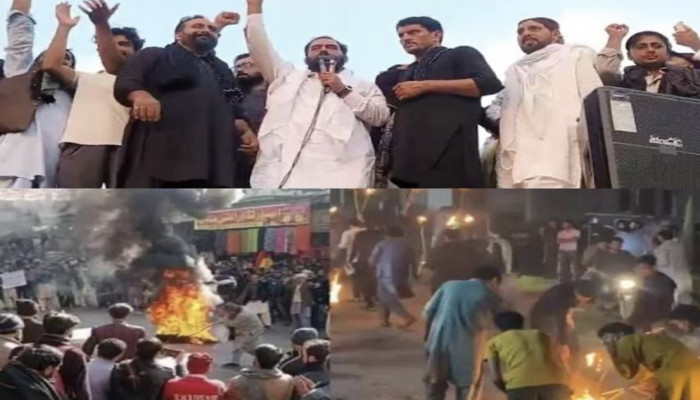
The political unrest in Pakistan-occupied Kashmir (PoK) has taken a serious turn as Joint Awami Action Committee (JAAC) leader Sardar Aman Khan appealed to India for humanitarian assistance. He claimed that the Pakistani administration has created an economic blockade in the region after launching a major crackdown on protesters. Khan urged India to open the Line of Control (LoC) and allow civilians to cross if the situation continues to worsen.
Addressing a large gathering at Rawalakot's Eidgah Ground, Khan spoke about the hardships faced by people in POK. He claimed that residents are struggling with shortages of essential supplies. "We need India's help. There is a shortage of rations... and we need your help," Khan said in a video that has widely circulated on social media. He alleged that security forces have intensified operations against protesters, leading to shortages of food and medicines and creating a severe humanitarian crisis in the region.
During the rally, Khan asked the crowd whether they should move towards the Line of Control. The gathering repeatedly responded, "Move towards it." He also warned that if the authorities continue to answer the people's demands with bullets, "we also have other paths."
Khan appealed to India to open the LoC in the Poonch and Doda sectors. He claimed that such a step would help people facing increasing difficulties under Islamabad's actions. He argued that civilians should have the option to move to India if conditions continue to deteriorate.
NDTV could not independently verify the authenticity of the video. Reports suggest that the footage is from Khan's public rally held on June 30.
The appeal comes at a time when PoK has witnessed large-scale protests for more than a month. The unrest has reportedly claimed dozens of lives. Last week, thousands of people gathered at the Eidgah Ground for a massive protest. The crowd raised slogans such as "POK is not part of Pakistan" and "We want freedom." The slogans reflected a major shift in the movement. What started as protests demanding reforms has now turned into a wider call for independence from Pakistan's political control over the region.
Political experts believe that the current crisis highlights the growing gap between the local population and the regional administration. They argue that the government in POK has little real authority and remains dependent on Islamabad for major decisions. According to them, the latest developments have exposed the dissatisfaction among many residents.
Experts also believe that Pakistan's decision to ban the JAAC and use force against protesters reflects a broader strategy led by the country's military establishment. They argue that the authorities want to suppress the increasing public protests across the occupied territory.
The unrest intensified after Pakistani authorities officially banned the JAAC on June 5. The government declared the grassroots organisation a "terrorist" group. The move drew attention to the shrinking political space for local organisations in POK. Pakistan has traditionally relied on its mainstream political parties to govern the region. These parties have remained in power for decades, while local political groups have gradually lost influence.
A recent report by the International Centre for Peace Studies also examined the political situation in Pakistan-occupied Kashmir and Pakistan-occupied Gilgit-Baltistan (PoGB). The report stated that the party ruling in Islamabad has consistently won elections in both regions. It argued that this repeated pattern cannot simply be treated as a coincidence. The report suggested that Islamabad continues to maintain strong political control over the occupied territories through its established political system.
The ongoing protests and Khan's appeal have drawn fresh attention to the situation in PoK. His call for humanitarian assistance and the demand to open the Line of Control have added a new dimension to the crisis. The developments have also raised concerns over the humanitarian conditions in the region as political tensions continue to grow.



 Loading...please wait
Comments