




PM Modi launches projects worth ₹33,500 crores in Delhi, inaugurates two new metro corridors
- In Reports
- 12:05 PM, Mar 09, 2026
- Myind Staff
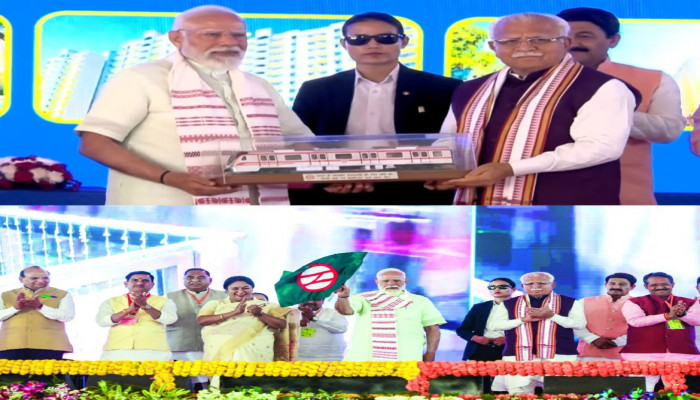
Prime Minister Narendra Modi on Monday inaugurated and laid the foundation stone for multiple development projects worth around ₹33,500 crore in New Delhi. The projects include major infrastructure developments and new corridors of the Delhi Metro aimed at improving connectivity and strengthening urban facilities in the national capital.
Speaking at the event, the Prime Minister said that the facilities and infrastructure in the national capital are continuously being improved. He highlighted that the projects launched today will help improve connectivity and make daily life easier for the residents of Delhi.
PM Modi said, “The facilities and infrastructure in the national capital are being steadily strengthened and expanded.” He added that the new metro section that has been opened will provide major benefits to millions of people living in the city.
The Prime Minister also spoke about the role of women in India’s development. He said the country is witnessing a new chapter in women's empowerment and that women are playing a significant role in nation-building. Referring to the leadership of Delhi Chief Minister Rekha Gupta, PM Modi said the city is witnessing continuous development.
He said, “India is scripting a new chapter in women's empowerment and they are playing an important role in the country’s development.” He further stated, “India’s women’s power is moving ahead with renewed energy in every sector and making a significant contribution to nation-building.”
During his address, the Prime Minister also criticised the previous Delhi government led by the Aam Aadmi Party. PM Modi alleged that several development works in the capital had been delayed for nearly a decade.
He said, “For nearly ten years, the Aam Aadmi Party government in Delhi had stalled every development work. PM Modi added that the current BJP government is working with a mission approach to address various challenges faced by the national capital. He said, “Now the BJP government is working in mission mode to resolve various challenges related to Delhi.”
The Prime Minister also spoke about efforts being made to clean the Yamuna River. According to him, the government has started several projects worth crores of rupees to improve the condition of the river and restore its cleanliness.
Apart from development projects in Delhi, the Prime Minister also commented on an incident involving President Droupadi Murmu during her visit to West Bengal. PM Modi accused the Trinamool Congress (TMC) government in the state of disrespecting the President during an event.
He said, “President Murmu had gone to West Bengal to attend a major festival of the tribal community, and instead of honouring the President, the TMC boycotted the event.”
The Prime Minister noted that President Murmu herself belongs to the tribal community and has consistently expressed concern about the development of the Santhal tribal society.
He said, “This is not only an insult to the President but also an insult to the Constitution of the country and the great traditions of democracy.”
A major part of the programme focused on expanding the Delhi Metro network. Prime Minister Modi inaugurated and laid the foundation stone for metro projects worth about ₹18,300 crore. As part of this, two new metro corridors were also inaugurated.
The first corridor is the Majlis Park–Maujpur Babarpur section of the Pink Line, which is approximately 12.3 kilometres long. The second corridor is the Deepali Chowk–Majlis Park section of the Magenta Line, which is about 9.9 kilometres long.
These new metro routes will improve connectivity across several areas of Delhi, including Burari, Bhajanpura, Yamuna Vihar, Madhuban Chowk, Bhalaswa and Majlis Park. The new links are expected to make travel easier for commuters living in these regions.
The Prime Minister also laid the foundation stone for three additional metro corridors under Phase 5-A of the Delhi Metro project. Together, these corridors will cover a route length of around 16.10 kilometres.
The three new planned corridors include R.K. Ashram Marg to Indraprastha, Aerocity to Indira Gandhi Airport Terminal-1, and Tughlakabad to Kalindi Kunj. These routes will provide direct connectivity to important parts of the capital and improve travel between Noida, South Delhi and the airport.
Union Housing and Urban Affairs Minister Manohar Lal Khattar also spoke at the event. He said that the metro rail has become an essential part of daily life in Delhi. He said, “Metro rail has become the lifeline of Delhi and is helping commuters to save considerable travel time.”
He also spoke about the expansion of metro networks across India. According to the minister, before 2013-14, the country had only around 245 kilometres of metro network spread across five cities.
He said that under the leadership of Prime Minister Modi, metro development has accelerated significantly in the past eleven years. The combined network of metro lines and Namo Bharat RRTS has now reached about 1,100 kilometres.
The Minister added that with this growth, India has become the third-largest country in the world in terms of metro rail networks after the United States and China.
The programme was attended by Delhi Chief Minister Rekha Gupta, Minister of State for Housing and Urban Affairs Tokhan Sahu and other officials.
Earlier in the day, Prime Minister Modi also visited the General Pool Residential Accommodation (GPRA) Type-5 quarters in Sarojini Nagar in New Delhi. During the visit, he handed over house keys to women allottees and interacted with Women Shram Jeevi workers.
The Prime Minister also inaugurated and laid the foundation stone for projects worth ₹15,200 crore under the GPRA redevelopment plan. These projects are located in Sarojini Nagar, Netaji Nagar, Kasturba Nagar and Sriniwaspuri.
The redevelopment programme aims to modernise government residential colonies and create better infrastructure for government employees and administrative offices.
The projects are being implemented through a self-sustainable financial model designed to avoid putting pressure on public funds. Under this model, the government is developing and monetising a limited portion of the project area for commercial and residential use to finance the redevelopment work.
Revenue generated through this process will be used to fund modern government housing, infrastructure and public facilities.
Once completed, the redevelopment plan will provide more than 9,350 modern flats for government employees. It will also create around 48 lakh square feet of office space.
The government said the project will help improve administrative efficiency and also create opportunities for monetisation.



 Loading...please wait
Comments