




PM Modi launches ₹1.06 lakh crore projects, unveils India's first integrated refinery-cum-petrochemical complex
- In Reports
- 06:18 PM, Jul 04, 2026
- Myind Staff
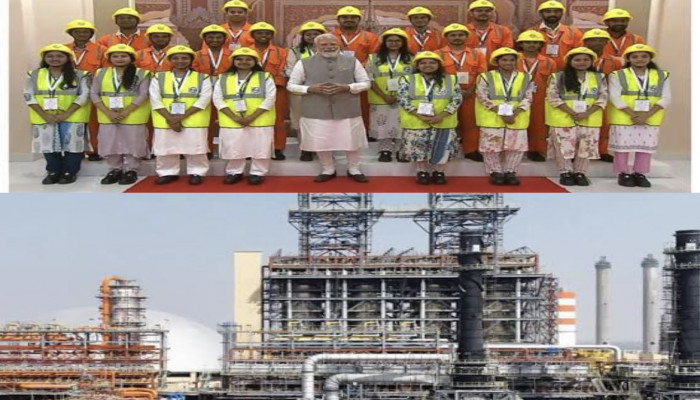
Prime Minister Narendra Modi dedicated India's first integrated refinery-cum-petrochemical complex with a refining capacity of 9 million metric tonnes per annum (MMTPA) to the nation on Saturday. He also launched and laid the foundation stone for several major development projects worth around ₹1.06 lakh crore in Rajasthan. The projects cover important sectors such as energy, railways, roads, urban transport, renewable energy, power transmission, and aviation.
Union Petroleum and Natural Gas Minister Hardeep Singh Puri and Rajasthan Chief Minister Bhajanlal Sharma attended the programme at Pachpadra in Rajasthan's Balotra district.
The integrated refinery-cum-petrochemical complex has been developed as a joint venture between Hindustan Petroleum Corporation Limited (HPCL) and the Rajasthan government. The project has been built with an investment of more than ₹79,450 crore. It is India's first refinery that combines petroleum refining with petrochemical production at the same location.
The complex has a petrochemical production capacity of 2.4 MMTPA. It also has a Nelson Complexity Index of 17.0, which reflects its advanced refining capability. The refinery can achieve petrochemical yields of more than 26 percent. These figures match global standards for efficiency and sustainability.
"The project is expected to play a pivotal role in strengthening India's energy security, enhancing petrochemical self-sufficiency, and driving industrial growth," the government said in a release, adding that it will serve as an anchor industry for the development of a Petrochemical and Plastic Park in the region.
Prime Minister Modi also laid the foundation stone for Phase 2 of the Jaipur Metro Rail Project. The project involves an investment of more than ₹13,000 crore. The second phase will develop a 41-kilometre north-south metro corridor from Prahladpura to Todi Mod. The route will connect major industrial and residential areas, including Sitapura and Vishwakarma Industrial Area (VKI). It will have 36 metro stations.
The metro corridor will improve connectivity to important locations such as the Sitapura Industrial Area, VKI, Jaipur Airport, Tonk Road, SMS Hospital, SMS Stadium, Ambabari, and Vidyadhar Nagar. The first phase of the Jaipur Metro already operates an 11.64-kilometre corridor with 11 stations.
The Prime Minister also dedicated the Churu-Sadulpur and Churu-Ratangarh rail doubling projects to the nation. The Churu-Sadulpur section covers 58 kilometres, while the Churu-Ratangarh section spans 46 kilometres. The two railway projects have been completed at a cost of around ₹900 crore. Together, they add 104 kilometres of improved railway connectivity in north-west Rajasthan and will strengthen transportation in the region.
Modi also inaugurated the four-laning of the NH-125A Jodhpur Ring Road Section-2 between Karwar and Dangiyawas. The road project has been completed at a cost of ₹740 crore and is expected to improve road connectivity and traffic movement.
In the renewable energy sector, the Prime Minister dedicated SJVN Limited's 1,000 MW Bikaner Solar Energy Project to the nation. The project has been developed with an investment of around ₹5,500 crore. He also inaugurated NHPC's 300 MW Karnisar Bikaner Solar Energy Plant.
The SJVN solar project uses 24.22 lakh domestically manufactured solar modules. The NHPC solar plant uses nearly 7.75 lakh domestically manufactured solar photovoltaic cells and modules. These projects support India's clean energy goals and promote the use of locally manufactured equipment.
Under the renewable energy initiatives, Modi also inaugurated a power transmission line built at a cost of more than ₹1,900 crore. The transmission line will evacuate electricity generated from the Rajasthan Renewable Energy Zone (REZ). He also laid the foundation stone for a new 530-kilometre power transmission system for the Rajasthan REZ. These transmission systems will help transfer renewable energy efficiently and ensure an uninterrupted electricity supply across the state.
Ahead of the Prime Minister's visit, Union Petroleum and Natural Gas Minister Hardeep Singh Puri highlighted the importance of the refinery project.
"The country is getting a new greenfield refinery after ten years," he told reporters here ahead of the PM's visit.
Prime Minister Modi also inaugurated the newly built terminal at Jodhpur Airport on Saturday. He launched the Modified UDAN Scheme in the city to strengthen the vision of 'Ude Desh Ka Aam Nagrik'. The government expects the scheme to accelerate the next phase of aviation-led development. It focuses on several strategic areas designed to improve regional air connectivity across the country.
The new airport terminal at Jodhpur has been developed at a cost of ₹480 crore. It covers more than 23,000 square metres and can handle up to 20 lakh passengers every year. The terminal's architecture draws inspiration from Rajasthan's royal heritage. It combines modern passenger facilities with traditional features such as arches and jharokhas. The new terminal is expected to support tourism, trade, and employment in the region.
The terminal also follows sustainable design practices. According to a release issued by the Press Information Bureau, it includes water conservation measures, energy-efficient systems, and green building practices. The building aims to achieve a 5-Star GRIHA rating.
The Modified UDAN Scheme has received an allocation of ₹28,840 crore for the next ten years. The investment aims to strengthen India's aviation sector and improve regional connectivity. On July 3, PM Modi shared the scheme's focus in a post on X.
"The focus of the scheme would be "on developing 100 aerodromes from existing unserved strips and allocating more resources to Operations and Maintenance (O&M) support."
The scheme also proposes the development of 200 modern helipads to improve connectivity in remote and difficult regions. It continues support for Viability Gap Funding (VGF) for airlines, with more than ₹10,000 crore allocated for this purpose. The funding will support regional flight operations and improve their long-term commercial viability. The scheme also promotes the procurement of indigenous aircraft and helicopters. This step aims to strengthen connectivity in underserved areas and supports the vision of Aatmanirbhar Bharat.
Apart from the Rajasthan projects, Prime Minister Modi will also inaugurate the CG Semi Outsourced Semiconductor Assembly and Test (OSAT) facility in Sanand, Gujarat. The facility marks another major step in strengthening India's semiconductor manufacturing ecosystem.



 Loading...please wait
Comments