



Philippines accuses China of using cyanide to poison waters near South China Sea atoll
- In Reports
- 01:26 PM, Apr 14, 2026
- Myind Staff
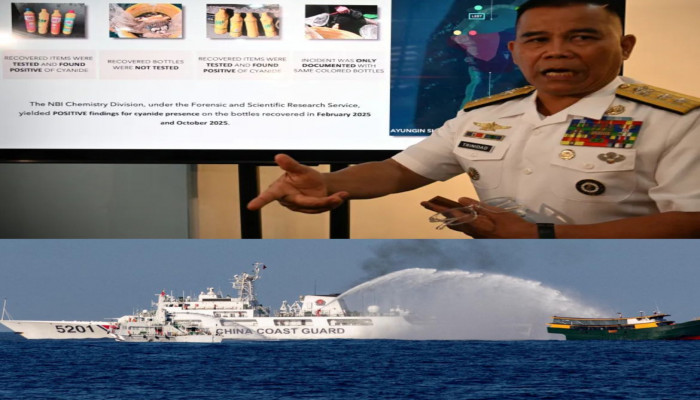
The Philippines has accused China of using cyanide near a disputed atoll in the South China Sea, raising serious concerns about environmental damage and regional tensions. Officials in Manila claim that the toxic substance was found on Chinese fishing boats operating close to Second Thomas Shoal, a strategically important reef in the Spratly Islands. The discovery has led to fears that marine ecosystems could be harmed and that the stability of a grounded Philippine warship in the area could be affected.
According to Philippine security officials, laboratory tests confirmed the presence of cyanide in bottles seized by the navy last year. The samples were collected near Second Thomas Shoal, which the Philippines calls Ayungin Shoal. The reef is significant because it supports a warship that the Philippines deliberately grounded there to assert its territorial claim. Officials warned that the use of cyanide could weaken the reef structure and disrupt the natural balance of marine life in the area.
Cornelio Valencia, spokesperson for the National Security Council, strongly criticised the alleged use of the chemical. “We wish to underscore that the use of cyanide in Ayungin Shoal is a form of sabotage that seeks to kill local fish populations, depriving navy personnel of a vital food source,” he said during a press conference. He added that cyanide exposure could damage coral reefs and “ultimately compromise” the stability of the grounded vessel.
China has firmly rejected these accusations. Its Foreign Ministry dismissed the claims as baseless and politically motivated. Spokesperson Guo Jiakun responded by saying, “The Philippine side illegally harassed the Chinese fishing boats conducting normal fishing, grabbed the fishermen’s living supplies, and staged this so-called cyanide stunt. There is no credibility whatsoever to their story.” Beijing maintains that its fishing activities in the region are lawful and denies any involvement in harmful practices.
The situation reflects ongoing tensions between the two countries in the South China Sea. The Philippines has repeatedly accused China of interfering with its resupply missions to troops stationed on the grounded warship. One such incident occurred on June 17, 2024, when a confrontation turned violent and resulted in a Filipino sailor losing a finger. These encounters have increased concerns about safety and stability in the region.
Further incidents have also been reported. In December 2025, the Philippines claimed that Chinese coastguard ships used water cannons against Filipino fishermen near Sabina Shoal. The attack reportedly injured three people and caused significant damage to two fishing vessels. China has denied these allegations as well and accused the Philippines of entering waters it considers its own.
Despite the rising tensions, both countries have attempted to maintain dialogue. High-level talks were held last month to explore possible cooperation in oil and gas development, as well as confidence-building measures at sea. These discussions included proposals to improve communication between coastguards to prevent misunderstandings and clashes. However, the Philippine Foreign Ministry clarified that any cooperation would remain limited. It stated that such efforts “does not contemplate cooperation in sensitive operational areas” and confirmed that joint patrols were not discussed.
The South China Sea remains one of the most contested regions in the world. China claims almost the entire area, including waters and features also claimed by Brunei, Malaysia, the Philippines, and Vietnam. These overlapping claims have led to frequent disputes and confrontations. The strategic importance of the region is also high due to its rich natural resources and its role as a major global shipping route.
In 2016, an international arbitral tribunal ruled that China’s expansive claims had no legal basis under international law. However, China has refused to accept the ruling and continues to assert its position. This has further complicated efforts to resolve disputes peacefully.
The latest cyanide allegation adds another layer of tension to an already fragile situation. Environmental concerns, security risks, and geopolitical rivalry are all at play. With more than $3 trillion worth of trade passing through the South China Sea every year, maintaining stability in the region is crucial not only for the countries involved but also for the global economy.



 Loading...please wait
Comments