




Philip Gunawardena: The Sri Lankan Freedom Fighter Who Loved India as His Own
- In History & Culture
- 11:26 AM, Jan 26, 2026
- Nakshatra Jagannath & Prof. Ramamurthy Rallabandi
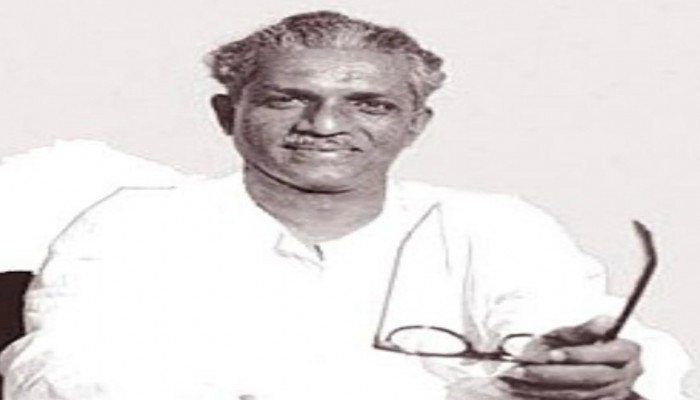
India’s freedom struggle was never confined to its borders. It was a subcontinental uprising of ideas, sacrifices, and solidarities that crossed oceans and empires. Among the lesser-known yet deeply significant figures of this shared struggle stands Philip Gunawardena, a Sri Lankan revolutionary, statesman, and ideologue whose life was intertwined with India’s march towards independence.
Revered today as the Father of Socialism in Sri Lanka and honoured as a National Hero, Gunawardena’s story also belongs to India.
A freedom struggle leader
In the early 1920s, long before independence became inevitable, Philip Gunawardena was already thinking beyond national boundaries. While studying in the United States, he enrolled at the University of Wisconsin–Madison, where destiny placed him alongside Jayaprakash Narayan, one of India’s most iconic socialist leaders.
The campus became a crucible for anti-imperialist thought. Together, these young men debated, organised, and imagined a world free from colonial domination, not just for India or Ceylon (Sri Lanka), but for all oppressed nations.
Gunawardena emerged from this period as a committed internationalist, convinced that the freedom of South Asia was indivisible.
From London to Europe: Fighting Empire Everywhere
By 1928, Gunawardena moved to Europe, beginning in England, where he worked closely with V.
K. Krishna Menon through the Indian League. At a time when London was the nerve centre of the British Empire, these activists challenged imperialism from within its own capital.
His revolutionary journey did not stop there. Gunawardena participated in frontline movements across Mexico, Spain, and France, absorbing ideas of socialism, labour rights, and anti-fascist resistance. This global exposure sharpened his politics, which he later carried back to South Asia.
Return to Ceylon and the Sooriyamal Movement
In 1932, Philip Gunawardena returned home to Sri Lanka, bringing with him a radical vision of social justice and political freedom. He became a founding leader of the Sooriyamal Movement, a nationalist campaign that challenged British colonial symbols and asserted indigenous identity.
By 1936, he was elected to the National State Council, the then Parliament quickly emerging as one of the most formidable voices against colonial rule.
Prison, Escape, and India
When World War II broke out, Gunawardena’s party, the Lanka Samasamaj Party (LSSP) took a bold stand. Unlike many colonial elites who supported Britain’s war effort, the LSSP demanded that Britain "Quit Ceylon," mirroring India’s own rising resistance. Philip was the first Sri Lankan to demand that the British ‘quit Ceylon’ in Parliament.
For this defiance, State Councillor Gunawardena was arrested and imprisoned. History, however, had other plans.
On 5 April 1942, during the Japanese air raid on Colombo, chaos created an opportunity. Gunawardena, along with other LSSP leaders, escaped from prison. Disguised as Guruswami, he fled to India with his wife Kusum, choosing once again to stand with India in its darkest hour.
In British India, the couple joined underground networks supporting the freedom struggle across the subcontinent.
In 1943, the British caught them and imprisoned them in Bombay with a newborn child. Philip Gunawardena, his wife Kusum, and their newborn child were arrested and imprisoned at Arthur Road Jail in Bombay.
It was an extraordinary act of sacrifice, foreign revolutionaries jailed on Indian soil, not for personal gain, but for India’s freedom. After a year in prison, they were deported to Sri Lanka, remaining under restrictions until the end of the Second World War in 1945.
Nehru’s Personal Gratitude
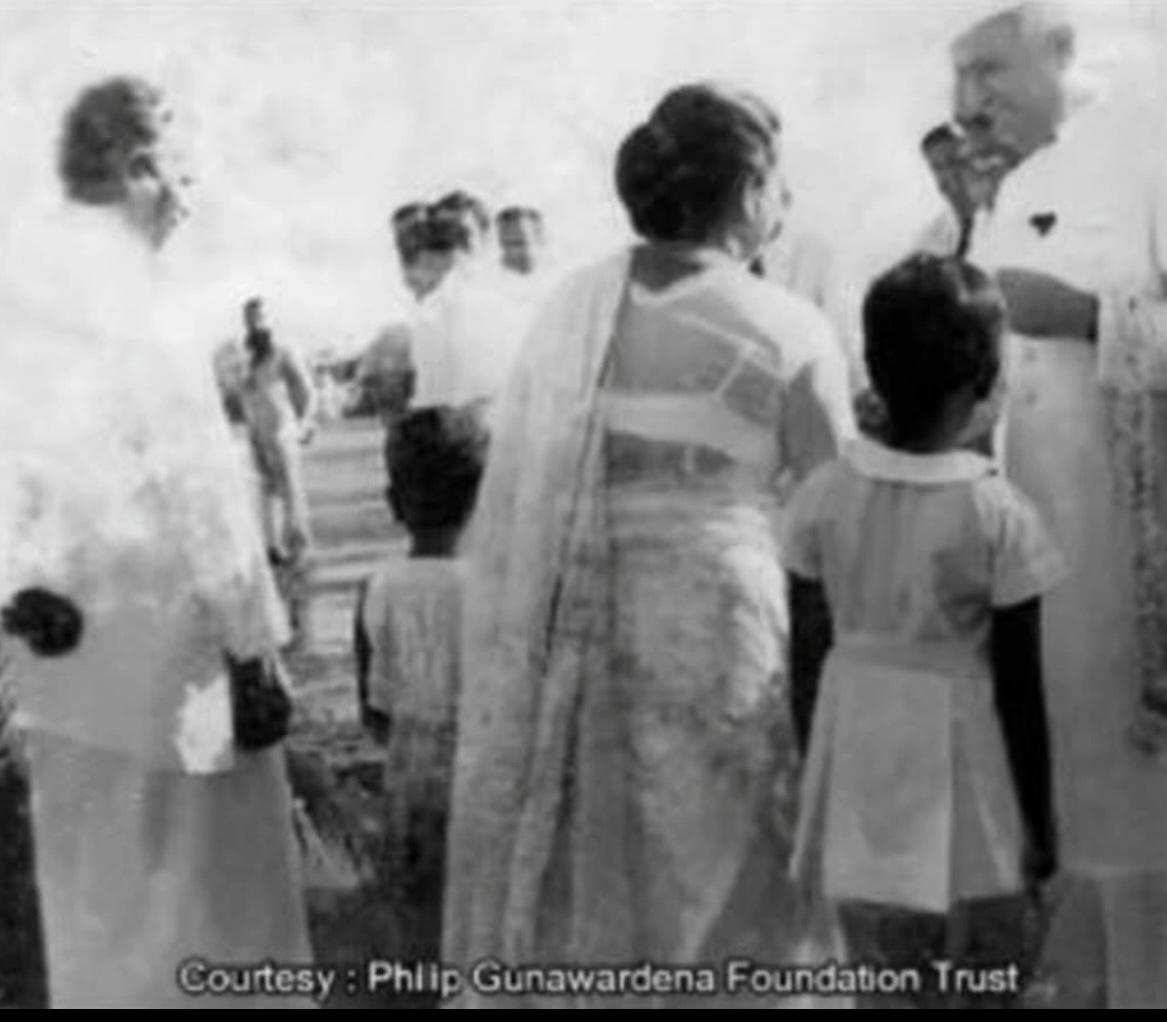
Some acts of solidarity are never forgotten. After India achieved independence, Jawaharlal Nehru, India’s first Prime Minister, visited the Gunawardena family home in Sri Lanka not as a formal gesture, but to personally thank Philip and Kusum for their courage, sacrifice, and unwavering support to India’s freedom movement. It was a moment that symbolised the moral unity of South Asia’s anti-colonial struggle.
A Statesman of Independent Sri Lanka
Following Sri Lanka’s independence in 1948, Philip Gunawardena transitioned from revolutionary to nation-builder. Both he and Kusum were elected to Parliament from the Avissawella electorate, a rare political partnership forged in struggle.
He became a founding leader and Cabinet Minister of the Mahajan Eksath Peramuna (MEP) government in 1956, often referred to as the People’s Revolution Government, and later served again in the National Government of 1965.
Until 1972, Gunawardena remained an active force in public life: fearless, ideological, and deeply committed to social justice.
Why India Must Remember Shri Philip Gunawardena
In India, we often remember our freedom struggle as a national epic. But figures like Philip Gunawardena remind us that it was also a civilisational and subcontinental movement, powered by shared values and mutual sacrifices. He fought for India without being Indian. He went to jail for India without being counted in its roll. And he was thanked by Nehru not as a foreigner, but as a colleague in the freedom struggle.
In remembering Philip Gunawardena, India remembers a chapter of its own freedom, one written beyond borders, in courage and conviction.
Images provided by the authors



 Loading...please wait
Comments