




Peterborough Temple Case: A Victory for Religious Equality and the Hindu Community in Britain
- In Current Affairs
- 07:23 PM, Jun 15, 2026
- Dr. Siddhartha Dave
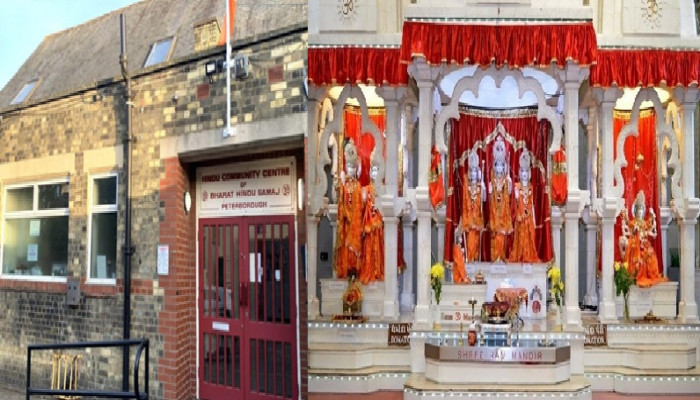
Court's intervention against the sale of a 40-year-old Hindu temple site to an Islamic organisation raises larger questions about minority rights, representation, and religious fairness in contemporary Britain
The recent legal setback suffered by Peterborough City Council in the United Kingdom has emerged as a significant moment for Britain's Hindu community. At the heart of the controversy lies a fundamental question that extends far beyond a single property dispute: Can the religious rights of a small minority community be overlooked in the name of administrative convenience, financial considerations, or political calculations?
The case revolves around a Hindu temple that has served the Peterborough community since 1986. Earlier this year, Peterborough City Council approved the sale of the land occupied by the temple to the United Kingdom Islamic Mission (UKIM), an organisation that already operates dozens of centres across Britain. The decision triggered widespread concern among local Hindus, who argued that the process was unfair, discriminatory, and failed to adequately consider the impact on the city's Hindu population.
The temple management had reportedly been engaged in discussions with the council since 2017 to secure ownership of the site. Despite these long-standing negotiations, the property was ultimately sold elsewhere. Members of the Hindu community challenged the decision in court, contending that the council had failed to properly assess equality obligations and had ignored the consequences of depriving Peterborough's Hindus of their only significant place of worship.
The court's decision to declare the council's action unlawful and capable of being set aside has therefore been welcomed as an important affirmation of religious equality under British law.
More Than a Property Dispute
To view this controversy merely as a real-estate transaction would be to misunderstand its significance.
Religious institutions are not simply buildings. They are centres of community life, cultural continuity, civilisational memory, and inter-generational identity. For minority communities in particular, temples, churches, synagogues, and gurdwaras serve as anchors of belonging in societies where they constitute a small percentage of the population.
Peterborough's Hindu community represents only a small fraction of the city's population. Yet the temple has functioned for decades as a focal point for religious observance, cultural education, festivals, and community cohesion.
The prospect of losing such an institution inevitably generated concern among British Hindus, who viewed the decision as disproportionately harmful to a minority community whose options for worship are already limited.
The Question of Representation
The controversy has also reignited discussion regarding political representation and local governance.
Modern democratic societies rightly celebrate diversity and inclusion. However, they also depend upon public institutions maintaining both actual and perceived neutrality. Whenever decisions involving religious communities appear unequal or insufficiently transparent, public confidence inevitably suffers.
The Peterborough case demonstrates the importance of ensuring that all communities—regardless of size—receive equal consideration under the law. Public bodies must not only act fairly but also be seen to act fairly.
This principle is particularly important in increasingly multicultural societies where competing community interests frequently intersect.
A Civilisational Perspective
For students of civilisation, the episode offers another important lesson.
One of the defining features of Sanatan civilisation has been its capacity for coexistence. Swami Vivekananda's famous address at the Parliament of Religions in Chicago in 1893 remains among the clearest articulations of this worldview. He did not merely advocate tolerance; he spoke of acceptance and respect for multiple paths to truth.
This outlook has historically enabled Hindu communities across the world to integrate successfully into diverse societies while maintaining their religious identity.
Yet coexistence requires reciprocity. A pluralistic society functions best when all communities enjoy equal protection and when no community's institutions are disadvantaged because of demographic size or political influence.
The Peterborough dispute became significant precisely because many British Hindus perceived that this principle had not been upheld.
A Growing Hindu Presence in Britain
Over the past several decades, Hindus have become one of Britain's most successful and law-abiding communities. They have contributed significantly to business, healthcare, education, public service, and academia.
At the same time, Hindu organisations have increasingly voiced concerns about underrepresentation in public discourse and occasional insensitivity toward Hindu institutions and interests.
The Peterborough case reflects this growing confidence among British Hindus to use democratic and legal mechanisms to defend their rights. Rather than resorting to confrontation, the community turned to the courts and relied upon the rule of law.
That approach has now yielded results.
A Message Beyond Britain
The implications of the Peterborough case extend beyond the United Kingdom.
Across Europe and other Western societies, questions surrounding religious freedom, minority rights, community representation, and multicultural governance are becoming increasingly important. Governments are seeking to balance competing interests while maintaining social harmony.
The Peterborough judgment reinforces an essential democratic principle: minority communities deserve equal treatment, equal respect, and equal protection under the law.
For Hindus worldwide, the case serves as a reminder that legal institutions remain powerful instruments for safeguarding religious rights.
For policymakers, it underscores the need for transparency, fairness, and sensitivity whenever decisions affect places of worship.
And for Britain itself, it offers an opportunity to reaffirm a foundational democratic value—that no religious community, however small, should feel that its heritage, institutions, or faith can be overlooked.
If the final judgment confirms the court's present findings, the outcome will be remembered not merely as a victory for one temple in Peterborough, but as an important affirmation of religious equality in modern Britain.



 Loading...please wait
Comments