




Pakistan, Saudi Arabia and Turkey forge defence pact, strengthening ‘Islamic NATO’ push
- In Reports
- 07:31 PM, Aug 07, 2026
- Myind Staff
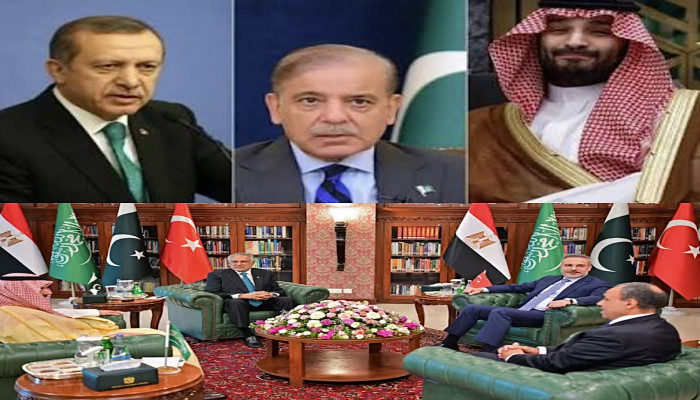
Pakistan, Saudi Arabia and Turkey have signed a mutual defence agreement that commits the three countries to treating an armed attack on any one of them as an attack on all three. The pact brings together three influential Muslim-majority countries and aims to strengthen their collective defence capabilities. The agreement could also mark a major step towards the idea of an ‘Islamic NATO’, a proposed security grouping involving Muslim countries.
Pakistani Prime Minister Shehbaz Sharif, Saudi Crown Prince Mohammed bin Salman and Turkish President Recep Tayyip Erdogan signed the agreement during a summit in Mecca on Friday. The Pakistani Foreign Office announced the development in a statement and said the pact would deepen defence ties among the three countries.
"The agreement is intended to strengthen collective deterrence against any act of aggression, and stipulates that any armed attack against any one of the three states shall be regarded as an attack against them all. It further provides for the enhancement of all aspects of defence cooperation among the three states," the statement said.
The agreement formally brings Pakistan, Saudi Arabia and Turkey into a closer defence partnership. Its central provision is the collective response to an armed attack. Under the pact, an attack against one of the three countries will be treated as an attack against all of them. The countries have also agreed to expand cooperation across different areas of defence.
The new three-way agreement builds on the mutual defence pact signed by Pakistan and Saudi Arabia last year, which brought the two countries closer on security and defence matters. After its signing, reports emerged that Pakistan and Saudi Arabia were considering bringing other West Asian countries into a broader security framework.
The latest agreement with Turkey gives that effort a wider regional dimension. The three countries bring different military, economic and strategic strengths to the partnership. Their combined capabilities could give the grouping greater influence across the wider Asian and West Asian security landscape.
Saudi Arabia brings significant financial resources and strong regional influence to the alliance. The kingdom remains one of the most economically powerful countries in the region. Its position in the Middle East also gives the partnership considerable political and strategic weight.
Turkey adds a strong defence industry and extensive military capabilities. It is a member of NATO and has developed a major military-industrial base over the years. Turkey has also emerged as one of the world's leading producers of military drones. Its growing defence manufacturing capabilities could play an important role in strengthening cooperation within the new grouping.
Pakistan brings another important strategic advantage. It has nuclear weapons and is the world's only nuclear-armed Islamic nation. The country also has a battle-tested military with extensive experience in security and combat operations. Its military capabilities add a different dimension to the partnership.
Together, the three countries form a combination of economic strength, regional influence, advanced defence production and nuclear capability. Saudi Arabia, Turkey and Pakistan could use these strengths to expand defence cooperation and improve their collective deterrence.
The agreement also comes at a time when security partnerships are becoming increasingly important across Asia and the Middle East. By formally linking their defence commitments, the three countries have created a framework that could develop into a broader security arrangement involving other countries in the future.
The pact is being viewed as an important development in efforts to build what has been described as an ‘Islamic NATO’. While the agreement currently involves Pakistan, Saudi Arabia and Turkey, its expansion could bring additional Muslim-majority countries into a wider defence network. The three-way partnership therefore has the potential to influence regional alliances and reshape the security architecture of Asia.
Pakistan, Saudi Arabia and Turkey have now placed collective defence at the centre of their growing strategic relationship. Their differing strengths make the partnership significant, while the commitment to respond collectively to an attack gives the agreement a clear security dimension.



 Loading...please wait
Comments