




Pakistan plans to deploy submarine in Bay of Bengal, a first since 1971 defeat
- In Reports
- 12:35 PM, Jun 18, 2026
- Myind Staff
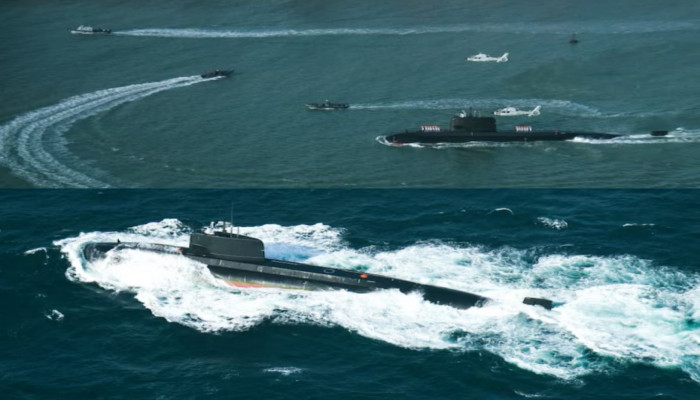
Pakistan is looking to expand its naval presence into the Bay of Bengal with the induction of its first China-built Hangor-class submarine. The move is significant because Pakistan has had almost no meaningful naval presence in the Bay of Bengal since its defeat in the 1971 war, which led to the creation of Bangladesh.
The name Hangor carries strong historical significance for Pakistan. During the 1971 India-Pakistan war, the Pakistani submarine PNS Hangor sank India's INS Khukri. It was the first time an Indian Navy warship was sunk in wartime after Independence and it remains one of the Pakistan Navy's most celebrated operations. However, the sinking did not change the outcome of the war. Pakistan suffered a major defeat as Indian forces dominated the conflict on land, in the air and at sea, helping secure Bangladesh's liberation.
More than five decades later, another submarine carrying the Hangor name is drawing attention. Pakistan's first Hangor-class submarine was commissioned in China in April and arrived in Karachi last week. Soon after its arrival, senior Pakistani naval officers began speaking about a role that extends beyond Pakistan's traditional area of operations in the Arabian Sea.
According to a senior Pakistan Navy officer, the submarine could give Islamabad the ability to maintain a presence in the Bay of Bengal, a region where Pakistan's naval footprint has remained minimal since 1971. The statement comes at a time when Pakistan and Bangladesh are improving diplomatic and military ties. It also comes amid increasing naval competition across the Indian Ocean region.
Since the 1971 war, Pakistan's naval activities have largely remained concentrated in the northern Arabian Sea. In contrast, the Bay of Bengal has traditionally been an area where India enjoys significant strategic and geographical advantages. The region hosts India's Eastern Naval Command in Visakhapatnam and lies close to the strategically important Andaman and Nicobar Islands. The Bay of Bengal is also a major route for trade and energy transportation between India and Bangladesh.
The region has gained even greater geopolitical importance due to increasing competition among naval powers in the Indo-Pacific. This makes recent remarks by a senior Pakistani naval officer particularly noteworthy.
According to Colombo-based news outlet The Morning, Commodore Omer Farooq, who commanded the flotilla escorting the submarine from China to Pakistan, said the induction of the Hangor-class submarines would give Pakistan the reach needed to maintain a presence in the Bay of Bengal.
Farooq described the submarine as a "game changer" and noted that Pakistan planned to induct eight submarines of the class.
The remarks were made during an event aboard the Pakistani frigate PNS Taimur at Colombo Port in Sri Lanka. Farooq was returning from China with the submarine when he stopped in Sri Lanka.
Before the arrival of PNS Hangor, the Pakistan Navy operated five submarines. The new Hangor-class vessels are expected to replace the ageing Agosta-class submarines currently in service.
Farooq's comments suggest that Pakistan is thinking beyond coastal defence and looking toward a broader operational role in the Indian Ocean. Such an expansion would bring Pakistani naval forces into areas where Indian naval assets maintain a strong presence.
It is important to note that the Bay of Bengal is not controlled by any single country. Under international law, nations have sovereignty over waters extending up to 12 nautical miles from their coastline and sovereign rights over an Exclusive Economic Zone extending up to 200 nautical miles. Beyond those limits are international waters, where military vessels from different countries are generally free to operate.
Despite this, the Bay of Bengal has long been viewed as a strategic area for India. It contains important sea routes, island territories and major naval facilities. The region is also central to India's wider Indo-Pacific strategy.
The timing of Pakistan's renewed interest in the Bay of Bengal is also important. It coincides with rapidly improving ties between Pakistan and Bangladesh. Diplomatic, commercial and military engagement between the two countries has increased since the interim government led by Muhammad Yunus took office in Dhaka.
Relations between Pakistan and Bangladesh remained strained for decades after the 1971 Liberation War. However, recent developments suggest a major shift. Direct flights between Dhaka and Karachi have resumed after several decades. The service is operated by Biman Bangladesh and uses Indian airspace.
Cultural exchanges have also increased. Urdu poetry events have been held at Dhaka University and Pakistani singer Rahat Fateh Ali Khan has performed in Bangladesh. Muhammad Yunus met Pakistan Prime Minister Shehbaz Sharif twice. Pakistan's Foreign Minister Ishaq Dar also visited Dhaka.
Trade between the two countries has expanded significantly. Reports indicate a 27 per cent increase in bilateral trade between August and December 2024. This was followed by a 20 per cent year-on-year increase by December 2025. Both countries also signed a memorandum for $1 billion investments.
Military cooperation has deepened as well. The Chief of the Bangladesh Air Force visited Pakistan in January and expressed interest in acquiring JF-17 fighter aircraft jointly developed by China and Pakistan. During the visit, he also met Pakistan's Chief of Defence Staff, Asim Munir. Forces from both countries participated in the Aman-25 maritime exercise.
Following the fall of the Sheikh Hasina government in 2024, direct sea trade between Karachi and Chattogram resumed for the first time since 1971. Pakistani vessels have received operational allowances at Mongla Port and visa restrictions have been relaxed.
In November 2025, the Pakistan Navy frigate PNS Saif visited Chattogram for four days. The visit marked the first time a Pakistani warship had visited Bangladesh since the 1971 Liberation War.
These developments indicate a major transformation in Pakistan-Bangladesh relations. They also raise the possibility of greater Pakistani naval activity in the eastern Indian Ocean. Although there is no indication that Bangladesh has agreed to host Pakistani military assets or provide naval facilities, reports suggest that Dhaka is discussing a mutual defence agreement with Islamabad. Such an agreement could formalise military cooperation, intelligence sharing and joint exercises.
Strategic experts are therefore paying close attention not only to the capabilities of Pakistan's new submarines but also to the opportunities that stronger Bangladesh-Pakistan ties could create.
At the same time, India and Bangladesh have also seen an improvement in relations since Tarique Rahman became Prime Minister in February.
The Hangor-class submarine is a key part of Pakistan's largest naval modernisation programme in decades. Pakistan plans to induct a total of eight submarines in the class. The newly arrived PNS Hangor is the first of these vessels.
Built in China, the submarines are expected to be equipped with Air-Independent Propulsion technology. Unlike conventional diesel-electric submarines, which must periodically surface or use a snorkel to recharge batteries, AIP-equipped submarines can remain underwater for much longer periods. This makes them harder to detect and track.
The Hangor name also serves as a reminder of the 1971 war. During that conflict, PNS Hangor torpedoed INS Khukri in the Arabian Sea, killing 176 Indian sailors, including Captain Mahendra Nath Mulla. He remained aboard the sinking ship and was later awarded the Maha Vir Chakra.
Pakistan's decision to revive the Hangor name highlights the symbolic importance attached to that operation. However, the strategic environment today is very different from 1971.
Over the past five decades, the Indian Navy has expanded significantly. It now operates nuclear-powered submarines, two aircraft carriers and advanced long-range maritime surveillance systems. India also maintains a strong presence in both the Arabian Sea and the Bay of Bengal.
As a result, Pakistan's new submarines are unlikely to change the balance of power in the Bay of Bengal. However, a greater Pakistani presence in the region could create additional strategic challenges for India. This comes at a time when India continues to strengthen its military infrastructure and naval capabilities around the Andaman and Nicobar Islands.



 Loading...please wait
Comments