




‘Pakistan occupied Kashmir, neither Azad nor disputed, it is occupied’: Protest leader
- In Reports
- 02:00 PM, Jul 16, 2026
- Myind Staff
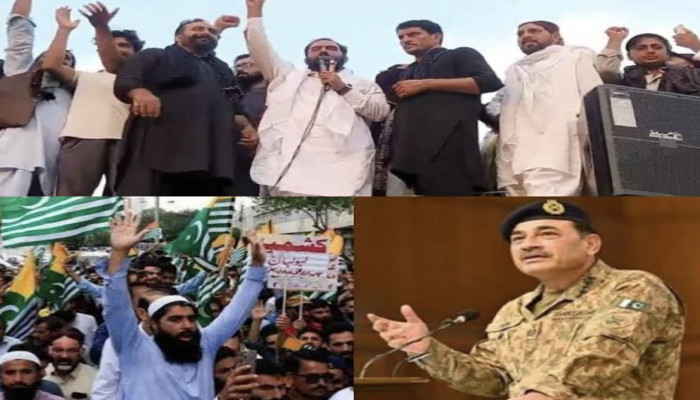
Pakistan's claim over Pakistan-occupied Kashmir (PoK) has come under renewed attention after a key leader of the ongoing protest movement openly rejected Islamabad's long-standing stand during a massive public rally in Rawalakot. Thousands of people gathered at Eidgah Ground, where movement leader Sardar Aman Khan delivered a strong speech that challenged Pakistan's official narrative on the region.
Addressing the large gathering, Khan declared that the region was neither "Azad" nor "disputed." He instead described it as an occupied territory. He told the crowd, "This is not a disputed territory... this is an occupied territory... it has been occupied," drawing loud applause and slogans from those attending the rally. His remarks marked one of the strongest public criticisms of Pakistan's position on the region by a local protest leader.
The rally took place as demonstrations in Rawalakot entered their 40th day. Protesters have continued to raise concerns over the conditions in the region. They have accused the Pakistani authorities of worsening the situation and ignoring the demands of local residents. The movement has gained momentum over the past several weeks, with large crowds attending protests across different areas.
During his speech, Khan also accused Pakistan of blocking the supply of essential goods. He claimed that food and medicines had not reached the region for the past three weeks. He said the shortages had created a humanitarian crisis for the local population. He appealed to people living across the Line of Control and also sought support from India.
The protests have already turned violent. A day before the rally, six civilians lost their lives after Pakistani forces allegedly opened fire during clashes. The incident added to tensions in the region and intensified public anger against the authorities.
Among those killed in the Baloch Sadhunati district were Zahid Mughal, Zafar Mughal, Arsalan Akbar and Wajid Hayat. Hayat died at the Matial Mira Bus Terminal in Rawalakot. Reports of the deaths further strengthened calls for justice and increased participation in the protests.
Earlier this month, thousands of people gathered near the Line of Control to continue their demonstrations. The protesters insisted that Pakistan-occupied Kashmir was not a part of Pakistan. The rallies reflected growing dissatisfaction among sections of the local population over Pakistan's administration of the region.
During one of the earlier demonstrations, Khan warned that continued restrictions on food and other essential supplies could force residents to seek help from India. His remarks highlighted the seriousness of the situation described by the protesters and their concerns over access to basic necessities.
At the latest rally, Khan asked the crowd whether they should march towards the Line of Control. Protesters responded with repeated chants of, "Move towards it." The response showed strong support for the movement and its demands.
Khan also stated that Pakistan-occupied Kashmir was not a part of Pakistan. He claimed that Pakistan needed the region more than the people of the region depended on Pakistan. His comments added to the growing criticism voiced during the ongoing demonstrations.
India also reacted to the developments in Pakistan-occupied Kashmir. On Tuesday, the Ministry of External Affairs criticised the situation and linked the protests to long-standing issues in the region. The ministry said the unrest reflected years of exploitation and denial of basic rights.
Randhir Jaiswal, the official spokesperson of the Ministry of External Affairs, said, "The ongoing protests in PoJK are a direct consequence of Pakistan's decades-long systemic exploitation, denial of fundamental rights, and administrative oppression in areas under its illegal and forcible occupation."
The Ministry of External Affairs also criticised Pakistan's handling of the protests. It accused Pakistani authorities of blocking essential supplies, using excessive force against civilians and restricting communication services. The ministry said these actions had worsened the situation on the ground.
Jaiswal further said, "Rather than addressing the legitimate grievances of the local populace, the Pakistani state has responded with extreme police brutality, including against helpless women and children, blocking essential supplies, including food and medicine, enforcing internet blackouts, and deploying lethal force against unarmed civilians, which has resulted in tragic fatalities."
India also urged the international community to hold Pakistan accountable for its response to the protests. The government said Pakistan should answer for the reported crackdown on civilians and address the concerns raised by the people living in Pakistan-occupied Kashmir.



 Loading...please wait
Comments