




Pakistan Bestows Unbridled Power on Field Marshal Asim Munir
- In Military & Strategic Affairs
- 01:09 PM, Sep 07, 2026
- Major General Harsha Kakar
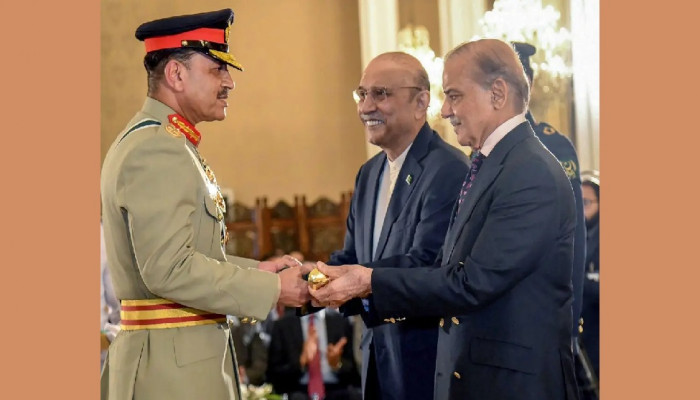
On 20th Aug, the Pakistan National Assembly passed two laws concerning its armed forces. These were the Defence Forces of Pakistan Act 2026 and an amendment to the National Command Authority Act 2010. These were cleared by the cabinet earlier that same morning and rushed through parliament without any discussion, amidst an opposition walkout. These were not on the Senate’s agenda for that day. Either the event was stage-managed to perfection, or Asim Munir’s control over the government is complete.
If Asim Munir wishes to be the Chief of Defence Forces (CDF), it implies control over the three services. Then why is he seeking to wear the dual hat of the army chief? The reason is evident. It is the army which controls all security institutions, rangers, frontier forces, etc., and is the only force which can overthrow the political leadership. Only by being the army chief can he control the state; otherwise, the CDF is akin to the defunct Chairman Joint Chiefs of Staff (CJSC). The other services play only a supportive role. Evidently, a dubious intent.
He was appointed as CDF for five years till end of 2030 unless he takes an extension for another five, which is likely. This has been the bane of Pakistan. Rarely has a chief vacated his post on time. This means that those in line for army chief, for the next decade, will go home, adding to heartburn and angst amongst his senior generals. Munir, in his current tenure, will remain in place beyond the next elections due in early 2029, thereby rigging them and deciding the PM of his choice, thus ensuring his extension.
Disgruntlement amongst the generals, while not in the public domain, will result in Munir handing them plum posts during and post-service, intending to humour them and deter them from seeking an opportunity to either embarrass or remove him. He also cannot question their continued looting of the national treasury. Possibly to assure them the Second Amendment was issued.
The Second Amendment makes the post of Commander of the National Strategic Command (CNSC) only for the Army. The scrapped CJSC was a rotational appointment between the three services. The amendment to the CNSC could have made an eligible four-star General, an Army chief, but was denied by Munir’s extension. This decision would anger the Navy and the Air Force, as they have no senior appointment outside their service. Anyone appointed CNSC will be unhappy as the post has no teeth or power and is only a table-pusher.
While the CDF chair gives Munir complete power over the armed forces and indirectly over all security agencies, including paramilitary, he lacks authority to remove chiefs of the navy, air force and the CNSC. Thus, if there are disagreements, there is little he can do, except push Shehbaz to do his bidding.
Interestingly, during Operation Bunyan Un Marsoos, Pakistan’s retort to Operation Sindoor, the Pak army had no role. Whatever failed action was undertaken, it was by their Air Force; hence, promoting Asim Munir made little sense, except to fulfil one more demand of his. It was Pakistan’s air bases, terrorist HQs and forward posts which took a battering and Munir could do nothing except hide in his bunker, request the US to intervene and play games by spreading fake news.
The losses suffered on a daily basis by his forces in battling insurgencies in Pakistan’s western provinces should logically be on his shoulders, but with no authority to question him, he is beyond reproach. To hide their failures, the Pak army either hides its losses from the public domain or blames India and Afghanistan. In response to India holding the IWT in abeyance, Munir, in one of his rare visits to Makkah, threatens India, then rushes to resolve another conflict.
In all probability, the real motive for promoting Munir as CDF appears to be to keep Imran jailed as both the Sharif brothers and Asim Munir have an inherent dislike for him, having suffered at his hands. The Sharif family is aware that Munir would never compromise with Imran, after having been humiliated by him and forcibly removed from the DG ISI appointment. Imran has tried reaching out to the Pak army but to no avail.
The current remodelling of the Pak forces is claimed to be “multidomain integration, restructuring and optimum jointness of the Armed Forces” and is a possible modification of a joint forces model, but without joint structures, it is just in name, more likely to ensure Munir cannot be touched. The Defence HQ (DHQ), under Munir, will coordinate operations but not integrate the services. Whether DHQ will be above army HQs, which he controls, or will they be merged has to be seen. This will determine what level of coordination takes place.
Politically, it makes Munir the most powerful man in the country. All authority, including that of nuclear forces, is under him, though officially it is claimed that he is vice-chairman of the National Command Authority, which oversees nuclear assets, with the PM at the head. His power is evident from the fact that the Pak government includes him in a committee formed to control population growth.
By giving him the powers to “retire, release, accept, or reject resignation of, or discharge from service, or retain in service, or relax age, or service limit of retirement”, anyone questioning his authority can be dealt with. It guarantees complete control, while subduing opposition to his appointment. Senior promotions would also be based on his whims and fancies. Moving courts on grievances is no longer possible. What is hurting Pakistan’s senior military members is that everything is now army-centric.
What is the impact on India? If Sindoor-type operations are considered, the role of the Pak army was negligible. While the claim is to enhance jointness, without joint structures, no mention of which has been made, it would be more of coordination rather than integration and joint operations. With Munir holding all appointments, any talks with Pakistan’s civilian leadership are meaningless. India anyway does not talk to the Pak army except in official DGMO conversations.
Aware that he cannot be removed, Munir now has the power to consider misadventures against India. This gets compounded by new agreements like the Mecca pact as well as Pakistan’s growing proximity to the US. He is simultaneously aware that the Pak army has shortfalls, and any misadventure could place his future at risk. India must continuously monitor Pakistan’s actions.


 Loading...please wait
Comments