




Pakistan bans Al Jazeera for airing government’s crackdown on POJK protesters
- In Reports
- 02:58 PM, Aug 04, 2026
- Myind Staff
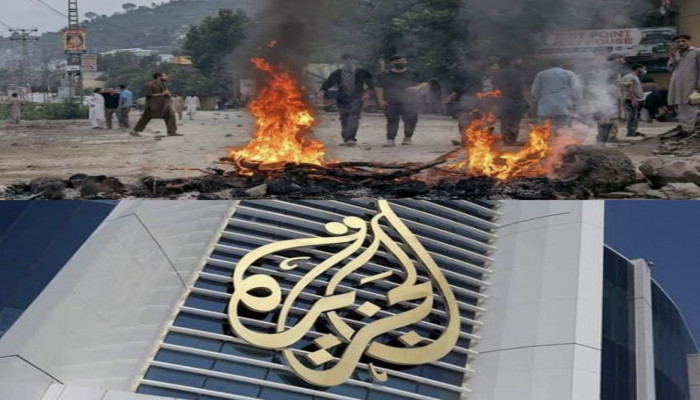
Pakistan has reportedly blocked access to Al Jazeera after the Qatar-based international news broadcaster aired a series of reports on the government's crackdown on anti-government demonstrations and election-related protests in Pakistan-occupied Jammu & Kashmir (PoJK). Although the government led by Prime Minister Shehbaz Sharif has not officially announced a ban on the broadcaster, several users across Pakistan claimed on social media that they were unable to access Al Jazeera's English-language website.
The development came soon after Al Jazeera carried detailed reports from Pakistan-occupied Kashmir during the election period. The reports focused on protests, voting, and the situation in the region. Following the coverage, Pakistan's Ministry of Information and Broadcasting strongly criticised the broadcaster. The ministry accused Al Jazeera of presenting a misleading picture of the elections and the voting process.
In a statement posted on its official X account, the ministry said, "We have taken note of Al Jazeera's selective reporting from handpicked polling stations in Muzaffarabad today. Through carefully chosen timings and scripted statements from selected individuals, the channel has sought to misrepresent the AJK elections and the voting process."
Pakistan refers to the territory under its control as 'Azad Jammu and Kashmir' (AJK). India, however, maintains that these areas are under Pakistan's illegal occupation. New Delhi has consistently stated that the entire Union Territories of Jammu and Kashmir and Ladakh are an integral and inalienable part of India. It also says that Pakistan continues to remain in "illegal and forcible occupation" of parts of these territories.
The Pakistani government further accused Al Jazeera of engaging in what it described as "yellow journalism." The term is commonly used for reporting that exaggerates facts to attract attention or create sensational headlines. Islamabad claimed that the broadcaster's reporting was aimed at damaging the credibility of the election process in the region.
In the same statement, the ministry said, "Such yellow journalism only confirms the agenda of external actors with vested interests who are attempting to delegitimise this electoral exercise and undermine the popular will of the people of Muzaffarabad and AJK, clearly demonstrated today in their rejection of anarchy and coercion."
The international press freedom organisations are now taking cognisance of this crackdown. The Committee to Protect Journalists (CPJ) criticised Pakistan over what it described as an ongoing crackdown on independent journalism in Pakistan-administered Kashmir. The organisation expressed concern over internet shutdowns, communication restrictions, obstacles to reporting, and the reported detention and disappearance of journalists.
In a post on X, CPJ said, "CPJ is monitoring the deteriorating press freedom conditions in Pakistan-administered Kashmir amid ongoing protests. Reports of internet blackouts, telecommunications shutdowns, restrictions on reporting, and the detention and disappearance of journalists are deeply concerning. Pakistani authorities must immediately end the crackdown on journalists, restore access to information, and allow independent reporting."
The organisation also raised concerns over the safety of journalists working in the region. It referred to reports about the disappearance of independent journalist Razi Tahir and his colleague Muhammad Saif. According to CPJ, both were reportedly taken away by men wearing police uniforms from their office in Islamabad on August 1. Their whereabouts remain unknown.
CPJ stated, "CPJ is deeply concerned by reports that independent journalist Razi Tahir and his colleague Muhammad Saif have been missing since August 1. They were reportedly taken by men in police uniforms from their office in Islamabad, and their whereabouts remain unknown. Pakistani authorities must acknowledge whether they are in state custody, ensure due process, and immediately release them if they are being arbitrarily detained."
The organisation repeated its demand in another statement. It said, "Journalists Razi Tahir and Muhammad Saif remain missing after reportedly being taken by men in police uniform on August 1. Pakistani authorities must acknowledge their detention if they are in state custody, ensure due process, and immediately release them. Kashmiri journalist Raja Ikram, who was reportedly detained in Islamabad on August 1, was later released."
CPJ also pointed to reports suggesting that restrictions on media access may now extend beyond the protest-hit region. It referred to unconfirmed reports claiming that Al Jazeera's website had become inaccessible in Pakistan after the broadcaster reported from Kashmir on August 1. The organisation also noted that Pakistan's Ministry of Information and Broadcasting had publicly accused Al Jazeera of practising "yellow journalism."
The press freedom body added that communication restrictions have continued for weeks in Pakistan-administered Kashmir. According to media reports cited by CPJ, a partial internet blackout and severe telecommunications restrictions have remained in place across the region since June 5. These measures, along with restrictions on journalists, have raised fresh concerns over press freedom and access to independent information during a politically sensitive period.
The reported restrictions on Al Jazeera have added another layer to the ongoing debate over media freedom in Pakistan. While the government insists that the broadcaster misrepresented the elections through selective reporting, international media watchdogs continue to raise concerns over growing restrictions on journalists, communication services, and independent reporting in Pakistan-administered Kashmir.



 Loading...please wait
Comments