




Pakistan boycotts India match but welcomes Indian-origin World Bank Chief Ajay Banga
- In Reports
- 06:19 PM, Feb 06, 2026
- Myind Staff
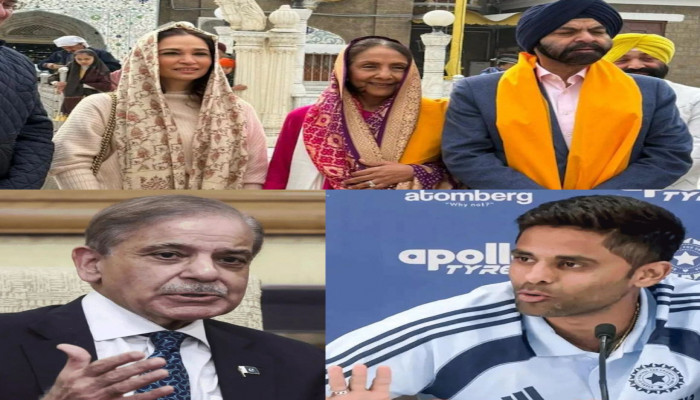
Pakistan has once again shown what many are calling double standards. On one side, it has decided to boycott the T20 World Cup match against India, using cricket as a political weapon. But on the other side, it gave a grand welcome to Indian-origin World Bank chief Ajay Banga, mainly because Pakistan badly needs financial support to run its weak economy.
Banga’s visit to Pakistan, including his trip to his ancestral home, was treated like a major political event. However, many believe the hospitality was not because of his roots, but because Pakistan depends heavily on loans from global financial institutions like the World Bank and the IMF.
Videos circulating on social media showed Banga being welcomed with high-level protocol. He was personally received by Pakistan’s finance minister Muhammad Aurangzeb and Punjab’s minister for minority affairs. His convoy was led by horse-mounted escorts and marching bands, which played the Bollywood track “mera piya ghar aaya.” Students were lined up along the streets, and huge banners carrying Banga’s photos were displayed along with Punjab Chief Minister Maryam Nawaz Sharif.
The reception looked less like a welcome for a bank official and more like one for a global leader.
The World Bank factor becomes more important because Pakistan is also trying to maintain goodwill over the Indus Waters Treaty issue. The World Bank is a signatory and acts as a facilitator of the 1960 Indus Waters Treaty. India, being an upstream country, suspended the treaty after the Pahalgam terror attack last year. Nearly 80% of Pakistan’s agriculture depends on the Indus rivers, making it a major lifeline for the country. Agriculture is also a key part of Pakistan’s food security and contributes 25% to its GDP.
For the last nine months, Pakistan has been reaching out to global forums and the Court of Arbitration after India’s move to suspend the treaty. But Pakistan has not gained much progress. This has increased the importance of the World Bank’s role, even though Banga had earlier made it clear that the institution would not intervene.
Last year, Ajay Banga categorically stated that the World Bank had no role in resolving the Indus waters dispute and that it was only a facilitator.
During the four-day visit, which was mostly personal, Banga travelled to Khushab, where his parents once lived before Partition. Pakistan also tried to present him as one of their own, even though Banga was born in Pune, Maharashtra, in 1959. His father, Harbhajan Singh Banga, migrated to India in 1947 and later served as an officer in the Indian Army.
One symbolic gesture drew major criticism online. Pakistani officials presented Banga with documents related to his ancestral house, the same house his family was forced to leave during Partition. Many called the gesture ironic and tone deaf.
On the last day of his visit, Banga held key meetings with Prime Minister Shehbaz Sharif and Finance Minister Muhammad Aurangzeb. The main discussion focused on Pakistan’s effort
2 / 2
to secure $20 billion (Rs 1.8 lakh crore) in financial aid from the World Bank over the next decade.
Pakistan’s economic crisis is severe. Official figures show the country’s external debt is nearly $135 billion (approximately Rs 11 lakh crore), and around one-fifth of that amount is owed to the World Bank.
The meeting with Banga came soon after Prime Minister Shehbaz Sharif openly admitted the embarrassment of seeking foreign aid. Speaking to exporters in Islamabad, Sharif said, “We feel ashamed when Field Marshal Asim Munir and I go around the world begging for money. Taking loans is a huge burden on our self-respect. Our heads bow down in shame.”
The entire episode has triggered widespread trolling online. Many Pakistanis themselves questioned the need for such a grand welcome for what some called a “bank employee.”
One user wrote, “Once again, Pakistan bows down to beg from a guy of Indian origin. Giving similar vibes as that of December 16, 1971,” referring to Islamabad’s surrender in the Liberation War.
Another user posted, “Despite the sheer hatred Pakistan shows toward India, they rolled out the red carpet for Indian-origin Ajay Banga purely because he controls the loan cheque.”
A Pakistani user, Shakeel Khokhar, criticised the event and called it “sycophancy at its best.” Others described it as a “new way of begging,” pointing to Pakistan’s desperation due to its growing debt crisis.
Even though Banga’s visit was largely about reconnecting with his roots, the government’s extravagant protocol has not gone unnoticed. Many believe the grand welcome was not genuine “mehman nawazi,” but a calculated attempt to secure goodwill for future financial inflows.



 Loading...please wait
Comments