



Ottawa says India no longer linked to violent crimes in Canada ahead of Carney’s visit
- In Reports
- 05:58 PM, Feb 26, 2026
- Myind Staff
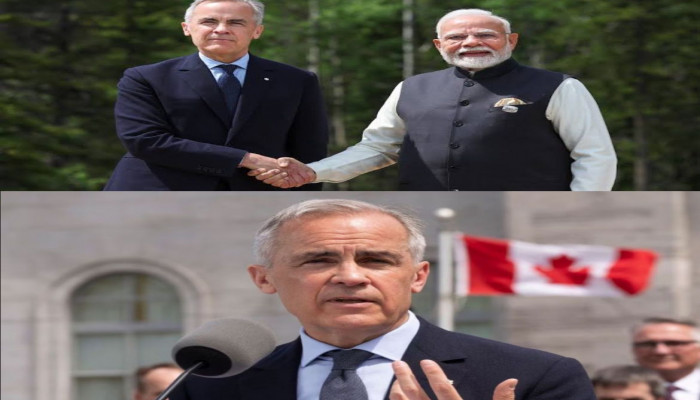
Canada has indicated a major shift in its position on India just before Prime Minister Mark Carney travels to India. In a clear change from the stand taken by former Prime Minister Justin Trudeau, the new Canadian government has said that India is no longer linked to violent crimes on Canadian soil.
The statement was made during a media briefing ahead of Carney’s upcoming visit to India. Senior Canadian officials said that Ottawa is not currently concerned about interference or repression by Indian agents. The remarks suggest that both countries are trying to move past years of tension and rebuild diplomatic ties.
Relations between Canada and India had worsened sharply after Trudeau publicly alleged that Indian agents were involved in the 2023 killing of Hardeep Singh Nijjar. Nijjar, who was a Canadian citizen, had been designated a terrorist by New Delhi in 2020 over allegations linked to Khalistani extremism. His killing in British Columbia became the biggest flashpoint between the two nations.
At the time, Trudeau had said there was a “credible” allegation that “agents linked to the government of India had killed a Canadian citizen on Canadian soil.” India strongly denied those claims, and the diplomatic fallout led to strained ties and a slowdown in cooperation.
Now, ahead of Carney’s visit, Canadian officials have struck a different tone. A senior Canadian official was quoted by the Toronto Star as saying, “I really don’t think we’d be taking this trip if we thought these kinds of activities were continuing.” This statement suggests that the Canadian government believes the alleged activities are not ongoing.
Another senior government official, speaking on condition of anonymity, told the Toronto Star, “We have a very robust diplomatic engagement, including between national security advisers, and I think we can say we’re confident that that activity is not continuing.” This indicates that discussions between security officials of both countries have progressed and built some level of trust.
After Nijjar’s death, Canada charged four individuals in connection with the killing. Authorities also referred to other violent incidents that were allegedly tied to foreign actors. Earlier, the Royal Canadian Mounted Police (RCMP) had linked India’s government to violent crime in Canada. The RCMP had spoken about threats against activists and evidence of “homicides and violent acts.”
Despite these earlier findings, the Carney government now appears ready to move forward while continuing legal processes. In a recent statement, Prime Minister Carney's office said, “Respect for the ongoing law enforcement dialogue will continue to be the basis of our step-by-step approach to re-engagement with India.” This shows that Canada wants to improve ties but will continue discussions through proper legal and security channels.
The renewed engagement fits with Carney’s “pragmatic” foreign policy approach. Canada is looking to strengthen both security and economic relations with India. India, as the world’s most populous nation, is seen as an important economic partner, especially at a time when Canada’s relationship with the United States faces uncertainty.
Carney is set to leave Ottawa for a nine-day trip that will include meetings with India’s Prime Minister Narendra Modi. The visit will also include stops in Mumbai, Australia, and Japan. During the trip, Canada plans to explore partnerships in sectors such as oil and gas, artificial intelligence, and other areas of economic cooperation.
However, the reset in relations is not without controversy within Canada. Some sections of the Canadian population remain critical of the government’s move to improve ties with India. On Wednesday, demonstrators linked to Sikhs for Justice gathered on Parliament Hill to protest against the government’s effort to rebuild relations with New Delhi.
Public debate continues, especially because of the earlier statements and findings by the RCMP regarding alleged links between Indian agents and violent activities in Canada. These past claims still influence opinions among certain communities.
Canada’s International Trade Minister, Maninder Sidhu, acknowledged the concerns. He noted that his constituency includes Canada’s largest South Asian community and said there are local worries about crime, especially extortion. Sidhu emphasised that law enforcement cooperation between the two countries has been strengthened.
He pointed out that Indian and Canadian officials have recently agreed to step up collaboration between their law enforcement agencies and to appoint liaison officers in each country. This move is aimed at improving communication and addressing security concerns directly.
Sidhu said, “I do believe we can do two things at the same time. We can keep our community safe. We can have a law enforcement dialogue. and we can continue to engage with partners around the world economically.” His statement reflects Canada’s new dual-track approach — maintaining security cooperation while also expanding economic engagement.
Overall, Canada’s latest remarks suggest a significant shift from the earlier confrontational tone. While legal processes and security discussions continue, both countries appear willing to move toward improved diplomatic and economic relations.



 Loading...please wait
Comments